Additional Maths 360 (2nd Ed) Chapter 2: Equations and Inequalities — Solutions
Please email me if you spot a mistake or have a question.
Choose an exercise, then tap a question to show its worked solution.
Try 1–11
Try 1
\begin{align*} 2x - y & = 3 \\ -y & = 3 - 2x \\ y & = 2x - 3 \phantom{0} \text{--- (1)} \\ \\ xy & = x + 2y \phantom{0} \text{--- (2)} \\ \\ \text{Substitute } & \text{(1) into (2),} \\ x(2x - 3) & = x + 2(2x - 3) \\ 2x^2 - 3x & = x + 4x - 6 \\ 2x^2 - 3x & = 5x - 6 \\ 2x^2 - 8x + 6 & = 0 \\ x^2 - 4x + 3 & = 0 \\ (x - 1)(x - 3) & = 0 \end{align*} \begin{align*} x - 1 & = 0 && \text{ or } & x - 3 & = 0 \\ x & = 1 &&& x & = 3 \\ \\ \text{Substitute } & \text{into (1),} &&& \text{Substitute } & \text{into (1),} \\ y & = 2(1) - 3 &&& y & = 2(3) - 3 \\ y & = -1 &&& y & = 3 \end{align*} $$ \therefore x = 1, y = -1 \text{ or } x = 3, y = 3 $$
Try 2
\begin{align*} y - x + 3 & = 0 \\ y & = x - 3 \phantom{0} \text{--- (1)} \\ \\ y & = x^2 - 4x + 1 \phantom{0} \text{--- (2)} \\ \\ \text{Substitute } & \text{(1) into (2),} \\ x - 3 & = x^2 - 4x + 1 \\ 0 & = x^2 - 5x + 4 \\ 0 & = (x - 1)(x - 4) \end{align*} \begin{align*} x - 1 & = 0 && \text{ or } & x - 4 & = 0 \\ x & = 1 &&& x & = 4 \\ \\ \text{Substitute } & \text{into (1),} &&& \text{Substitute } & \text{into (1),} \\ y & = 1 - 3 &&& y & = 4 - 3 \\ y & = -2 &&& y & = 1 \\ \\ \therefore & \phantom{.} (1, -2) &&& \therefore & \phantom{.} (4, 1) \end{align*}
Try 3
\begin{align*} \text{Let length} & = x \text{ cm}, \text{ breadth} = y \text{ cm} \\ \\ \text{Area} & = (x)(y) \\ 154 & = xy \phantom{0} \text{--- (1)} \\ \\ \text{Perimeter} & = 2x + 2y \\ 50 & = 2x + 2y \\ -2x & = 2y - 50 \\ 2x & = 50 - 2y \\ x & = 25 - y \phantom{0} \text{--- (2)} \\ \\ \text{Substitute } & \text{(2) into (1),} \\ 154 & = (25 - y)y \\ 154 & = 25y - y^2 \\ y^2 - 25y + 154 & = 0 \\ (y - 11)(y - 14) & = 0 \end{align*} \begin{align*} y - 11 & = 0 && \text{ or } & y - 14 & = 0 \\ y & = 11 &&& y & = 14 \\ \\ \text{Substitute } & \text{into (2),} &&& \text{Substitute } & \text{into (2),} \\ x & = 25 - 11 &&& x & = 25 - 14 \\ x & = 14 &&& x & = 11 \end{align*} $$ \therefore \text{Dimensions: 14 cm by 11 cm} $$
Try 4
(a)
\begin{align*} \text{Substitute } y = x + {1 \over 2} & \text{ into } y = 2x^2 + 5x, \\ x + {1 \over 2} & = 2x^2 + 5x \\ 0 & = 2x^2 + 4x - {1 \over 2} \\ 0 & = 4x^2 + 8x - 1 \\ \\ b^2 - 4ac & = (8)^2 - 4(4)(-1) \\ & = 80 > 0 \\ \\ \implies 0 = 4x^2 + 8x - 1 & \text{ has two real and distinct roots} \\ \\ \therefore \text{Line meets the } & \text{curve at two distinct points} \end{align*}
(b)
\begin{align*} \text{Substitute } y = x + k & \text{ into } y = 2x^2 + 5x, \\ x + k & = 2x^2 + 5x \\ 0 & = 2x^2 + 4x - k \\ \\ b^2 - 4ac & = (4)^2 - 4(2)(-k) \\ & = 16 + 8k \\ \\ b^2 - 4ac & = 0 \phantom{000000} [\text{Line is tangent to curve, i.e. meets only once}] \\ 16 + 8k & = 0 \\ 8k & = -16 \\ k & = -2 \end{align*}
(c)
\begin{align*} \text{Substitute } y = -2x & \text{ into } y = 3x^2 + m, \\ -2x & = 3x^2 + m \\ 0 & = 3x^2 + 2x + m \\ \\ b^2 - 4ac & = (2)^2 - 4(3)(m) \\ & = 4 - 12m \\ \\ b^2 - 4ac & < 0 \phantom{000000} [\text{Line does not meet curve}] \\ 4 - 12m & < 0 \\ -12m & < - 4 \\ m & > {-4 \over -12} \\ m & > {1 \over 3} \end{align*}
Try 5
(a)
\begin{align*} px^2 - 2x - 2 & =0 \\ \\ b^2 - 4ac & = (-2)^2 - 4(p)(-2) \\ & = 4 + 8p \\ \\ b^2 - 4ac & = 0 \\ 4 + 8p & = 0 \\ 8p & = -4 \\ p & = {-4 \over 8} \\ p & = -{1 \over 2} \end{align*}
(b)
\begin{align*} 4x^2 - 2x + 1 & = 2x - p \\ 4x^2 - 4x + 1 + p & = 0 \\ \\ b^2 - 4ac & = (-4)^2 - 4(4)(1 + p) \\ & = 16 - 16(1 + p) \\ & = 16 - 16 - 16p \\ & = -16p \\ \\ b^2 - 4ac & > 0 \\ -16p & > 0 \\ p & < {0 \over -16} \\ p & < 0 \end{align*}
(c)
\begin{align*} - x^2 + 3x - 2 + p & = 0 \\ \\ b^2 - 4ac & = (3)^2 - 4(-1)(p - 2) \\ & = 9 + 4(p - 2) \\ & = 9 + 4p - 8 \\ & = 4p + 1 \\ \\ b^2 - 4ac & \ge 0 \phantom{000000} [\text{1 or 2 real roots}] \\ 4p + 1 & \ge 0 \\ 4p & \ge -1 \\ p & \ge -{1 \over 4} \end{align*}
(d)
\begin{align*} -x^2 + 2x & < 5 + p \\ 0 & < x^2 - 2x + 5 + p \phantom{000} [ \implies x^2 - 2x + 5 + p \text{ must be positive} ] \\ \\ b^2 - 4ac & = (-2)^2 - 4(1)(5 + p) \\ & = 4 - 4(5 + p) \\ & = 4 - 20 - 4p \\ & = -16 - 4p \\ \\ b^2 - 4ac & < 0 \phantom{000} [\text{Graphically, } y = x^2 - 2x + 5 + p \text{ lies above } x \text{-axis, so it does not cut } x \text{-axis}] \\ -16 - 4p & < 0 \\ -4p & < 16 \\ p & > {16 \over -4} \\ p & > -4 \end{align*}
Try 6
\begin{align*} \text{Substitute } & y = mx + 2 \text{ into } y = x^2 + x + 3, \\ mx + 2 & = x^2 + x + 3 \\ 0 & = x^2 + x - mx + 1 \\ 0 & = x^2 + (1 - m)x + 1 \\ \\ b^2 - 4ac & = (1 - m)^2 - 4(1)(1) \\ & = \underbrace{ (1)^2 - 2(1)(m) + (m)^2 }_{ (a - b)^2 = a^2 - 2ab + b^2 } - 4 \\ & = 1 - 2m + m^2 - 4 \\ & = m^2 - 2m - 3 \\ \\ b^2 - 4ac & < 0 \phantom{000000} [\text{Line does not intersect curve}] \\ m^2 - 2m - 3 & < 0 \phantom{0} \text{ (Shown)} \end{align*}
Try 7
\begin{align*} R & = x (200 - 0.4x) \\ \\ \text{Let } & R = 20 \phantom{.} 000, \\ 20 \phantom{.} 000 & = x(200 - 0.4x) \\ 20 \phantom{.} 000 & = 200x - 0.4x^2 \\ 0 & = -0.4x^2 + 200x - 20 \phantom{.} 000 \\ \\ b^2 - 4ac & = (200)^2 - 4(-0.4)(- 20 \phantom{.} 000) \\ & = 8000 > 0 \\ \\ \implies \text{There are } & \text{two distinct roots for } 0 = -0.4x^2 + 200x - 20 \phantom{.} 000 \\ \\ x & = {-200 \pm \sqrt{8000} \over 2(-0.4)} \\ & \approx 138.2 \text{ or } 361.8 \\ \\ \text{Both values of } x & \text{ are positive (the number of tires sold must be positive)} \\ \\ \therefore \text{Jerry's busi} & \text{ness can generate a revenue of \$} 20 \phantom{.} 000 \end{align*}
Try 8
\begin{align*} x^2 & < 3x + 4 \\ x^2 - 3x - 4 & < 0 \\ (x + 1)(x - 4) & < 0 \end{align*}

\begin{align*} -1 & < x < 4 \end{align*}
Try 9
(i)
\begin{align*} \text{Substitute } & y = 0 \text{ into } y = x^2 - 2mx + 4, \\ 0 & = x^2 - 2mx + 4 \\ \\ b^2 - 4ac & = (-2m)^2 - 4(1)(4) \\ & = 4m^2 - 16 \\ \\ b^2 - 4ac & \ge 0 \phantom{000000} [\text{Equation has 1 or 2 real roots}] \\ 4m^2 - 16 & \ge 0 \\ m^2 - 4 & \ge 0 \\ (m + 2)(m - 2) & \ge 0 \phantom{000000} [a^2 - b^2 = (a + b)(a - b)] \end{align*}

\begin{align*} m \le -2 \text{ or } m \ge 2 \end{align*}
(ii)
\begin{align*} \text{Substitute } & y = x + 3 \text{ into } y = x^2 - 2mx + 4, \\ x + 3 & = x^2 - 2mx + 4 \\ 0 & = x^2 - 2m x - x + 1 \\ 0 & = x^2 + (-2m -1)x + 1 \\ \\ b^2 - 4ac & = (-2m - 1)^2 - 4(1)(1) \\ & = \underbrace{ (-2m)^2 - 2(-2m)(1) + (1)^2 }_{ (a - b)^2 = a^2 - 2ab + b^2 } - 4 \\ & = 4m^2 + 4m + 1 - 4 \\ & = 4m^2 + 4m - 3 \\ \\ b^2 - 4ac & > 0 \phantom{000000} [\text{Equation has 2 real roots}] \\ 4m^2 + 4m - 3 & > 0 \\ (2m - 1)(2m + 3) & > 0 \end{align*}

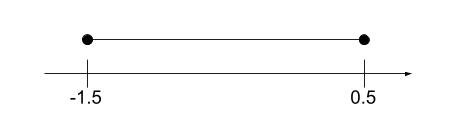
\begin{align*} m & < - 1.5 \text{ or } m > 0.5 \end{align*}
(iii)
\begin{align*} b^2 - 4ac & = 4m^2 + 4m - 3 \phantom{00000000} [\text{From (ii)}] \\ \\ b^2 - 4ac & < 0 \phantom{000000} [\text{No real roots, since line and curve do not intersect}] \\ 4m^2 + 4m - 3 & < 0 \\ (2m - 1)(2m + 3) & < 0 \end{align*}

\begin{align*} -1.5 & < m < 0.5 \end{align*}
Try 10
\begin{align*} 3x(x + m) + 6(m + 2) & = 3x^2 + 3mx + 6m + 12 \\ \\ [ \text{Coefficient of } & x^2 \text{ is positive} ] \\ \\ b^2 - 4ac & = (3m)^2 - 4(3)(6m + 12) \\ & = 9m^2 - 12(6m + 12) \\ & = 9m^2 - 72m - 144 \\ \\ b^2 - 4ac & < 0 \\ 9m^2 - 72m - 144 & < 0 \\ \\ \text{For } 9m^2 - 72m - 144 & = 0, \\ m & = {-b \pm \sqrt{b^2 - 4ac} \over 2a} \\ & = { -(-72) \pm \sqrt{(-72)^2 - 4(9)(-144)} \over 2(9)} \\ & = { 72 \pm \sqrt{10 \phantom{.} 368} \over 18} \\ & = 9.657 \text{ or } -1.657 \end{align*}

\begin{align*} -1.66 & < m < 9.66 \end{align*}
Try 11
\begin{align*} \$ 20 \text{ million} & = \$ 20 \phantom{.} 000 \phantom{.} 000 \\ & = \$ 20 \phantom{.} 000 \text{ thousand} \\ \\ \text{Cost, } C & < 20 \phantom{.} 000 \\ 0.03x^2 - 360x + 100 \phantom{.} 000 & < 20 \phantom{.} 000 \\ 0.03x^2 - 360x + 80 \phantom{.} 000 & < 0 \\ \\ x & = { -b \pm \sqrt{b^2 - 4ac} \over 2a} \\ & = { - (-360) \pm \sqrt{ (-360)^2 - 4(0.03)(80 \phantom{.} 000) } \over 2(0.03)} \\ & = { 360 \pm \sqrt{ 120 \phantom{.} 000} \over 0.06 } \\ & = 11 \phantom{.} 773.5 \text{ or } 226.50 \end{align*}

\begin{align*} 226.50 & < x < 11 \phantom{.} 773.5 \\ \\ \text{Since } x > 226.50, & \text{ round up: minimum value of } x = 227 \\ \text{Since } x < 11 \phantom{.} 773.5, & \text{ round down: maximum value of } x = 11 \phantom{.} 773 \\ \\ \text{Minimum number of laptops} & = 227 \times 100 \\ & = 22 \phantom{.} 700 \\ \\ \text{Maximum number of laptops} & = 11 \phantom{.} 773 \times 100 \\ & = 1 \phantom{.} 177 \phantom{.} 300 \end{align*}
Ex 2.1: Simultaneous Equations
Question 1
Method 1: By substitution. Substitute the linear equation into the non-linear equation to get a quadratic equation in x. Solve it, then substitute each value of x into the linear equation to find the corresponding value of y. (Since both equations have y as the subject, subtracting one equation from the other to eliminate y gives the same quadratic equation.)
\begin{align*} y & = x^2 - 4 \phantom{000} \text{---(1)} \\ y & = 2x - 4 \phantom{000} \text{---(2)} \\ \\ \text{Substitute } & (2) \text{ into } (1), \\ 2x - 4 & = x^2 - 4 \\ 0 & = x^2 - 2x \\ 0 & = x(x - 2) \\ \\ x = 0 \phantom{0} & \text{ or } \phantom{0} x - 2 = 0 \\ & \phantom{0000000} x = 2 \\ \\ \text{Substitute } & x = 0 \text{ into (2),} \\ y & = 2(0) - 4 \\ y & = -4 \\ \\ \text{Substitute } & x = 2 \text{ into (2),} \\ y & = 2(2) - 4 \\ y & = 0 \\ \\ \therefore x = 0, y = -4 & \text{ or } \phantom{.} x = 2, y = 0 \end{align*}
Method 2: Graphically. Draw the curve y = x2 - 4 and the line y = 2x - 4 on the same axes. The solutions are given by the coordinates of the points of intersection, (0, -4) and (2, 0).
Question 2
(a)
\begin{align}
y & = 2x + 1 \phantom{000} \text{ --- (1)} \\
\\
y & = x^2 + 2x - 3 \phantom{000} \text{ --- (2)} \\
\\
\text{Substitute } & (1) \text{ into (2),} \\
2x + 1 & = x^2 + 2x - 3 \\
0 & = x^2 - 4 \\
0 & = (x - 2)(x + 2)
\end{align}
\begin{align}
x - 2 & = 0 & \text{or } \phantom{00000} x + 2 & = 0 \\
x & = 2 & x & = - 2 \\
\\
\text{Substitute } & x = 2 \text{ into (1),} & \text{Substitute } & x = -2 \text{ into (1),} \\
y & = 2(2) + 1 & y & = 2(-2) + 1 \\
& = 5 & & = -3
\end{align}
$$ \therefore x = 2, y = 5 \text{ or } x = -2, y = -3 $$
(b)
\begin{align}
y & = 2 + x \phantom{000} \text{ --- (1)} \\
\\
y & = 2x^2 - 5x - 6 \phantom{000} \text{ --- (2)} \\
\\
\text{Substitute } & \text{(1) into (2),} \\
2 + x & = 2x^2 - 5x - 6 \\
0 & = 2x^2 - 6x - 8 \\
0 & = x^2 - 3x - 4 \\
0 & = (x - 4)(x + 1)
\end{align}
\begin{align}
x - 4 & = 0 &\text{or }\phantom{00000} x + 1 & = 0 \\
x & = 4 & x & = - 1 \\
\\
\\
\text{Substitute } & x = 4 \text{ into (1),} &
\text{Substitute } & x = -1 \text{ into (1),} \\
y & = 2 + (4) & y & = 2 + (-1) \\
& = 6 & & = 1
\end{align}
$$ \therefore x = 4, y = 6 \text{ or } x = -1, y = 1 $$
(c)
\begin{align}
2x + y & = 4 \\
y & = 4 - 2x \phantom{000} \text{ --- (1)} \\
\\
y^2 - 4x & = 0 \\
y^2 & = 4x \phantom{000} \text{ --- (2)} \\
\\
\text{Substitute } & \text{(1) into (2),} \\
(4 - 2x)^2 & = 4x \\
(4)^2 - 2(4)(2x) + (2x)^2 & = 4x \\
16 - 16x + 4x^2 & = 4x \\
4x^2 - 20x + 16 & = 0 \\
x^2 - 5x + 4 & = 0 \\
(x - 4)(x - 1) & = 0
\end{align}
\begin{align}
x - 4 & = 0 &\text{or }\phantom{00000} x - 1 & = 0 \\
x & = 4 & x & = 1 \\
\\
\\
\text{Substitute } & x = 4 \text{ into (1),} &
\text{Substitute } & x = 1 \text{ into (1),} \\
y & = 4 - 2(4) & y & = 4 - 2(1) \\
& = -4 & & = 2
\end{align}
$$ \therefore x = 4, y = -4 \text{ or } x = 1, y = 2 $$
Question 3
(a)
\begin{align*} y & = 2x - 5 \phantom{000} \text{---(1)} \\ x^2 + y^2 & = 10 \phantom{000} \text{---(2)} \\ \\ \text{Substitute } & (1) \text{ into } (2), \\ x^2 + (2x - 5)^2 & = 10 \\ x^2 + (2x)^2 - 2(2x)(5) + (5)^2 & = 10 \\ x^2 + 4x^2 - 20x + 25 & = 10 \\ 5x^2 - 20x + 15 & = 0 \\ x^2 - 4x + 3 & = 0 \\ (x - 1)(x - 3) & = 0 \\ \\ x - 1 = 0 \phantom{0} & \text{ or } \phantom{0} x - 3 = 0 \\ x = 1 \phantom{0} & \phantom{0000000} x = 3 \\ \\ \text{Substitute } & x = 1 \text{ into (1),} \\ y & = 2(1) - 5 \\ y & = -3 \\ \\ \text{Substitute } & x = 3 \text{ into (1),} \\ y & = 2(3) - 5 \\ y & = 1 \\ \\ \therefore \text{Coordinates of points of } & \text{ intersection are } (1, -3) \text{ and } (3, 1) \end{align*}
(b)
\begin{align*} y & = 11 - 2x \phantom{000} \text{---(1)} \\ 2x^2 - y^2 & = 23 \phantom{000} \text{---(2)} \\ \\ \text{Substitute } & (1) \text{ into } (2), \\ 2x^2 - (11 - 2x)^2 & = 23 \\ 2x^2 - [ (11)^2 - 2(11)(2x) + (2x)^2] & = 23 \\ 2x^2 - (121 - 44x + 4x^2) & = 23 \\ 2x^2 - 121 + 44x - 4x^2 & = 23 \\ -2x^2 + 44x - 144 & = 0 \\ x^2 - 22x + 72 & = 0 \\ (x - 4)(x - 18) & = 0 \\ \\ x - 4 = 0 \phantom{0} & \text{ or } \phantom{0} x - 18 = 0 \\ x = 4 \phantom{0} & \phantom{00000000} x = 18 \\ \\ \text{Substitute } & x = 4 \text{ into (1),} \\ y & = 11 - 2(4) \\ y & = 3 \\ \\ \text{Substitute } & x = 18 \text{ into (1),} \\ y & = 11 - 2(18) \\ y & = -25 \\ \\ \therefore \text{Coordinates of points of } & \text{ intersection are } (4, 3) \text{ and } (18, -25) \end{align*}
(c)
\begin{align*} x & = 5 - y \phantom{000} \text{---(1)} \\ \\ x^2 + x + y^2 & = 51 \phantom{000} \text{---(2)} \\ \\ \text{Substitute } & (1) \text{ into } (2), \\ (5 - y)^2 + (5 - y) + y^2 & = 51 \\ (5)^2 - 2(5)(y) + (y)^2 + 5 - y + y^2 & = 51 \\ 25 - 10y + y^2 + 5 - y + y^2 & = 51 \\ 2y^2 - 11y + 30 & = 51 \\ 2y^2 - 11y - 21 & = 0 \\ (y - 7)(2y + 3) & = 0 \\ \\ y - 7 = 0 \phantom{0} & \text{ or } \phantom{0} 2y + 3 = 0 \\ y = 7 \phantom{0} & \phantom{0000000} 2y = -3 \\ & \phantom{00000000} y = -{3 \over 2} \\ \\ \text{Substitute } & y = 7 \text{ into (1),} \\ x & = 5 - (7) \\ x & = -2 \\ \\ \text{Substitute } & y = -{3 \over 2} \text{ into (1),} \\ x & = 5 - \left(-{3 \over 2}\right) \\ x & = {13 \over 2} \\ \\ \therefore \text{Coordinates of points of } & \text{ intersection are } (-2, 7) \text{ and } \left({13 \over 2}, -{3 \over 2}\right) \end{align*}
Question 4
\begin{align*} 2x^2 + xy - y^2 & = 26 \phantom{000} \text{---(1)} \\ \\ 4x - 2y & = 26 \\ -2y & = 26 - 4x \\ y & = 2x - 13 \phantom{000} \text{---(2)} \\ \\ \text{Substitute } & (2) \text{ into } (1), \\ 2x^2 + x(2x - 13) - (2x - 13)^2 & = 26 \\ 2x^2 + 2x^2 - 13x - [ (2x)^2 - 2(2x)(13) + (13)^2] & = 26 \\ 4x^2 - 13x - (4x^2 - 52x + 169) & = 26 \\ 4x^2 - 13x - 4x^2 + 52x - 169 & = 26 \\ 39x - 169 & = 26 \\ 39x & = 195 \\ x & = {195 \over 39} \\ x & = 5 \\ \\ \text{Substitute } & x = 5 \text{ into (2),} \\ y & = 2(5) -13 \\ y & = -3 \end{align*}
Question 5
(a)
\begin{align}
xy + 20 & = 5x \phantom{000} \text{ --- (1)} \\
\\
x - 2y - 3 & = 0 \\
x & = 2y + 3 \phantom{000} \text{ --- (2)} \\
\\
\text{Substitute } & \text{(2) into (1),} \\
(2y + 3)(y) + 20 & = 5(2y + 3) \\
2y^2 + 3y + 20 & = 10y + 15 \\
2y^2 - 7y + 5 & = 0 \\
(2y - 5)(y - 1) & = 0
\end{align}
\begin{align}
2y - 5 & = 0 &\text{or }\phantom{00000} y - 1 & = 0 \\
2y & = 5 & y & = 1 \\
y & = {5 \over 2} \\
\\
\text{Substitute } & y = {5 \over 2} \text{ into (2),} &
\text{Substitute } & y = 1 \text{ into (2),} \\
x & = 2\left(5 \over 2\right) + 3 & x & = 2(1) + 3 \\
& = 8 & & = 5
\end{align}
$$ \therefore \text{Points of intersection are } \left(8, {5 \over 2}\right) \text{ and } (5, 1) $$
(b)
\begin{align}
2x - y & = 4 \\
-y & = 4 - 2x \\
y & = 2x - 4 \phantom{000} \text{ --- (1)} \\
\\
2x^2 + 4xy - 3y & = 0 \phantom{000} \text{ --- (2)} \\
\\
\text{Substitute } & \text{(1) into (2),} \\
2x^2 + 4x(2x - 4) - 3(2x - 4) & = 0 \\
2x^2 + 8x^2 - 16x - 6x + 12 & = 0 \\
10x^2 - 22x + 12 & = 0 \\
5x^2 - 11x + 6 & = 0 \\
(5x - 6)(x - 1) & = 0
\end{align}
\begin{align}
5x - 6 & = 0 &\text{or }\phantom{00000} x - 1 & = 0 \\
5x & = 6 & x & = 1 \\
x & = {6 \over 5} \\
\\
\\
\text{Substitute } & x = {6 \over 5} \text{ into (1),} &
\text{Substitute } & x = 1 \text{ into (1),} \\
y & = 2\left(6 \over 5\right) - 4 & y & = 2(1) - 4 \\
& = -{8 \over 5} & & = - 2
\end{align}
$$ \therefore \text{Points of intersection are } \left( {6 \over 5}, -{8 \over 5} \right) \text{ and } (1, -2) $$
(c)
\begin{align}
3x + y & = 1 \\
y & = 1 - 3x \phantom{000} \text{ --- (1)} \\
\\
(x + y)(x + 2y) & = 3 \phantom{000} \text{ --- (2)} \\
\\
\text{Substitute } & \text{(1) into (2),} \\
[x + (1 - 3x)][x + 2(1 - 3x)] & = 3 \\
(x + 1 - 3x)(x + 2 - 6x) & = 3 \\
(1 - 2x)(2 - 5x) & = 3 \\
2 - 5x - 4x + 10x^2 & = 3 \\
10x^2 - 9x + 2 & = 3 \\
10x^2 - 9x - 1 & = 0 \\
(10x + 1)(x - 1) & = 0
\end{align}
\begin{align}
10x + 1 & = 0 &\text{or }\phantom{00000} x - 1 & = 0 \\
10x & = -1 & x & = 1 \\
x & = -{1 \over 10} \\
\\
\\
\text{Substitute } & x = -{1 \over 10} \text{ into (1),} &
\text{Substitute } & x = 1 \text{ into (1),} \\
y & = 1 - 3\left(-{1 \over 10}\right) & y & = 1 - 3(1) \\
& = {13 \over 10} & & = -2
\end{align}
$$ \therefore \text{Points of intersection are } \left( -{1 \over 10}, {13 \over 10} \right) \text{ and } (1, -2) $$
Question 6 - Graphical solution
(i)
There are no points of intersection between the curve y = x2 + 1 and the line y = x.
(ii)
Draw the line y = x + 2. It is parallel to y = x (both have gradient 1) and has y-intercept 2. At x = 0, the line (y = 2) is above the curve (y = 1), so the line cuts the curve at two distinct points.
Equation of line drawn: y = x + 2
(iii)
$$ x^2 + 1 = x + 2 $$
Question 7
(i)
Since the coefficient of x2 is 2 > 0, the curve y = 2x2 + bx + c has a minimum point. The line y = -4 meets the curve at only one point, so it touches the curve at its minimum point, i.e. the minimum value of y is -4.
Since d > 0, the line y = -4 + d lies above the minimum point, so it cuts the curve at two points.
2 solutions
(ii)
The line y = -4 - d lies below the minimum point, so it does not meet the curve.
0 solutions
Question 8 - Real-life problem
\begin{align*} x + x + y & = 18 \\ 2x + y & = 18 \\ y & = 18 - 2x \phantom{000} \text{---(1)} \\ \\ xy & = 40 \phantom{000} \text{---(2)} \\ \\ \text{Substitute } & (1) \text{ into } (2), \\ x(18 - 2x )& = 40 \\ 18x - 2x^2 & = 40 \\ 0 & = 2x^2 - 18x + 40 \\ 0 & = x^2 - 9x + 20 \\ 0 & = (x - 4)(x - 5) \\ \\ x - 4 = 0 \phantom{0} & \text{ or } \phantom{0} x - 5 = 0 \\ x = 4 \phantom{0} & \phantom{0000000} x = 5 \\ \\ \text{Substitute } & x = 4 \text{ into (1),} \\ y & = 18 - 2(4) \\ y & = 10 \\ \\ \text{Substitute } & x = 5 \text{ into (1),} \\ y & = 18 - 2(5) \\ y & = 8 \\ \\ \therefore \text{Dimensions of rectangle} & \text{ are } 4 \text{ m by 10 m or 5 m by 8 m} \end{align*}
Question 9 - Real-life problem
(i)
\begin{align} \text{Area} & = (x)(y) \\ & = xy \\ \\ \text{Perimeter} & = 2(x) + 2(y) \\ & = 2x + 2y \end{align}
(ii)
\begin{align}
xy & = 216 \phantom{000} \text{ --- (1)} \\
\\
2x + 2y & = 60 \\
2y & = 60 - 2x \\
y & = 30 - x \phantom{000} \text{ --- (2)} \\
\\
\text{Substitute } & \text{(2) into (1),} \\
x(30 - x) & = 216 \\
30x - x^2 & = 216 \\
0 & = x^2 - 30x + 216 \\
0 & = (x - 12)(x - 18)
\end{align}
\begin{align}
x - 12 & = 0 &\text{or }\phantom{00000} x - 18 & = 0 \\
x & = 12 & x & = 18 \\
\\
\text{Substitute } & x = 12 \text{ into (2),} &
\text{Substitute } & x = 18 \text{ into (2),} \\
y & = 30 - (12) & y & = 30 - (18) \\
& = 18 & & = 12
\end{align}
$$ \therefore \text{Dimensions of land are } 12 \text{ m by } 18 \text{ m} $$
Question 10 - Real-life problem
(i)
\begin{align} \text{By Pythagoras'} & \text{ theorem,} \\ x^2 + y^2 & = 5^2 \\ x^2 + y^2 & = 25 \phantom{000} \text{ --- (1)} \end{align}
(ii)
\begin{align}
y - x & = 1 \\
y & = x + 1 \phantom{000} \text{ --- (2)} \\
\\
\text{Substitute } & \text{(2) into (1),} \\
x^2 + (x + 1)^2 & = 25 \\
x^2 + (x)^2 + 2(x)(1) + (1)^2 & = 25 \\
x^2 + x^2 + 2x + 1 & = 25 \\
2x^2 + 2x - 24 & = 0 \\
x^2 + x - 12 & = 0 \\
(x + 4)(x - 3) & = 0
\end{align}
\begin{align}
x + 4 & = 0 &\text{or }\phantom{00000} x - 3 & = 0 \\
x & = -4 & x & = 3 \\
\\
\text{Substitute } & x = -4 \text{ into (2),} &
\text{Substitute } & x = 3 \text{ into (2),} \\
y & = (-4) + 1 & y & = (3) + 1 \\
& = -3 & & = 4
\end{align}
$$ \therefore x = -4, y = -3 \text{ or } x = 3, y = 4 $$
(iii)
Since the length of the base of the ladder from the wall (\(x\)) and the length of the top of the ladder from the floor (\(y\)) must be positive, only \(x = 3\) and \(y = 4\) can be accepted.
Question 11 - Real-life problem
(i)
\begin{align} \text{Total surface area} & = 2\pi r h + 2\pi r^2 \\ 32\pi & = 2\pi rh + 2\pi r^2 \\ 32 & = 2rh + 2r^2 \\ 16 & = rh + r^2 \text{ (Shown)} \end{align}
(ii)
\begin{align}
16 & = rh + r^2 \phantom{000} \text{ --- (1)} \\
\\
h - r & = 4 \\
h & = r + 4 \phantom{000} \text{ --- (2)} \\
\\
\text{Substitute } & \text{(2) into (1),} \\
16 & = r(r + 4) + r^2 \\
16 & = r^2 + 4r + r^2 \\
16 & = 2r^2 + 4r \\
0 & = 2r^2 + 4r - 16 \\
0 & = r^2 + 2r - 8 \\
0 & = (r + 4)(r - 2)
\end{align}
\begin{align}
r + 4 & = 0 &\text{or }\phantom{00000} r - 2 & = 0 \\
r & = - 4 \text{ (Reject since } r > 0 \text{)} & r & = 2
\end{align}
\begin{align}
\text{Substitute } & r = 2 \text{ into (2),} \\
h & = (2) + 4 \\
& = 6
\end{align}
$$ \therefore r = 2, h = 6 $$
Question 12
(i)
\begin{align*} 12x^2 - 5y^2 & = 7 \\ \\ \text{Using } & (1, p), \\ 12(1)^2 - 5(p)^2 & = 7 \\ 12 - 5p^2 & = 7 \\ -5p^2 & = 7 - 12 \\ -5p^2 & = -5 \\ p^2 & = {-5 \over -5} \\ p^2 & = 1 \\ p & = \pm \sqrt{1} \\ p & = \pm 1 \\ \\ 2p^2 x - 5y & = 7 \\ \\ \text{Using } & (1, p), \\ 2p^2 (1) - 5(p) & = 7 \\ 2p^2 - 5p & = 7 \\ 2p^2 - 5p - 7 & = 0 \\ (p + 1)(2p - 7) & = 0 \\ \\ p + 1 = 0 \phantom{00} & \text{ or } \phantom{0} 2p - 7 = 0 \\ p = - 1 \phantom{.} & \phantom{00000000} p = {7 \over 2} \\ \\ \text{Since } p & \text{ must satisfy both equations,} \\ \therefore p & = -1 \end{align*}
(ii)
\begin{align*} 12x^2 - 5y^2 & = 7 \phantom{000} \text{---(1)} \\ \\ 2p^2 x - 5y & = 7 \\ 2(-1)^2 x - 5y & = 7 \\ 2x - 5y & = 7 \\ 2x & = 5y + 7 \\ x & = 2.5y + 3.5 \phantom{000} \text{---(2)} \\ \\ \text{Substitute } & (2) \text{ into } (1), \\ 12(2.5y + 3.5)^2 - 5y^2 & = 7 \\ 12[ (2.5y)^2 + 2(2.5y)(3.5) + (3.5)^2] - 5y^2 & = 7 \\ 12(6.25y^2 + 17.5y + 12.25) - 5y^2 & = 7 \\ 75y^2 + 210y + 147 - 5y^2 & = 7 \\ 70y^2 + 210y + 140 & = 0 \\ y^2 + 3y + 2 & = 0 \\ (y + 1)(y + 2) & = 0 \\ \\ y + 1 = 0 \phantom{00.} & \text{ or } \phantom{0} y + 2 = 0 \\ y = -1 \phantom{0} & \phantom{0000000} y = -2 \\ \\ \text{The root } y = -1 & \text{ gives the given point } (1, -1), \text{ so use } y = -2. \\ \\ \text{Substitute } & y = -2 \text{ into (2),} \\ x & = 2.5(-2) + 3.5 \\ x & = -1.5 \\ \\ \therefore \text{Other point of intersection} & \text{ is } (-1.5, -2) \end{align*}
Question 13
\begin{align*} {x \over 2} + {y \over 5} & = 5 \\ 10\left({x \over 2} + {y \over 5} \right) & = 10(5) \\ 5x + 2y & = 50 \\ 2y & = 50 - 5x \\ y & = 25 - 2.5x \phantom{000} \text{---(1)} \\ \\ {2 \over x} + {5 \over y} & = {5 \over 6} \phantom{000} \text{---(2)} \\ \\ \text{Substitute } & (1) \text{ into } (2), \\ {2 \over x} + {5 \over 25 - 2.5x} & = {5 \over 6} \\ {2(25 - 2.5x) \over x(25 - 2.5x)} + {5(x) \over x(25- 2.5x)} & = {5 \over 6} \\ {2(25 - 2.5x) + 5x \over x(25 - 2.5x)} & = {5 \over 6} \\ {50 - 5x + 5x \over x(25 - 2.5x)} & = {5 \over 6} \\ {50 \over x(25 - 2.5x)} & = {5 \over 6} \\ 6(50) & = 5x(25 - 2.5x) \\ 300 & = 125x - 12.5x^2 \\ 0 & = -12.5x^2 + 125x - 300 \\ 0 & = 12.5x^2 - 125x + 300 \\ 0 & = x^2 - 10x + 24 \\ 0 & = (x - 4)(x - 6) \\ \\ x - 4 = 0 \phantom{0} & \text{ or } \phantom{0} x - 6 = 0 \\ x = 4 \phantom{0} & \phantom{0000000} x = 6 \\ \\ \text{Substitute } & x = 4 \text{ into (1),} \\ y & = 25 - 2.5(4) \\ y & = 15 \\ \\ \text{Substitute } & x = 6 \text{ into (1),} \\ y & = 25 - 2.5(6) \\ y & = 10 \\ \\ \therefore x = 4, y = 15 & \text{ or } \phantom{.} x = 6, y = 10 \end{align*}
Question 14
\begin{align*} s & = x^2 + y^2 \phantom{000} \text{--- (1)} \\ \\ t & = xy \phantom{000} \text{---(2)} \\ \\ (1) & + 2 \times (2), \\ s + 2t & = x^2 + y^2 + 2xy \\ s + 2t & = x^2 + 2xy + y^2 \\ s + 2t & = (x + y)^2 \\ \pm \sqrt{s + 2t} & = x + y \\ \sqrt{s + 2t} & = x + y \phantom{000} \text{ --- (3)} [\text{Reject negative value since } x > y > 0] \\ \\ (1) & - 2 \times (2), \\ s - 2t & = x^2 + y^2 - 2xy \\ s - 2t & = x^2 - 2xy + y^2 \\ s - 2t & = (x - y)^2 \\ \pm \sqrt{s - 2t} & = x - y \\ \sqrt{s-2t} & = x - y \phantom{000} \text{ --- (4)} \phantom{0} [\text{Reject negative value since } x > y > 0] \\ \\ (3) & + (4), \\ \sqrt{s + 2t} + \sqrt{s - 2t} & = x + y + (x - y) \\ \sqrt{s + 2t} + \sqrt{s - 2t} & = 2x \\ {\sqrt{s + 2t} + \sqrt{s - 2t} \over 2} & = x \\ \\ (3) & - (4), \\ \sqrt{s + 2t} - \sqrt{s - 2t} & = x + y - (x - y) \\ \sqrt{s + 2t} - \sqrt{s - 2t} & = x + y - x + y \\ \sqrt{s + 2t} - \sqrt{s - 2t} & = 2y \\ {\sqrt{s + 2t} - \sqrt{s - 2t} \over 2} & = y \end{align*}
Question 15 - Solve simultaneous equations (difficult!)
(i)
\begin{align*} 21x + 6y & = 10 \\ 6y & = 10 - 21x \phantom{000} \text{--- (1)} \\ \\ (7x - 20)^2 + (6y + 10)^2 & = 200 \phantom{000} \text{---(2)} \\ \\ \text{Substitute } & \text{(1) into (2)}, \\ (7x - 20)^2 + (10 - 21x + 10)^2 & = 200 \\ (7x - 20)^2 + (20 - 21x)^2 & = 200 \\ (7x)^2 - 2(7x)(20) + (20)^2 + (20)^2 - 2(20)(21x) + (21x)^2 & = 200 \\ 49x^2 - 280x + 400 + 400 - 840x + 441x^2 & = 200 \\ 490x^2 - 1120x + 600 & = 0 \\ 49x^2 - 112x + 60 & = 0 \\ (7x - 6)(7x - 10) & = 0 \\ \\ 7x - 6 = 0 \phantom{0} & \text{ or } \phantom{0} 7x - 10 = 0 \\ x = {6 \over 7} \phantom{.} & \phantom{000000000} x = {10 \over 7} \\ \\ \text{Substitute } & x = {6 \over 7} \text{ into (1),} \\ 6y & = 10 - 21 \left(6 \over 7\right) \\ 6y & = -8 \\ y & = {-8 \over 6} \\ y & = -{4 \over 3} \\ \\ \text{Substitute } & x = {10 \over 7} \text{ into (1),} \\ 6y & = 10 - 21 \left(10 \over 7\right) \\ 6y & = -20 \\ y & = {-20 \over 6} \\ y & = -{10 \over 3} \\ \\ \therefore x = {6 \over 7}, y = -{4 \over 3} \text{ or } \phantom{.} x = {10 \over 7}, y = -{10 \over 3} \end{align*}
(ii)
\begin{align*} 21x + 6y & = 1 \\ 6y & = 1 - 21x \phantom{000} \text{--- (1)} \\ \\ (7x - 20)^2 + (6y + 10)^2 & = 200 \phantom{000} \text{---(2)} \\ \\ \text{Substitute } & \text{(1) into (2)}, \\ (7x - 20)^2 + (1 - 21x + 10)^2 & = 200 \\ (7x - 20)^2 + (11 - 21x)^2 & = 200 \\ (7x)^2 - 2(7x)(20) + (20)^2 + (11)^2 - 2(11)(21x) + (21x)^2 & = 200 \\ 49x^2 - 280x + 400 + 121 - 462x + 441x^2 & = 200 \\ 490x^2 - 742x + 321 & = 0 \\ \\ b^2 - 4ac & = (-742)^2 - 4(490)(321) \\ & = 550564 - 629160 \\ & = -78596 \\ & < 0 \end{align*}
Without solving, we can tell from the discriminant. Since b2 - 4ac < 0, the quadratic equation has no real roots, so the simultaneous equations have no solutions, i.e. the line and the curve do not meet (graph on Desmos).
(iii)
\begin{align*}
21x + 6y & = k \\
6y & = k - 21x \phantom{000} \text{--- (1)} \\
\\
(7x - 20)^2 + (6y + 10)^2 & = 200 \phantom{000} \text{---(2)} \\
\\
\text{Substitute } & \text{(1) into (2)}, \\
(7x - 20)^2 + (k - 21x + 10)^2 & = 200 \\
(7x - 20)^2 + [(k + 10) - 21x]^2 & = 200 \\
(7x)^2 - 2(7x)(20) + (20)^2 + (k + 10)^2 - 2(k + 10)(21x) + (21x)^2 & = 200 \\
49x^2 - 280x + 400 + k^2 + 2(k)(10) + 10^2 - 42kx - 420x + 441x^2 & = 200 \\
490x^2 - 700x - 42kx + 400 + k^2 + 20k + 100 & = 200 \\
490x^2 + (-700 - 42k)x + (k^2 + 20k + 300) & = 0
\end{align*}
\begin{align*}
x & = {-b \pm \sqrt{b^2 - 4ac} \over 2a} \\
x & = {-(-700-42k) \pm \sqrt{ (-700 - 42k)^2 - 4(490)(k^2 + 20k + 300)} \over 2(490)} \\
x & = { (700 + 42k) \pm \sqrt{ (-700)^2 - 2(-700)(42k) + (42k)^2 - 1960k^2 - 39200k - 588000} \over 980} \\
x & = { (700 + 42k) \pm \sqrt{ 490000 + 58800k + 1764k^2 - 1960k^2 - 39200k - 588000} \over 980} \\
x & = { (700 + 42k) \pm \sqrt{ -196k^2 + 19600k - 98000} \over 980}
\end{align*}
\begin{align*}
\text{For there to }& \text{be only 1 solution, } \\
-196k^2 + 19600k - 98000 & = 0 \\
196k^2 - 19600k + 98000 & = 0 \\
k^2 - 100k + 500 & = 0 \\
\left(k - {100 \over 2}\right)^2 - \left(100 \over 2\right)^2 + 500 & = 0 \\
(k - 50)^2 - 2500 + 500 & = 0 \\
(k - 50)^2 - 2000 & = 0 \\
(k - 50)^2 & = 2000 \\
k - 50 & = \pm \sqrt{2000} \\
k & = 50 \pm \sqrt{2000} \\
k & \approx 94.7 \text{ or } 5.28
\end{align*}
(iv)
Substituting the linear equation into the non-linear equation always gives a quadratic equation in x (see (iii)). A quadratic equation has at most two real roots, and each value of x gives only one value of y (from 6y = k - 21x). Hence there cannot be more than two solutions, i.e. the line can meet the curve at most twice.
Ex 2.2: Nature of Roots of a Quadratic Equation
Question 1
(i)
\begin{align*} b^2 - 4ac & = (b)^2 - 4(2)(3b) \\ & = b^2 - 8(3b) \\ & = b^2 - 24b \\ \\ b^2 - 4ac & > 0 \phantom{00000} [\text{Two real and distinct roots}] \\ b^2 - 24b & > 0 \end{align*}
(ii)
\begin{align*} b^2 - 24b & > 0 \\ b(b - 24) & > 0 \\ \\ \text{Let } b & = 25, \\ b^2 - 24b & = (25)^2 - 24(25) \\ & = 25 > 0 \\ \\ \therefore b & = 25 \text{ satisfies the condition} \end{align*}
Question 2
(a)
\begin{align*} px^2 - 6x + p & = 0 \\ \\ b^2 - 4ac & = (-6)^2 - 4(p)(p) \\ & = 36 - 4p^2 \\ \\ b^2 - 4ac & = 0 \phantom{00000} [\text{Real and equal roots}] \\ 36 - 4p^2 & = 0 \\ -4p^2 & = -36 \\ p^2 & = {-36 \over -4} \\ p^2 & = 9 \\ p & = \pm \sqrt{9} \\ p & = \pm 3 \end{align*}
(b)
\begin{align*} 3x^2 + 2x - p & = 0 \\ \\ b^2 - 4ac & = (2)^2 - 4(3)(-p) \\ & = 4 - 12(-p) \\ & = 4 + 12p \\ \\ b^2 - 4ac & > 0 \phantom{00000} [\text{Real and distinct roots}] \\ 4 + 12p & > 0 \\ 12p & > - 4 \\ p & > {-4 \over 12} \\ p & > -{1 \over 3} \end{align*}
(c)
\begin{align*} 2x^2 + 3x +2p & = 0 \\ \\ b^2 - 4ac & = (3)^2 - 4(2)(2p) \\ & = 9 - 8(2p) \\ & = 9 - 16p \\ \\ b^2 - 4ac & \ge 0 \phantom{00000} [\text{Real roots - distinct or equal}] \\ 9 - 16p & \ge 0 \\ -16p & \ge -9 \\ 16p & \le 9 \\ p & \le {9 \over 16} \end{align*}
(d)
\begin{align*} px^2 - x - 4 & = 0 \\ \\ b^2 - 4ac & = (-1)^2 - 4(p)(-4) \\ & = 1 - 4p(-4) \\ & = 1 + 16p \\ \\ b^2 - 4ac & < 0 \phantom{00000} [\text{No real roots}] \\ 1 + 16p & < 0 \\ 16p & < -1 \\ p & < -{1 \over 16} \end{align*}
Question 3
(a)
\begin{align*} y & = 2x^2 \phantom{000} \text{ --- (1)} \\ y & = 5x - 3 \phantom{000} \text{ --- (2)} \\ \\ \text{Substitute } & \text{(1) into (2),} \\ 2x^2 & = 5x - 3 \\ 2x^2 - 5x + 3 & = 0 \\ \\ b^2 - 4ac & = (-5)^2 - 4(2)(3) \\ & = 1 \\ \\ \text{Since } b^2 - 4ac > 0, & \text{ the line and curve intersect at 2 points} \end{align*}
(b)
\begin{align*} y & = x^2 - 1 \phantom{000} \text{ --- (1)} \\ y & = 8x - 17 \phantom{000} \text{ --- (2)} \\ \\ \text{Substitute } & \text{(1) into (2),} \\ x^2 - 1 & = 8x - 17 \\ x^2 - 8x + 16 & = 0 \\ \\ b^2 - 4ac & = (-8)^2 - 4(1)(16) \\ & = 0 \\ \\ \text{Since } b^2 - 4ac = 0, & \text{ the line and curve intersect at 1 point} \end{align*}
(c)
\begin{align*} y & = 3x^2 \phantom{000} \text{ --- (1)} \\ y & = 2x - 5 \phantom{000} \text{ --- (2)} \\ \\ \text{Substitute } & \text{(1) into (2),} \\ 3x^2 & = 2x - 5 \\ 3x^2 - 2x + 5 & = 0 \\ \\ b^2 - 4ac & = (-2)^2 - 4(3)(5) \\ & = -56 \\ \\ \text{Since } b^2 - 4ac < 0, & \text{ the line and curve do not intersect} \end{align*}
Question 4 - Explain whether line intersects curve
\begin{align*}
y & = -6x - 5 \phantom{000} \text{ --- (1)} \\
y & = mx^2 + 2 \phantom{000} \text{ --- (2)} \\
\\
\text{Substitute } & \text{(1) into (2),} \\
-6x - 5 & = mx^2 + 2 \\
0 & = mx^2 + 6x + 2 + 5 \\
0 & = mx^2 + 6x + 7 \\
\\
b^2 - 4ac & = (6)^2 - 4(m)(7) \\
& = 36 - 28m \\
\\
\text{Since } m & < 1, \\
28m & < 28 \\
-28m & > -28 \\
-28m + 36 & > -28 + 36 \\
36 - 28m & > 8 \\
\implies b^2 - 4ac & > 8 \\
\\
\text{Since } b^2 - 4ac > 0 \text{ for } m < 1, & \text{ the line and curve intersect at two points}
\end{align*}
Note: m ≠ 0, since y = mx2 + 2 is a curve. (If m = 0, y = 2 is a horizontal line, which meets the line y = -6x - 5 at only one point.)
Question 5
(a)
\begin{align*} x^2 + (p + 2)x + 4(p - 1) & = 0 \\ x^2 + (p + 2)x + (4p - 4) & = 0 \\ \\ b^2 - 4ac & = (p + 2)^2 - 4(1)(4p - 4) \\ & = (p)^2 + 2(p)(2) + (2)^2 - 4(4p - 4) \\ & = p^2 + 4p + 4 - 16p + 16 \\ & = p^2 - 12p + 20 \\ \\ b^2 - 4ac & = 0 \phantom{00000} [\text{Real and equal roots}] \\ p^2 - 12p + 20 & = 0 \\ (p - 2)(p - 10) & = 0 \\ \\ p - 2 = 0 \phantom{0} & \text{ or } \phantom{0} p - 10 = 0 \\ p = 2 \phantom{0} & \phantom{00000000} p = 10 \end{align*}
(b)
\begin{align*} 3x^2 & = 2x + p - 1 \\ 0 & = -3x^2 + 2x + (p - 1) \\ \\ b^2 - 4ac & = (2)^2 - 4(-3)(p - 1) \\ & = 4 + 12(p - 1) \\ & = 4 + 12p - 12 \\ & = 12p - 8 \\ \\ b^2 - 4ac & > 0 \phantom{00000} [\text{Real and distinct roots}] \\ 12p - 8 & > 0 \\ 12p & > 8 \\ p & > {8 \over 12} \\ p & > {2 \over 3} \end{align*}
(c)
\begin{align*} x^2 + p^2 & = 3px - 5 \\ x^2 - 3px + p^2 + 5 & = 0 \\ \\ b^2 - 4ac & = (-3p)^2 - 4(1)(p^2 + 5) \\ & = 9p^2 - 4(p^2 + 5) \\ & = 9p^2 - 4p^2 - 20 \\ & = 5p^2 - 20 \\ \\ b^2 - 4ac & = 0 \phantom{00000} [\text{Real and equal/repeated roots}] \\ 5p^2 - 20 & = 0 \\ 5p^2 & = 20 \\ p^2 & = {20 \over 5} \\ p^2 & = 4 \\ p & = \pm \sqrt{4} \\ p & = \pm 2 \end{align*}
(d)
\begin{align*} (x + 1)(2x - 1) & = p - 2 \\ 2x^2 - x + 2x - 1 & = p - 2 \\ 2x^2 + x - 1 & = p - 2 \\ 2x^2 + x + 1 - p & = 0 \\ \\ b^2 - 4ac & = (1)^2 - 4(2)(1 - p) \\ & = 1 - 8(1 - p) \\ & = 1 - 8 + 8p \\ & = 8p - 7 \\ \\ b^2 - 4ac & > 0 \phantom{00000} [\text{Real and distinct/unequal roots}] \\ 8p - 7 & > 0 \\ 8p & > 7 \\ p & > {7 \over 8} \end{align*}
(e)
\begin{align*} p(x + 1)(x - 3) & = x - 4p - 2 \\ p(x^2 - 3x + x - 3) & = x - 4p - 2 \\ p(x^2 - 2x - 3) & = x - 4p - 2 \\ px^2 - 2px - 3p & = x - 4p - 2 \\ px^2 - 2px -x + p + 2 & = 0 \\ px^2 + (-2p - 1)x + (p + 2) & = 0 \\ \\ b^2 - 4ac & = (-2p - 1)^2 - 4(p)(p + 2) \\ & = (-2p)^2 - 2(-2p)(1) + (1)^2 - 4p(p + 2) \\ & = 4p^2 + 4p + 1 - 4p^2 - 8p \\ & = -4p + 1 \\ \\ b^2 - 4ac & < 0 \phantom{00000} [\text{No real roots}] \\ -4p + 1 & < 0 \\ -4p & < - 1 \\ 4p & > 1 \\ p & > {1 \over 4} \end{align*}
Question 6 - Show that roots are real
\begin{align*} x^2 + (p + 1)x & = 5 - 2p \\ x^2 + (p + 1)x + (2p - 5) & = 0 \\ \\ b^2 - 4ac & = (p + 1)^2 - 4(1)(2p - 5) \\ & = (p)^2 + 2(p)(1) + (1)^2 - 4(2p - 5) \\ & = p^2 + 2p + 1 - 8p + 20 \\ & = p^2 - 6p + 21 \\ & = \left(p - {6 \over 2}\right)^2 - \left(6 \over 2\right)^2 + 21 \\ & = (p - 3)^2 - 9 + 21 \\ & = (p - 3)^2 + 12 \\ \\ \text{For all real values} & \text{ of } p, \\ (p - 3)^2 & \ge 0 \\ (p - 3)^2 + 12 & \ge 12 \\ \implies b^2 - 4ac & \ge 12 \\ \\ \text{Since } b^2 - 4ac > 0 \text{ for all real} & \text{ values of } p, \text{ the roots of the equation are real} \end{align*}
Question 7
\begin{align*} y & = 2x^2 + x + 2p - 1 \phantom{000} \text{ --- (1)} \\ \\ y + 2x & = p \phantom{000} \text{ --- (2)} \\ \\ \text{Substitute } & \text{(1) into (2),} \\ 2x^2 + x + 2p - 1 + 2x & = p \\ 2x^2 + 3x + p - 1 & = 0 \\ \\ b^2 - 4ac & = (3)^2 - 4(2)(p - 1) \\ & = 9 - 8(p - 1) \\ & = 9 - 8p + 8 \\ & = 17 - 8p \\ \\ b^2 - 4ac & > 0 \phantom{00000} [\text{Intersect at two distinct points}] \\ 17 - 8p & > 0 \\ -8p & > -17 \\ 8p & < 17 \\ p & < {17 \over 8} \end{align*}
Question 8
(a)
\begin{align} y & = kx - 5 \phantom{000} \text{ --- (1)} \\ \\ x^2 & = 2y + 1 \phantom{000} \text{ --- (2)} \\ \\ \text{Substitute } & \text{(1) into (2),} \\ x^2 & = 2(kx - 5) + 1 \\ x^2 & = 2kx - 10 + 1 \\ x^2 & = 2kx - 9 \\ x^2 - 2kx + 9 & = 0 \\ \\ [a = 1, b & = -2k, c = 9] \\ \\ b^2 - 4ac & = 0 \\ (-2k)^2 - 4(1)(9) & = 0 \\ 4k^2 - 36 & = 0 \\ 4k^2 & = 36 \\ k^2 & = {36 \over 4} \\ & = 9 \\ k & = \pm \sqrt{9} \\ & = \pm 3 \end{align}
(b)
\begin{align} x + 3y & = k - 1 \\ 3y & = k - 1 - x \\ y & = {k - 1 - x \over 3} \phantom{000} \text{ --- (1)} \\ \\ y^2 & = 2x + 5 \phantom{000} \text{ --- (2)} \\ \\ \text{Substitute } & \text{(1) into (2),} \\ \left(k - 1 - x \over 3\right)^2 & = 2x + 5 \\ {(k - 1 - x)^2 \over 9} & = 2x + 5 \\ (k - 1 - x)^2 & = 18x + 45 \\ (k - 1 - x)(k - 1 - x) & = 18x + 45 \\ k^2 - k - kx -k + 1 + x - kx + x + x^2 & = 18x + 45 \\ x^2 + 2x - 2kx + k^2 - 2k + 1 & = 18x + 45 \\ x^2 - 16x - 2kx + k^2 - 2k - 44 & = 0 \\ x^2 + (-16 - 2k)x + (k^2 - 2k - 44) & = 0 \\ \\ [a = 1, b & = -16 - 2k, c = k^2 - 2k - 44] \\ \\ \\ b^2 - 4ac & \ge 0 \phantom{00000} [\text{1 or 2 points of intersection}] \\ (-16 - 2k)^2 - 4(1)(k^2 - 2k - 44) & \ge 0 \\ (-16)^2 - 2(-16)(2k) + (2k)^2 - 4(k^2 - 2k - 44) & \ge 0 \\ 256 + 64k + 4k^2 - 4k^2 + 8k + 176 & \ge 0 \\ 72k + 432 & \ge 0 \\ 72k & \ge -432 \\ k & \ge {-432 \over 72} \\ k & \ge -6 \end{align}
(c)
\begin{align} y & = kx + 2 \phantom{000} \text{ --- (1)} \\ \\ y^2 & = 8x - x^2 \phantom{000} \text{ --- (2)} \\ \\ \text{Substitute } & \text{(1) into (2),} \\ (kx + 2)^2 & = 8x - x^2 \\ (kx)^2 + 2(kx)(2) + (2)^2 & = 8x - x^2 \\ k^2 x^2 + 4kx + 4 & = 8x - x^2 \\ k^2 x^2 + x^2 + 4kx - 8x + 4 & = 0 \\ (k^2 + 1)x^2 + (4k - 8)x + 4 & = 0 \\ \\ [a = k^2 + 1, b & = 4k - 8, c = 4] \\ \\ b^2 - 4ac & > 0 \\ (4k - 8)^2 - 4(k^2 + 1)(4) & > 0 \\ (4k)^2 - 2(4k)(8) + (8)^2 - 16(k^2 + 1) & > 0 \\ 16k^2 - 64k + 64 - 16k^2 - 16 & > 0 \\ -64k + 48 & > 0 \\ -64k & > -48 \\ 64k & < 48 \\ k & < {48 \over 64} \\ k & < {3 \over 4} \end{align}
(d)
\begin{align} y & = x + k - 1 \phantom{000} \text{ --- (1)} \\ \\ (y - 1)^2 & = 4x \phantom{000} \text{ --- (2)} \\ \\ \text{Substitute } & \text{(1) into (2),} \\ (x + k - 1 - 1)^2 & = 4x \\ (x + k - 2)^2 & = 4x \\ (x + k - 2)(x + k - 2) & = 4x \\ x^2 + kx - 2x + kx + k^2 - 2k - 2x -2k + 4 & = 4x \\ x^2 + 2kx - 4x + k^2 - 4k + 4 & = 4x \\ x^2 + 2kx - 8x + k^2 - 4k + 4 & = 0 \\ x^2 + (2k - 8)x + (k^2 - 4k + 4) & = 0 \\ \\ [a = 1, b & = 2k - 8, c = k^2 - 4k + 4] \\ \\ b^2 - 4ac & < 0 \\ (2k - 8)^2 - 4(1)(k^2 - 4k + 4) & < 0 \\ (2k)^2 - 2(2k)(8) + (8)^2 - 4(k^2 - 4k + 4) & < 0 \\ 4k^2 - 32k + 64 - 4k^2 + 16k - 16 & < 0 \\ -16k + 48 & < 0 \\ -16k & < - 48 \\ 16k & > 48 \\ k & > {48 \over 16} \\ k & > 3 \end{align}
Question 9
(i)
\begin{align*} y & = x^2 \phantom{000} \text{ --- (1)} \\ y & = mx - m + 1 \phantom{000} \text{ --- (2)} \\ \\ \text{Substitute } & \text{(1) into (2),} \\ x^2 & = mx - m + 1 \\ 0 & = -x^2 + mx + (1 - m) \\ \\ b^2 - 4ac & = (m)^2 - 4(-1)(1 - m) \\ & = m^2 + 4(1 - m) \\ & = m^2 + 4 - 4m \\ & = m^2 - 4m + 4 \\ & = (m)^2 - 2(m)(2) + (2)^2 \\ & = (m - 2)^2 \\ \\ b^2 - 4ac & = 0 \phantom{00000} [\text{Intersect at one point}] \\ (m - 2)^2 & = 0 \\ m - 2 & = \sqrt{0} \\ m - 2 & = 0 \\ m & = 2 \end{align*}
(ii)
If \(m = 2\), the line is tangent to the curve at the point (1, 1).
Question 10 - Show that equation has no real roots
\begin{align} 2x^2 + p & = 2(x - 1) \\ 2x^2 + p & = 2x - 2 \\ 2x^2 - 2x + p + 2 & = 0 \\ \\ [a = 2, b & = -2, c = p + 2] \\ \\ b^2 - 4ac & = (-2)^2 - 4(2)(p + 2) \\ & = 4 - 8(p + 2) \\ & = 4 - 8p - 16 \\ & = -8p - 12 \\ \\ \text{If } p & > -{3 \over 2}, \\ 8p & > 8\left(-{3 \over 2}\right) \\ 8p & > -12 \\ -8p & < 12 \\ -8p - 12 & < 0 \\ \implies b^2 - 4ac & < 0 \\ \\ \therefore\text{Equation has } & \text{no real roots for } p > -{3 \over 2} \end{align}
Question 11
(i)
\begin{align*}
y & = (k + 3)x^2 - 3x \phantom{000} \text{ --- (1)} \\
y & = x + k \phantom{000} \text{ --- (2)} \\
\\
\text{Substitute } & \text{(1) into (2),} \\
(k + 3)x^2 - 3x & = x + k \\
(k + 3)x^2 - 4x - k & = 0 \\
\\
b^2 - 4ac & = (-4)^2 - 4(k + 3)(-k) \\
& = 16 - (4k + 12)(-k) \\
& = 16 - (-4k^2 - 12k) \\
& = 16 + 4k^2 + 12k \\
& = 4k^2 + 12k + 16 \\
& = 4(k^2 + 3k) + 16 \\
& = 4 \left[ \left(k + {3 \over 2}\right)^2 - \left(3 \over 2\right)^2 \right] + 16 \\
& = 4 [ (k + 1.5)^2 - 2.25] + 16 \\
& = 4(k + 1.5)^2 - 9 + 16 \\
& = 4(k + 1.5)^2 + 7 \\
\\
\text{For all real} & \text{ values of } k, \\
(k + 1.5)^2 & \ge 0 \\
4(k + 1.5)^2 & \ge 4(0) \\
4(k + 1.5)^2 & \ge 0 \\
4(k + 1.5)^2 + 7 & \ge 7 \\
\\
\text{Since } b^2 - 4ac > 0 \text { for all } & \text{real values of } k, \text{ the line will meet the curve at two distinct points} \\
\therefore \text{There are no values of } & k \text{ such that the curve lies completely above the line}
\end{align*}
Note: k ≠ -3, since y = (k + 3)x2 - 3x is a curve. (If k = -3, y = -3x is a straight line, which still meets the line y = x - 3, so the answer is still no.)
(ii)
Since \(b^2 - 4ac > 0\) for all real values of \(k\), the line will meet the curve at two distinct points.
Question 12 - Form equation of function
\begin{align*}
f(x) & = ax^2 + bx + c \phantom{00000} [\text{General quadratic function}] \\
\\
\text{Since the graph has} & \text{ a maximum point, } a < 0 \\
\\
\text{Choose } a = -1 \text{ and } b = 0, \phantom{0} f(x) & = -x^2 + d \phantom{00000} [d \text{ is a constant}] \\
\\
\\
f(x) & = 10 \\
-x^2 + d & = 10 \\
0 & = x^2 + 10 - d \\
0 & = x^2 + 0x + (10 - d) \\
\\
[a = 1, b & = 0, c = 10 - d] \\
\\
b^2 - 4ac & = (0)^2 - 4(1)(10 - d) \\
& = 0 - 4(10 - d) \\
& = 0 - 40 + 4d \\
& = 4d - 40 \\
\\
b^2 - 4ac & < 0 \phantom{00000} [\text{No real roots for } f(x) = 10] \\
4d - 40 & < 0 \\
4d & < 40 \\
d & < {40 \over 4} \\
d & < 10 \\
\\
\therefore \text{Let } d = 9, \phantom{0} f(x) & = -x^2 + 9
\end{align*}
Explanation: The coefficient of x2 is negative, so the graph of f(x) = -x2 + 9 has a maximum point. The maximum value of f(x) is 9, which is less than 10, so f(x) can never equal 10, i.e. there are no real solutions to f(x) = 10.
(Check out the sketch of the graph on Desmos, where you can see that the quadratic function satisfies the properties listed in the question)
Question 13 - Real-life problem
\begin{align*} h & = -11t^2 + 20t + 1 \\ \\ \text{When } & h = 6, \\ 6 & = -11t^2 + 20t + 1 \\ 0 & = -11t^2 + 20t - 5 \\ \\ b^2 - 4ac & = (20)^2 - 4(-11)(-5) \\ & = 180 \\ \\ \text{Since } b^2 - 4ac > 0, & \text{ the equation has two real and distinct roots} \\ \\ t & = {-20 \pm \sqrt{180} \over 2(-11)} \\ t & \approx 0.299 \text{ or } 1.52 \\ \\ \text{Both values of } t & \text{ are positive, so the key reaches a height of 6 m after it is thrown} \\ \therefore \text{It is possible} & \text{ for John to catch the key} \end{align*}
Question 14 - Real-life problem
(i)
\begin{align} \text{When } & C = 10, \\ 10 & = 1.2n^2 - 14.4n + 53.7 \\ 0 & = 1.2n^2 -14.4n + 43.7 \\ \\ [a = 1.2, b & = -14.4, c = 43.7] \\ \\ \\ b^2 - 4ac & = (-14.4)^2 - 4(1.2)(43.7) \\ & = -2.4 < 0 \\ \\ \text{Since } b^2 - 4ac < 0, & \phantom{0} \text{equation has no real solutions}. \\ \\ \therefore \text{It is not possible to have } & \text{a cost of production of 10 thousand dollars.} \end{align}
(ii)
\begin{align} \text{When } & C = 80, \\ 80 & = 1.2n^2 - 14.4n + 53.7 \\ 0 & = 1.2n^2 -14.4n - 26.3 \\ \\ [a = 1.2, b & = -14.4, c = -26.3] \\ \\ \\ b^2 - 4ac & = (-14.4)^2 - 4(1.2)(-26.3) \\ & = 333.6 > 0 \\ \\ \text{Since } b^2 - 4ac > 0, & \phantom{0} \text{equation has 2 real solutions}. \\ \\ n & = {-(-14.4) \pm \sqrt{333.6} \over 2(1.2)} \\ n & \approx 13.6 \text{ or } -1.61 \text{ (rejected since } n \ge 0 \text{)} \\ \\ \therefore \text{It is possible for } & \text{the cost of production to reach 80 thousand dollars (when } n \approx 13.6 \text{).} \end{align}
(iii)
\begin{align} C & = 1.2n^2 - 14.4n + 53.7 \\ C & = 1.2(n^2 - 12n) + 53.7 \\ C & = 1.2 \left[ n^2 - 12n + \left(12 \over 2\right)^2 - \left(12 \over 2\right)^2 \right] + 53.7 \phantom{000000} [\text{Complete the square}] \\ C & = 1.2 ( n^2 - 12n + 6^2 - 36 ) + 53.7 \\ C & = 1.2 [ (n - 6)^2 - 36 ] + 53.7 \\ C & = 1.2 (n - 6)^2 - 43.2 + 53.7 \\ C & = 1.2 (n - 6)^2 + 10.5 \\ \\ \text{Minimum } & \text{value of } C = 10.5 \phantom{000000} [\text{when } n = 6] \\ \\ \implies \text{Minimum } & \text{cost of production} = 10.5 \text{ thousand dollars} \\ \\ \\ \text{For cost of} & \text{ production to be } \textbf{always} \text{ more than } x \text{ thousand dollars,} \\ \\ & \phantom{.} 0 < x < 10.5 \end{align}
Question 15 - Real-life problem
(i)
\begin{align} y & = -0.5t^2 + 7t + k \\ \\ \text{When } t = 10 & \text{ and } y = 26, \\ 26 & = -0.5(10)^2 + 7(10) + k \\ 26 & = -50 + 70 + k \\ 26 + 50 - 70 & = k \\ 6 & = k \\ \\ y & = -0.5t^2 + 7t + 6 \\ \\ \text{When } & t = 0, \\ y & = -0.5(0)^2 + 7(0) + 6 \\ y & = 6 \\ \\ \therefore \text{Initial height} & = 6 \text{ m} \end{align}
(ii)
\begin{align} y & = -0.5t^2 + 7t + 6 \\ \\ \text{When } & y = 30, \\ 30 & = -0.5t^2 + 7t + 6 \\ 0 & = -0.5t^2 + 7t - 24 \\ 0 & = -t^2 + 14t - 48 \\ 0 & = t^2 - 14t + 48 \\ 0 & = (t - 6)(t - 8) \\ \\ t - 6 = 0 \phantom{00}&\text{or}\phantom{000} t - 8 = 0 \\ t = 6 \phantom{00}&\phantom{or000-8} t = 8 \\ \\ \text{Since the coefficient of } t^2 \text{ is negative}, & \phantom{0} \text{the path of the ball resembles the shape of a maximum curve} (\cap). \\ \\ \text{Thus the ball is above 30 m} & \text{ between 6 and 8 seconds.} \\ \\ \therefore 6 < \phantom{.}& t < 8 \end{align}
(iii)
\begin{align*} \text{Time when ball is at maximum height} & = {6 + 8 \over 2} \\ & = 7 \\ \\ \text{When } & t = 7, \\ y & = -0.5(7)^2 + 7(7) + 6 \\ y & = 30.5 \\ \\ \text{Maximum height} & = 30.5 \text{ m} \end{align*}
(iv)
\begin{align*} y & = a(t - p)^2 + q \\ \\ \text{The ball is at} & \text{ maximum height of } 30.5 \text{ m when } t = 7 \\ \\ y & = a(t - 7)^2 + 30.5 \\ \\ \text{When } & t = 0 \text{ and } y = 6, \\ 6 & = a(0 - 7)^2 + 30.5 \\ 6 & = a(49) + 30.5 \\ 6 & = 49a + 30.5 \\ -24.5 & = 49a \\ {-24.5 \over 49} & = a \\ -0.5 & = a \\ \\ \therefore y & = -0.5(t - 7)^2 + 30.5 \end{align*}
(v)
No. Since \(c\) can be any real number, the curve \(y = -0.5x^2 + 7x + c\) is the same as the curve of the ball only when \(c = 6\) (from part (i)).
Even when \(c = 6\), \(x\) can take any real value, including negative values. However, since time (\(t\)) cannot be negative, the curve that represents the motion of the ball is only valid for \(t \ge 0\), until the ball reaches the ground at \(t = 7 + \sqrt{61} \approx 14.8\) (when \(y = 0\)).
Ex 2.3: Quadratic Inequalities
Question 1
(a)
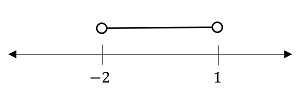
$$ (x - 1)(x + 2) < 0 $$
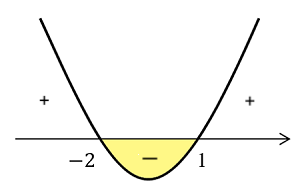
$$ - 2 < x < 1 $$
(b)
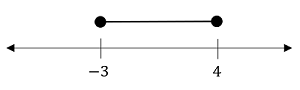
$$ (x + 3)(x - 4) \le 0 $$
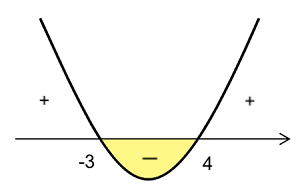
$$ - 3 \le x \le 4 $$
(c)
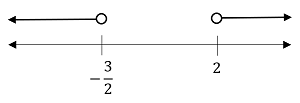
$$ (2x + 3)(x - 2) > 0 $$
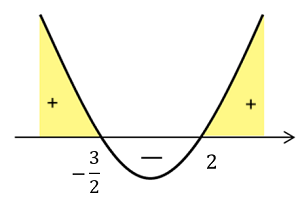
$$ x < - {3 \over 2} \text{ or } x > 2 $$
(d)
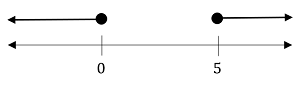
$$ x(x - 5) \ge 0 $$
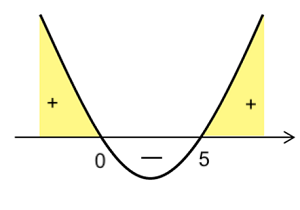
$$ x \le 0 \text{ or } x \ge 5 $$
(e)
\begin{align*}
x^2 - 4x & \le 0 \\
x(x - 4) & \le 0
\end{align*}
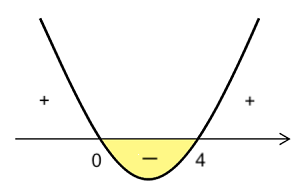
$$ 0 \le x \le 4 $$

(f)
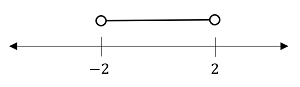
\begin{align*}
x^2 - 4 & < 0 \\
x^2 - 2^2 & < 0 \\
(x + 2)(x - 2) & < 0 \phantom{00000} [a^2 - b^2 = (a + b)(a - b)]
\end{align*}
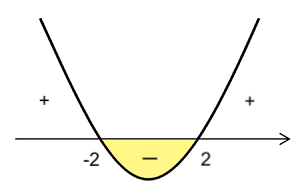
$$ -2 < x < 2 $$
Question 2
(a)
\begin{align}
x(x - 2) & < 3 \\
x^2 - 2x & < 3 \\
x^2 - 2x - 3 & < 0 \\
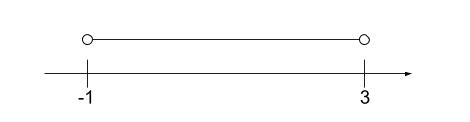
(x + 1)(x - 3) & < 0
\end{align}
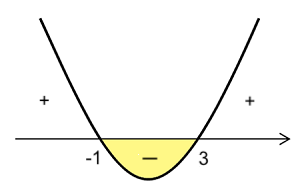
$$ -1 < x < 3 $$
(b)
\begin{align}
x^2 & > 4x + 12 \\
x^2 - 4x - 12 & > 0 \\
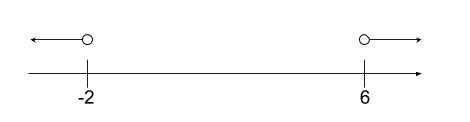
(x + 2)(x - 6) & > 0
\end{align}
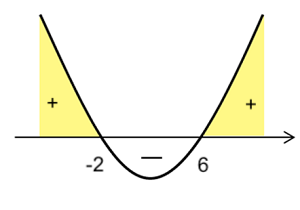
$$ x < -2 \text{ or } x > 6 $$
(c)
\begin{align}
4x(x + 1) & \le 3 \\
4x^2 + 4x & \le 3 \\
4x^2 + 4x - 3 & \le 0 \\
(2x + 3)(2x - 1) & \le 0
\end{align}
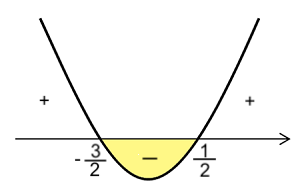
$$ -{3 \over 2} \le x \le {1 \over 2} $$
(d)
\begin{align}
(1 - x)^2 & \ge 17 - 2x \\
(1)^2 - 2(1)(x) + (x)^2 & \ge 17 - 2x \\
1 - 2x + x^2 & \ge 17 - 2x \\
1 - 17 - 2x + 2x + x^2 & \ge 0 \\
- 16 + x^2 & \ge 0 \\
x^2 - 16 & \ge 0 \\
(x + 4)(x - 4) & \ge 0
\end{align}
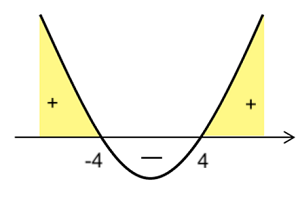
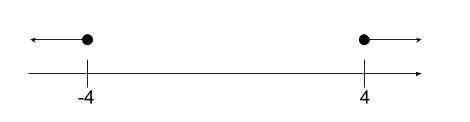
$$ x \le - 4 \text{ or } x \ge 4 $$
(e)
\begin{align}
(x + 2)^2 & < x(4 - x) + 40 \\
x^2 + 2(x)(2) + 2^2 & < 4x - x^2 + 40 \\
x^2 + 4x + 4 & < 4x - x^2 + 40 \\
x^2 + x^2 + 4x - 4x + 4 - 40 & < 0 \\
2x^2 - 36 & < 0 \\
x^2 - 18 & < 0 \\
x^2 - (\sqrt{18})^2 & < 0 \\
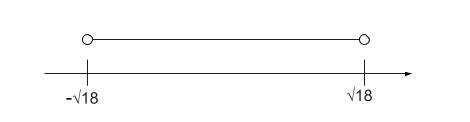
(x + \sqrt{18})(x - \sqrt{18}) & < 0
\end{align}

$$ -\sqrt{18} < x < \sqrt{18} $$
Question 3 - Real-life problem
\begin{align*}
y & = d^2 - 5d + 80 \\
\\
y & \ge 104 \\
d^2 - 5d + 80 & \ge 104 \\
d^2 - 5d - 24 & \ge 0 \\
(d + 3)(d - 8) & \ge 0
\end{align*}
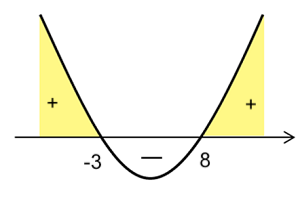
\begin{align*}
d \le - 3 & \text{ or } d \ge 8 \\
\\
\text{Since } d > 0, & \text{ reject } d \le -3 \\
\\
\therefore \text{Least no. of days} & = 8
\end{align*}
Question 4 - Real-life problem
(i)
\begin{align*}
h & = -16t^2 + 160t + 48 \\
\\
h & > 384 \phantom{00000} [\text{Height exceeds 384 m}] \\
-16t^2 + 160t + 48 & > 384 \\
-16t^2 + 160t - 336 & > 0 \\
16t^2 - 160t + 336 & < 0 \\
t^2 - 10t + 21 & < 0 \\
(t - 3)(t - 7) & < 0
\end{align*}
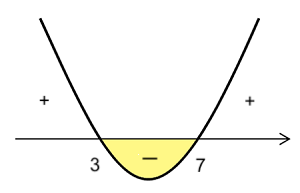
$$ 3 < t < 7 $$
(ii)
\begin{align*} h & = -16t^2 + 160t + 48 \\ & = -16(t^2 - 10t) + 48 \\ & = -16 \left[ \left(t - {10 \over 2}\right)^2 - \left(10 \over 2\right)^2 \right] + 48 \\ & = -16 [ (t - 5)^2 - 25 ] + 48 \\ & = -16(t - 5)^2 + 400 + 48 \\ & = -16(t - 5)^2 + 448 \\ \\ \text{Maximum height} & = 448 \text{ m} \\ \\ \therefore \text{Object cannot reach } & 1000 \text{ m above the ground} \end{align*}
Question 5
(a)
\begin{align}
x^2 - px + p & = 0 \\
\\
[a = 1, b & = -p, c = p] \\
\\
b^2 - 4ac & > 0 \\
(-p)^2 - 4(1)(p) & > 0 \\
p^2 - 4p & > 0 \\
p(p - 4) & > 0
\end{align}
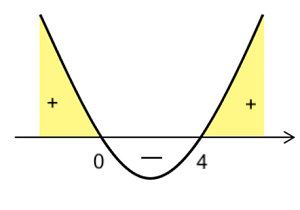
$$ p < 0 \text{ or } p > 4 $$
(b)
\begin{align}
9x^2 + 2px + 1 & = 0 \\
\\
[a = 9, b & = 2p, c = 1] \\
\\
b^2 - 4ac & \ge 0 \phantom{00000} [\text{2 real distinct roots or 2 real equal roots}]\\
(2p)^2 - 4(9)(1) & \ge 0 \\
4p^2 - 36 & \ge 0 \\
p^2 - 9 & \ge 0 \\
(p + 3)(p - 3) & \ge 0
\end{align}
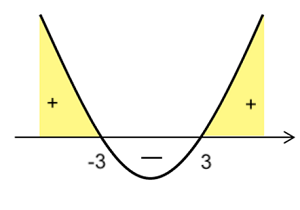
$$ p \le -3 \text{ or } p \ge 3 $$
(c)
\begin{align}
px^2 - 2x + 2p + 1 & = 0 \\
\\
[a = p, b & = -2, c = 2p + 1] \\
\\
b^2 - 4ac & < 0 \\
(-2)^2 - 4(p)(2p + 1) & < 0 \\
4 - 4p (2p + 1) & < 0 \\
4 - 8p^2 - 4p & < 0 \\
-8p^2 - 4p + 4 & < 0 \\
8p^2 + 4p - 4 & > 0 \\
2p^2 + p - 1 & > 0 \\
(p + 1)(2p - 1) & > 0
\end{align}
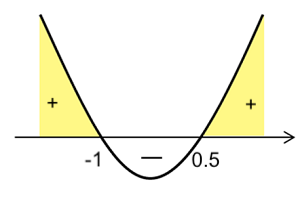
$$ p < -1 \text{ or } p > {1 \over 2} $$
(d)
\begin{align}
2x^2 - 2px + p^2 + p & = 0 \\
\\
[a = 2, b & = -2p, c = p^2 + p] \\
\\
b^2 - 4ac & \ge 0 \phantom{00000} [\text{2 real distinct roots or 2 real equal roots}] \\
(-2p)^2 - 4(2)(p^2 + p) & \ge 0 \\
4p^2 - 8(p^2 + p) & \ge 0 \\
4p^2 - 8p^2 - 8p & \ge 0 \\
-4p^2 - 8p & \ge 0 \\ \\
4p^2 + 8p & \le 0 \\
p^2 + 2p & \le 0 \\
p(p + 2) & \le 0
\end{align}
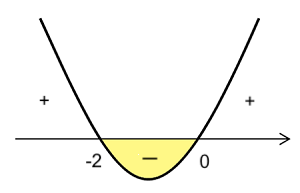
$$ -2 \le p \le 0 $$
Question 6 - Real-life problem
\begin{align*}
\text{Let } x \text{ m} & \text{ be the width of the pool} \\
\\
\text{Length of pool} & = (2x + 3) \text{ m} \\
\\
\text{Area} & \le 54 \text{ m}^2 \\
x(2x + 3) & \le 54 \\
2x^2 + 3x & \le 54 \\
2x^2 + 3x - 54 & \le 0 \\
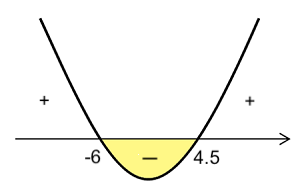
(x + 6)(2x - 9) & \le 0
\end{align*}
\begin{align*}
-6 \le & \phantom{.} x \le 4.5 \\
\\
\text{Since width } & \text{should be at least 2 m, } \\
2 \text{ m} \le & \text{ width} \le 4.5 \text{ m}
\end{align*}
Question 7 - Quadratic expression is always positive
\begin{align*}
x^2 + (n + 1)x + 4n & > 11 \\
x^2 + (n + 1)x + 4n - 11 & > 0 \phantom{00000} [\text{Always positive: coefficient of } x^2 \text{ is } 1 > 0 \text{ and } b^2 - 4ac < 0] \\
\\
b^2 - 4ac & = (n + 1)^2 - 4(1)(4n - 11) \\
& = (n)^2 + 2(n)(1) + (1)^2 - 4(4n - 11) \\
& = n^2 + 2n + 1 - 16n + 44 \\
& = n^2 - 14n + 45 \\
\\
b^2 - 4ac & < 0 \phantom{00000} [\text{No real roots}] \\
n^2 - 14n + 45 & < 0 \\
(n - 5)(n - 9) & < 0
\end{align*}
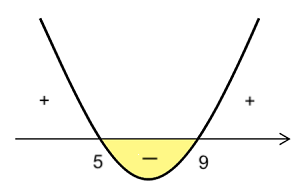
$$ 5 < n < 9 $$
Question 8 - Quadratic equation has real roots
\begin{align*}
k^2 x^2 - 2x + 1 & = kx \\
k^2 x^2 - kx - 2x + 1 & = 0 \\
k^2 x^2 + (-k - 2)x + 1 & = 0 \\
\\
b^2 - 4ac & = (-k - 2)^2 - 4(k^2)(1) \\
& = (-k)^2 - 2(-k)(2) + (2)^2 - 4k^2 \\
& = k^2 + 4k + 4 - 4k^2 \\
& = -3k^2 + 4k + 4 \\
\\
b^2 - 4ac & \ge 0 \phantom{00000} [\text{Two real distinct or equal roots}] \\
-3k^2 + 4k + 4 & \ge 0 \\
3k^2 - 4k - 4 & \le 0 \\
(3k + 2)(k - 2) & \le 0
\end{align*}
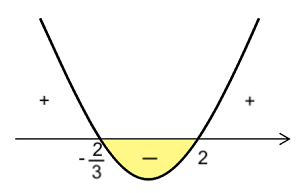
\begin{align*}
-{2 \over 3} & \le k \le 2 \\
\\
\text{Since } k \ne 0 \text{ (or else} & \text{ equation will not be quadratic)}, \\
-{2 \over 3} \le k < 0 & \text{ or } \phantom{.} 0 < k \le 2
\end{align*}
Question 9 - Work backwards from inequality
(a)
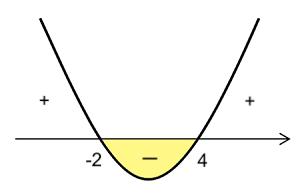
\begin{align}
-2 < \phantom{.} & x < 4 \\
\\
\text{Working } & \text{backwards}, \\
(x + 2)(x - 4) & < 0 \\
x^2 - 4x + 2x - 8 & < 0 \\
x^2 - 2x - 8 & < 0 \\
x^2 - 2x & < 8 \\
\\
\therefore a = -2, & \phantom{.} b = 8
\end{align}
(b)
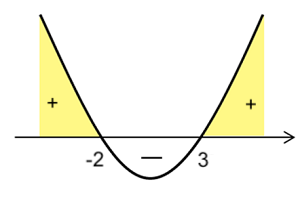
\begin{align}
x < -2 \text{ or } & x > 3 \\
\\
\text{Working } & \text{backwards}, \\
(x + 2)(x - 3) & > 0 \\
x^2 - 3x + 2x - 6 & > 0 \\
x^2 - x - 6 & > 0 \\
x^2 - 6 & > x \\
2x^2 - 12 & > 2x \\
\\
\therefore a = -12, & \phantom{.} b = 2
\end{align}
Question 10 - Real-life problem
(i)
\begin{align} d & \le 80 \\ \\ \text{Since } & d = 0.15v^2 + v, \\ 0.15v^2 + v & \le 80 \\ 0.15v^2 + v - 80 & \le 0 \\ 1.5v^2 + 10v - 800 & \le 0 \phantom{0000000} [\text{Multiply by 10}] \\ \\ 3v^2 + 20v - 1600 & \le 0 \text{ (Shown)} \phantom{0000000} [\text{Multiply by 2}] \end{align}
(ii)
\begin{align}
3v^2 + 20v - 1600 & \le 0 \\
(3v + 80)(v - 20) & \le 0
\end{align}
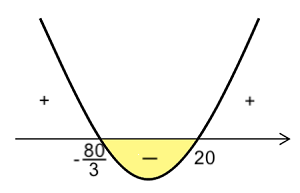
$$ - {80 \over 3} \le v \le 20 $$
$$ \text{Since } v \ge 0, \phantom{0} 0 \le v \le 20 $$
$$ \therefore \text{Maximum speed} = 20 \text{ m/s} $$
Question 11
(i)
\begin{align*} \text{Since } & k < 0, \\ -6k & > 0 \\ - 6k + 4 & > 0 + 4 \\ 4 - 6k & > 4 \\ \\ \therefore \text{Coefficient} & \text{ of } x^2 \text{ is positive} \end{align*}
(ii)
\begin{align*}
f(x) & = 0 \\
(4 - 6k)x^2 + (8 - 2k)x + 4 & = 0 \\
\\
b^2 - 4ac & = (8 - 2k)^2 - 4(4 - 6k)(4) \\
& = (8)^2 - 2(8)(2k) + (2k)^2 - (16 - 24k)(4) \\
& = 64 - 32k + 4k^2 - (64 - 96k) \\
& = 64 - 32k + 4k^2 - 64 + 96k \\
& = 4k^2 + 64k \\
\\
b^2 - 4ac & < 0 \phantom{00000} [\text{No real roots}] \\
4k^2 + 64k & < 0 \\
4k(k + 16) & < 0
\end{align*}

$$ -16 < k < 0 $$
Question 12
(a)
\begin{align*} y & = 2x + m \phantom{00000} \text{--- (1)} \\ y & = 2x^2 - 6x + 5 \phantom{00000} \text{--- (2)} \\ \\ \text{Substitute } & \text{(1) into (2),} \\ 2x + m & = 2x^2 - 6x + 5 \\ 0 & = 2x^2 - 8x + 5 - m \\ \\ b^2 - 4ac & = (-8)^2 - 4(2)(5 - m) \\ & = 64 - 8(5 - m) \\ & = 64 - 40 + 8m \\ & = 24 + 8m \\ \\ b^2 - 4ac & = 0 \phantom{00000} [\text{1 real root, since line is tangent to curve}] \\ 24 + 8m & = 0 \\ 8m & = -24 \\ m & = {-24 \over 8} \\ m & = -3 \end{align*}
(b)
\begin{align*} (k + 2)x^2 - 2\sqrt{2k + 1} x + 4 & = 0 \\ \\ b^2 - 4ac & = \left(-2 \sqrt{2k + 1}\right)^2 - 4(k + 2)(4) \\ & = 4(2k + 1) - (4k + 8)(4) \\ & = 8k + 4 - (16k + 32) \\ & = 8k + 4 - 16k - 32 \\ & = -8k - 28 \\ \\ \text{Since } k & > 0, \\ -8k & < 0 \\ -8k - 28 & < 0 - 28 \\ -8k - 28 & < -28 \\ \implies b^2 - 4ac & < -28 \\ \\ \text{Since } b^2 - 4ac < 0 \text{ for } & k > 0, \text{ the equation has no real roots} \end{align*}
Question 13 - Solve simultaneous inequalities
(a)
\begin{align*}
2x + 1 & \le 8 \\
2x & \le 7 \\
x & \le {7 \over 2} \\
x & \le 3.5
\end{align*}
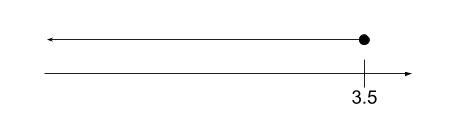
(b)
\begin{align*}
x + 2 & \le x^2 \\
0 & \le x^2 - x - 2 \\
0 & \le (x + 1)(x - 2)
\end{align*}
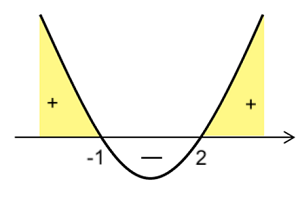
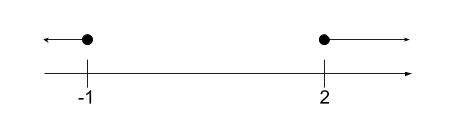
$$ x \le -1 \text{ or } x \ge 2 $$
Combine the number line with the number line from (a) and identify the overlapping region(s):
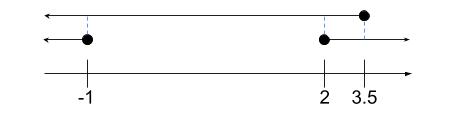
$$ x \le -1 \text{ or } 2 \le x \le 3.5$$
Question 14 - Work backwards from inequality
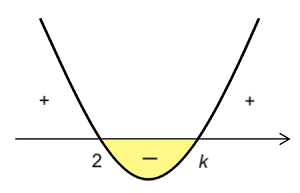
\begin{align}
2 < \phantom{.} & x < k \\
\\
\text{Working } & \text{backwards,} \\
(x - 2)(x - k) & < 0 \\
x^2 - kx - 2x + 2k & < 0 \\
2x^2 - 2kx - 4x + 4k & < 0 \\
2x^2 + (-2k - 4)x + 4k & < 0 \\
\\
\therefore y = 2x^2 + & (-2k - 4)x + 4k \\
\\
\text{By comparison with } y & = 2x^2 + px + 16, \\
\\
4k & = 16 \\
k & = {16 \over 4} \\
& = 4 \\
\\ \\
-2k - 4 & = p \\
-2(4) - 4 & = p \\
-12 & = p
\end{align}
Question 15 - Real-life problem
(i)
\begin{align} 1 + 2x + {3 \over 2}(x - 1)x & = 100000 \\ 2 + 4x + 3(x - 1)x & = 200000 \\ 2 + 4x + 3x(x - 1) & = 200000 \\ 2 + 4x + 3x^2 - 3x & = 200000 \\ 3x^2 + 4x - 3x + 2 - 200000 & = 0 \\ 3x^2 + x - 199998 & = 0 \\ \\ x & = {-b \pm \sqrt{b^2 - 4ac} \over 2a} \\ & = {-1 \pm \sqrt{1^2 - 4(3)(-199998)} \over 2(3)} \\ & = {-1 \pm \sqrt{2399977} \over 6} \\ & = 258.0309 \text{ or } -258.3643 \\ & \approx 258.03 \text{ or } -258.36 \end{align}
(ii)
\begin{align}
1 + 2x + {3 \over 2}(x - 1)x & \le 100000 \\
& . \\
& . \phantom{000} [\text{Same steps as part (i)}] \\
& . \\ \\
3x^2 + x - 199998 & \le 0
\end{align}
Use the solutions from (i):
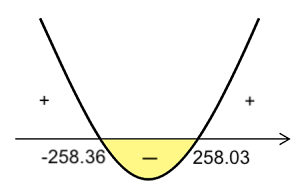
$$ -258.36 \le x \le 258.03 $$
(iii)
Notice the expression is the same as the expression in (i), except the variable x is replaced by n.
\begin{align}
\text{Since there can only be a } & \text{maximum of 100000 lines}, \\
\\
1 + 2n + {3 \over 2}n(n - 1) & \le 100000 \\
& . \\
& . \phantom{000} [\text{Same steps as part (ii)}] \\
& . \\ \\
3n^2 + n - 199998 & \le 0
\end{align}
$$ -258.36 \le n \le 258.03 $$
$$ \text{Since } n \text{ must be a positive whole number and } n \le 258.03, $$
$$ \therefore \text{Maximum no. of users} = 258 $$
Revision Exercise 2
Question A1
(a)(i)
\begin{align*} y & = 2x^2 - 4x + 5 \\ y & = 2(x^2 - 2x) + 5 \\ y & = 2 \left[ \left( x - {2 \over 2} \right)^2 -\left( 2 \over 2\right)^2 \right] + 5 \\ y & = 2 [ (x - 1)^2 - 1] + 5 \\ y & = 2(x - 1)^2 - 2 + 5 \\ y & = 2(x - 1)^2 + 3 \\ \\ \text{Mini} & \text{mum point is } (1, 3) \\ \\ \text{Let } & x = 0, \\ y & = 2(0 - 1)^2 + 3 \\ y & = 5 \\ \\ \text{Coor} & \text{dinates of } y\text{-intercept is } (0, 5) \end{align*}
(a)(ii)
\begin{align*} y & = 2x^2 - 4x + 5 \phantom{000} \text{--- (1)} \\ y & = 2x + c \phantom{000} \text{--- (2)} \\ \\ \text{Substitute } & \text{(1) into (2),} \\ 2x^2 - 4x + 5 & = 2x + c \\ 2x^2 - 6x + 5 - c & = 0 \\ \\ b^2 - 4ac & = (-6)^2 - 4(2)(5 - c) \\ & = 36 - 8(5 - c) \\ & = 36 - 40 + 8c \\ & = 8c - 4 \\ \\ b^2 - 4ac & = 0 \phantom{000} [\text{Real and equal roots since line is tangent to curve}] \\ 8c - 4 & = 0 \\ 8c & = 4 \\ c & = {4 \over 8} \\ c & = {1 \over 2} \end{align*}
(b)
\begin{align*}
y & = px - 3 \phantom{000} \text{--- (1)} \\
y & = 4x^2 + 5 \phantom{000} \text{--- (2)} \\
\\
\text{Substitute } & \text{(1) into (2),} \\
px - 3 & = 4x^2 + 5 \\
0 & = 4x^2 - px + 8 \\
\\
b^2 - 4ac & = (-p)^2 - 4(4)(8) \\
& = p^2 - 128 \\
\\
b^2 - 4ac & \ge 0 \phantom{000} [\text{Real and distinct/equal roots since line intersects curve}] \\
p^2 - 128 & \ge 0 \\
(p)^2 - (\sqrt{128})^2 & \ge 0 \\
(p + \sqrt{128})(p - \sqrt{128}) & \ge 0 \phantom{000} [a^2 - b^2 = (a + b)(a - b)]
\end{align*}
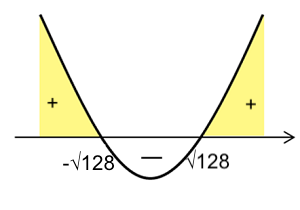
$$ p \le - \sqrt{128} \text{ or } p \ge \sqrt{128} $$
$$ \text{Since } \sqrt{128} \approx 11.3, \text{ the negative values of } p \text{ satisfy } p \le -11.3 $$
$$ \text{Largest negative integer} = -12 $$
Question A2
(i)
\begin{align*} 3x + 4y & = 8 \\ 4y & = 8 - 3x \phantom{000} \text{--- (1)} \\ (4y + 3)^2 + (6x - 20)^2 & = 200 \phantom{000} \text{--- (2)} \\ \\ \text{Substitute } & \text{(1) into (2),} \\ (8 - 3x + 3)^2 + (6x - 20)^2 & = 200 \\ (11 - 3x)^2 + (6x - 20)^2 & = 200 \\ (11)^2 - 2(11)(3x) + (3x)^2 + (6x)^2 - 2(6x)(20) + (20)^2 & = 200 \\ 121 - 66x + 9x^2 + 36x^2 - 240x + 400 & = 200 \\ 45x^2 - 306x + 521 & = 200 \\ 45x^2 - 306x + 321 & = 0 \\ \\ x & = {-b \pm \sqrt{b^2 - 4ac} \over 2a} \\ & = {-(-306) \pm \sqrt{(-306)^2 - 4(45)(321)} \over 2(45)} \\ & = {306 \pm \sqrt{35856} \over 90} \\ & = 5.5040 \text{ or } 1.296 \\ \\ \text{Substitute } & x = 5.5040 \text{ into } (1), \\ 4y & = 8 - 3(5.5040) \\ 4y & = -8.512 \\ y & = -2.128 \\ \\ \text{Substitute } & x = 1.296 \text{ into } (1), \\ 4y & = 8 - 3(1.296) \\ 4y & = 4.112 \\ y & = 1.028 \\ \\ \therefore x \approx 5.50, y \approx -2.13 & \text{ or } x \approx 1.30, y \approx 1.03 \end{align*}
(ii)
\begin{align*} 3x + 4y & = -10 \\ 4y & = -10 - 3x \phantom{000} \text{--- (1)} \\ (4y + 3)^2 + (6x - 20)^2 & = 200 \phantom{000} \text{--- (2)} \\ \\ \text{Substitute } & \text{(1) into (2),} \\ (-10 - 3x + 3)^2 + (6x - 20)^2 & = 200 \\ (-7 - 3x)^2 + (6x - 20)^2 & = 200 \\ (-7)^2 - 2(-7)(3x) + (3x)^2 + (6x)^2 - 2(6x)(20) + (20)^2 & = 200 \\ 49 + 42x + 9x^2 + 36x^2 - 240x + 400 & = 200 \\ 45x^2 - 198x + 449 & = 200 \\ 45x^2 - 198x + 249 & = 0 \\ 15x^2 - 66x + 83 & = 0 \\ \\ b^2 - 4ac & = (-66)^2 - 4(15)(83) \\ & = -624 \\ \\ \text{Since } b^2 - 4ac < 0, \text{ there are no} & \text{ solutions for the simultaneous equations} \end{align*}
(iii)
Substituting the linear equation into the non-linear equation always gives a quadratic equation in x. A quadratic equation has at most two real roots, and each value of x gives only one value of y (from 4y = k - 3x). Hence there cannot be more than two solutions, i.e. the line can meet the curve at most twice (graph on Desmos).
Question A3 - Real-life problem
\begin{align*}
\text{Let } x & \text{ denote the length of the lawn in m} \\
\\
\text{Width} & = (x - 2) \text{ m}
\\
\text{Width} & > 6.4 \text{ m} \\
x - 2 & > 6.4 \\
x & > 8.4 \phantom{00000} [\text{Condition #1}] \\
\\
\text{Area} & < 63 \text{ m}^2 \\
x(x - 2) & < 63 \\
x^2 - 2x & < 63 \\
x^2 - 2x - 63 & < 0 \\
(x + 7)(x - 9) & < 0
\end{align*}
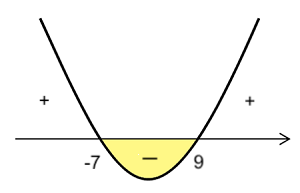
$$ -7 < x < 9 \phantom{00000} [\text{Condition #2}] $$
We need to satisfy condition #1 and condition #2
$$ \therefore 8.4 < x < 9 $$
$$ 8.4 \text{ m} < \text{Length} < 9 \text{ m} $$
Question A4 - Real-life problem
\begin{align*}
\text{Let } x \text{ denote the length of} & \text{ 'shorter' leg of the triangle in cm} \\
\\
\text{Length of 'longer' leg} & = (x + 7) \text{ cm} \\
\\
\text{Hypotenuse} & \ge 13 \text{ cm} \\
(\text{Hypotenuse})^2 & \ge 13^2 \\
(\text{Hypotenuse})^2 & \ge 169 \\
\\
[\text{Pythagoras theorem}] \phantom{0000} x^2 + (x + 7)^2 & \ge 169 \\
x^2 + (x)^2 + 2(x)(7) + (7)^2 & \ge 169 \\
x^2 + x^2 + 14x + 49 & \ge 169 \\
2x^2 + 14x - 120 & \ge 0 \\
x^2 + 7x - 60 & \ge 0 \\
(x + 12)(x - 5) & \ge 0
\end{align*}
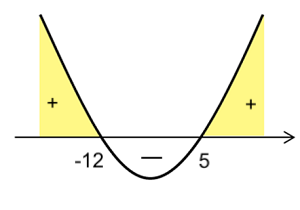
$$ x \le -12 \text{ or } x \ge 5 $$
$$ \text{Since length of shorter leg } > 0, \text{length of shorter leg is at least 5 cm} $$
Question A5
(a)
\begin{align*}
x^2 - 5x + 3 & > 5 - 4x \\
x^2 - x - 2 & > 0 \\
(x + 1)(x - 2) & > 0
\end{align*}
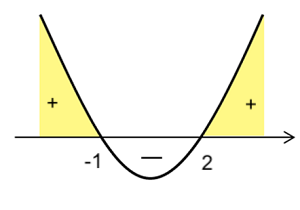
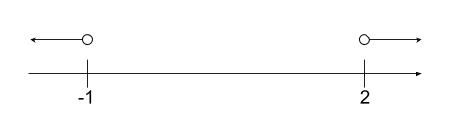
$$ x < -1 \text{ or } x > 2 $$
(b)
\begin{align*} 3x^2 - 6x + c & > 4 \\ 3x^2 - 6x + c - 4 & > 0 \phantom{00000} [\text{Always positive: } a = 3 > 0 \text{ and } b^2 - 4ac < 0] \\ \\ b^2 - 4ac & = (-6)^2 - 4(3)(c - 4) \\ & = 36 - 12(c - 4) \\ & = 36 - 12c + 48 \\ & = 84 - 12c \\ \\ b^2 - 4ac & < 0 \phantom{00000} [\text{No real roots}] \\ 84 - 12c & < 0 \\ -12c & < -84 \\ 12c & > 84 \\ c & > {84 \over 12} \\ c & > 7 \end{align*}
Question A6 - Work backwards from inequality
(i)
\begin{align*}
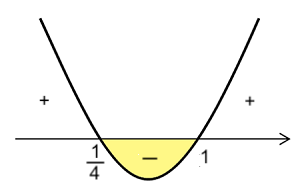
{1 \over 4} < & \phantom{.} x < 1 \\
\\
(4x - 1)(x - 1) & < 0 \\
4x^2 - 4x - x + 1 & < 0 \\
4x^2 - 5x + 1 & < 0 \\
-4x^2 + 5x - 1 & > 0 \\
\\
\text{Comparing coefficients, } & p = 4 \text{ and } q = 5
\end{align*}
(ii)
\begin{align*}
y & = -4x^2 + 5x - 1 \\
\\
y & = 1 - 4x \\
\\
1 - 4x & > -4x^2 + 5x - 1 \phantom{00000} [\text{Curve lies below line}] \\
0 & > -4x^2 + 9x - 2 \\
0 & < 4x^2 - 9x + 2 \\
0 & < (4x - 1)(x - 2)
\end{align*}
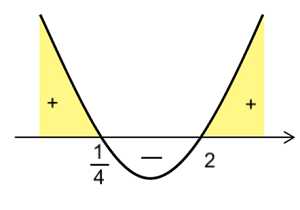
$$ x < {1 \over 4} \text{ or } x > 2 $$
Question A7
\begin{align*} x^2 + xy & = 15 \phantom{000} \text{--- (1)} \\ \\ 3x + 5y & = 5 \\ 5y & = 5 - 3x \\ y & = 1 - {3 \over 5}x \phantom{000} \text{--- (2)} \\ \\ \text{Substitute } & \text{(2) into (1),} \\ x^2 + x\left(1 - {3 \over 5}x\right) & = 15 \\ x^2 + x - {3 \over 5}x^2 & = 15 \\ {2 \over 5}x^2 + x & = 15 \\ 2x^2 + 5x & = 75 \\ 2x^2 + 5x - 75 & = 0 \\ (2x + 15)(x - 5) & = 0 \\ \\ 2x + 15 = 0 \phantom{00-} & \text{ or } \phantom{0} x - 5 = 0 \\ 2x = -15 \phantom{0} & \phantom{0000000} x = 5 \\ x = -7.5 \phantom{.} & \\ \\ \text{Substitute } & x = -7.5 \text{ into (2),} \\ y & = 1 - {3 \over 5}(-7.5) \\ y & = 5.5 \\ \\ \text{Substitute } & x = 5 \text{ into (2),} \\ y & = 1 - {3 \over 5}(5) \\ y & = -2 \\ \\ \therefore \text{Coordinates of intersect} & \text{ion are } (-7.5, 5.5) \text{ and } (5, -2) \end{align*}
Question B1
(a)
\begin{align}
(x + 1)^2 & = h(x + 2) \\
x^2 + 2(x) + 1^2 & = hx + 2h \\
x^2 + 2x + 1 & = hx + 2h \\
x^2 + 2x - hx + 1 - 2h & = 0 \\
x^2 + (2 - h)x + (1 - 2h) & = 0 \\
\\
[a = 1, b & = 2 - h, c = 1 - 2h] \\
\\
b^2 - 4ac & \ge 0 \\
(2 - h)^2 - 4(1)(1 - 2h) & \ge 0 \\
2^2 - 2(2)(h) + h^2 - 4(1 - 2h) & \ge 0 \\
4 - 4h + h^2 - 4 + 8h & \ge 0 \\
h^2 + 4h & \ge 0 \\
h(h + 4) & \ge 0
\end{align}
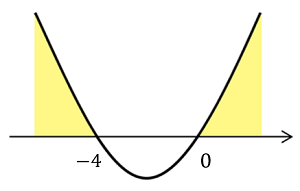
$$ h \le -4 \text{ or } h \ge 0 $$
$$ \therefore h \text{ cannot lie between -4 and 0}. $$
(b)(i)
\begin{align}
y & = 3x + k \phantom{000} \text{ --- (1)} \\
\\
y^2 & = 1 - x^2 \phantom{000} \text{ --- (2)} \\
\\
\text{Substitute } & \text{(1) into (2),} \\
(3x + k)^2 & = 1 - x^2 \\
(3x)^2 + 2(3x)(k) + k^2 & = 1 - x^2 \\
9x^2 + 6kx + k^2 & = 1 - x^2 \\
9x^2 + x^2 + 6kx + k^2 - 1 & = 0 \\
10x^2 + 6kx + (k^2 - 1) & = 0 \\
\\
[a = 10, b & = 6k, c = k^2 - 1] \\
\\
b^2 - 4ac & > 0 \\
(6k)^2 - 4(10)(k^2 - 1) & > 0 \\
36k^2 - 40(k^2 - 1) & > 0 \\
36k^2 - 40k^2 + 40 & > 0 \\
-4k^2 + 40 & > 0 \\
\\
4k^2 - 40 & < 0 \\
k^2 - 10 & < 0 \\
k^2 - (\sqrt{10})^2 & < 0 \\
(k + \sqrt{10})(k - \sqrt{10}) & < 0
\end{align}
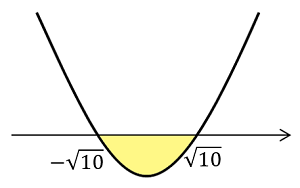
$$ -\sqrt{10} < k < \sqrt{10} $$
(b)(ii)
For the line to be a tangent to the curve, b2 - 4ac = 0. \begin{align*} -4k^2 + 40 & = 0 \\ 4k^2 & = 40 \\ k^2 & = 10 \\ \therefore k & = \pm \sqrt{10} \end{align*}
Question B2
(a)
\begin{align*}
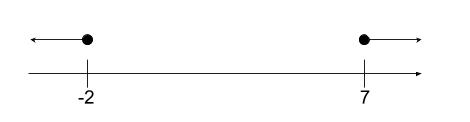
(1 + x)(6 - x) & \le -8 \\
6 - x + 6x - x^2 & \le - 8 \\
-x^2 + 5x + 6 & \le -8 \\
-x^2 + 5x + 14 & \le 0 \\
x^2 - 5x - 14 & \ge 0 \\
(x - 7)(x + 2) & \ge 0
\end{align*}
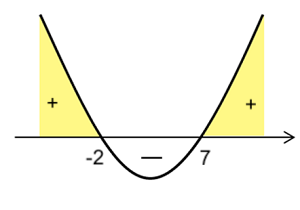
$$ x \le -2 \text{ or } x \ge 7 $$
(b)
\begin{align*}
2x (x + 2) & < (x + 1)(x + 3) \\
2x^2 + 4x & < x^2 + 3x + x + 3 \\
2x^2 + 4x & < x^2 + 4x + 3 \\
x^2 - 3 & < 0 \\
x^2 - (\sqrt{3})^2 & < 0 \\
(x + \sqrt{3}) (x - \sqrt{3}) & < 0 \phantom{0000000} [a^2 - b^2 = (a + b)(a - b)]
\end{align*}
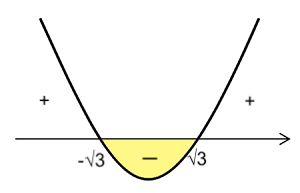
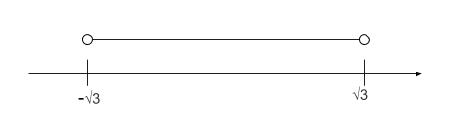
$$ -\sqrt{3} < x < \sqrt{3} $$
Question B3
(a)
\begin{align}
y & = -x^2 + 2(k - 3)x - 25 \\
& = -x^2 + (2k - 6)x - 25 \\
\\
[a = -1, b & = 2k - 6, c = - 25] \\
\\
b^2 - 4ac & < 0 \phantom{00000} [\text{Entirely below the } x\text{-axis: } a = -1 < 0 \text{ and no real roots}] \\
(2k - 6)^2 - 4(-1)(-25) & < 0 \\
(2k)^2 - 2(2k)(6) + 6^2 - 100 & < 0 \\
4k^2 - 24k + 36 - 100 & < 0 \\
4k^2 - 24k - 64 & < 0 \\
k^2 - 6k - 16 & < 0 \\
(k + 2)(k - 8) & < 0
\end{align}
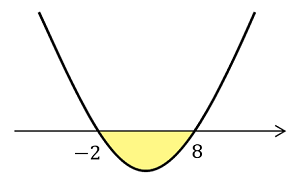
$$ -2 < k < 8 $$
(b)(i)
\begin{align} \text{When } & y = 0, \\ 0 & = (x - 3)(x + 1) \\ \\ x - 3 = 0 \phantom{00}&\text{or}\phantom{00} x + 1 = 0 \\ x = 3 \phantom{00} &\phantom{or00+1} x = - 1 \\ \\ \implies \text{Coordinates of } & x\text{-intercepts are } (3, 0) \text{ and } (-1, 0) \end{align}
(b)(ii)
\begin{align*} (x - 3)(x + 1) & = p \\ x^2 + x - 3x - 3 & = p \\ x^2 - 2x - 3 & = p \\ x^2 - 2x - 3 - p & = 0 \\ \\ b^2 - 4ac & = (-2)^2 - 4(1)(-3-p) \\ & = 4 - 4(-3-p) \\ & = 4 +12 + 4p \\ & = 16 + 4p \\ \\ b^2 - 4ac & = 0 \phantom{00000} [\text{Real and equal roots}] \\ 16 + 4p & = 0 \\ 4p & = -16 \\ p & = {-16 \over 4} \\ p & = -4 \\ \\ \text{When } & p = -4, \\ x^2 - 2x - 3 - (-4) & = 0 \\ x^2 - 2x + 1 & = 0 \\ (x)^2 - 2(x)(1) + (1)^2 & = 0 \\ (x - 1)^2 & = 0 \phantom{00000} [a^2 - 2ab + b^2 = (a - b)^2] \\ x - 1 & = \sqrt{0} \\ x - 1 & = 0 \\ x & = 1 \end{align*}
Question B4
(i)
\begin{align*}
y & = 5x^2 \phantom{000} \text{--- (1)} \\
y & = px - 5 \phantom{000} \text{--- (2)} \\
\\
\text{Substitute } & \text{(1) into (2)}, \\
5x^2 & = px - 5 \\
5x^2 - px + 5 & = 0 \\
\\
b^2 - 4ac & = (-p)^2 - 4(5)(5) \\
& = p^2 - 100 \\
\\
b^2 - 4ac & < 0 \phantom{00000} [\text{No real roots, since curve lies above line}] \\
p^2 - 100 & < 0 \\
p^2 - 10^2 & < 0 \\
(p + 10)(p - 10) & < 0 \phantom{00000} [a^2 - b^2 = (a + b)(a - b)]
\end{align*}
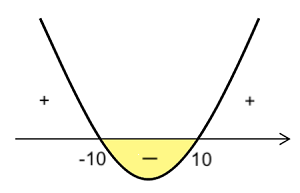
$$ -10 < p < 10 $$
(ii)
From part (i), since a = 5 > 0 and b2 - 4ac < 0 (the curve lies above the line), the expression 5x2 - px + 5 is always positive.
\begin{align*}
-10 < & \phantom{.} p < 10 \\
-20 < & \phantom{.} 2p < 20 \\
5 < 2p & + 25 < 45 \\
\\
\implies 2p + 25 & > 0 \\
\\
\text{For } -10 < \phantom{.} p < 10, & \phantom{.} 2p + 25 > 0 \text{ and } 5x^2 - px + 5 > 0 \\
\\
\therefore {2p + 25 \over 5x^2 - px + 5} & > 0
\end{align*}
Question B5 - Real-life problem
(i)
\begin{align*} h & = -{1 \over 5}t^2 + 5t \\ & = -{1 \over 5} (t^2 - 25t) \\ & = -{1 \over 5} \left[ \left(t - {25 \over 2}\right)^2 - \left(25 \over 2\right)^2 \right] \\ & = -0.2 [ (t - 12.5)^2 - 156.25] \\ & = -0.2(t - 12.5)^2 + 31.25 \\ \\ \text{Max. height} & = 31.25 \text{ m} \\ \\ \text{Since } 31.25 \text{ m} & > 30 \text{ m}, \\ \therefore \text{Projectile } & \text{can reach a height of 30 m} \end{align*}
(ii)
$$ t = 12.5 \text{ s} $$
(iii)
The path of the projectile resembles the shape of a maximum curve (∩), so the projectile is at least 10 m above the ground between the two times when h = 10.
\begin{align*}
h & = -0.2(t - 12.5)^2 + 31.25 \\
\\
\text{When } & h = 10, \\
10 & = -0.2(t - 12.5)^2 + 31.25 \\
0.2(t - 12.5)^2 & = 21.25 \\
(t- 12.5)^2 & = {21.25 \over 0.2} \\
(t - 12.5)^2 & = 106.25 \\
t - 12.5 & = \pm \sqrt{106.25} \\
t - 12.5 & = \pm 10.308 \\
t & = 10.308 + 12.5 \text{ or } -10.308 + 12.5 \\
t & = 22.808 \text{ or } 2.192 \\
t & \approx 22.8 \text{ or } 2.19 \\
\\
\therefore 2.19 \le & \phantom{.} t \le 22.8
\end{align*}
Question B6
(a)(i)
\begin{align*} f(x) & = ax^2 + bx + 5 \\ & = a \left(x^2 + {b \over a}x \right) + 5 \\ & = a \left[ \left(x + {b \over 2a}\right)^2 - \left(b \over 2a\right)^2 \right] + 5 \\ & = a \left[ \left(x + {b \over 2a}\right)^2 - {b^2 \over 4a^2} \right] + 5 \\ & = a \left(x + {b \over 2a}\right)^2 - {b^2 \over 4a} + 5 \\ \\ {b \over 2a} & = -3 \\ b & = -6a \\ \\ -{b^2 \over 4a} + 5 & = -4 \\ -{b^2 \over 4a} & = - 9 \\ {b^2 \over 4a} & = 9 \\ {(-6a)^2 \over 4a} & = 9 \\ {36a^2 \over 4a} & = 9 \\ 9a & = 9 \\ a & = {9 \over 9} \\ a & = 1 \\ \\ b & = -6(1) \\ b & = -6 \end{align*}
(a)(ii)
Since a = 1 > 0, the graph of y = f(x) is a minimum curve (∪). Its minimum value of -4 is below the x-axis, so the graph will meet the x-axis at two distinct points, i.e. f(x) = 0 has real and distinct roots.
(Alternatively, f(x) = x2 - 6x + 5, so b2 - 4ac = (-6)2 - 4(1)(5) = 16 > 0.)
(b)
\begin{align*} y & = 2x^2 - 8x + 9 \\ \\ b^2 - 4ac & = (-8)^2 - 4(2)(9) \\ & = -8 \\ \\ \text{Since } a > 0 \text{ and } & b^2 - 4ac < 0 , \text{ the expression is always positive} \end{align*}
Question B7
(a)
\begin{align*} x^2 - 2x + 2 - k & = 0 \\ \\ b^2 - 4ac & = (-2)^2 - 4(1)(2 - k) \\ & = 4 - 4(2 - k) \\ & = 4 - 8 + 4k \\ & = 4k - 4 \\ \\ \text{For } k & < 1, \\ 4k & < 4 \\ 4k - 4 & < 4 -4 \\ 4k - 4 & < 0 \\ \implies b^2 - 4ac & < 0 \\ \\ \text{Since } b^2 - 4ac < 0 \text{ for } k < 1, & \text{ the roots of the equation are not real} \end{align*}
(b)
\begin{align*}
y + px & = 8 \\
y & = -px + 8 \phantom{000} \text{--- (1)} \\
\\
x^2 + 4y & = 20 \phantom{000} \text{--- (2)} \\
\\
\text{Substitute } & \text{(1) into (2),} \\
x^2 + 4(-px + 8) & = 20 \\
x^2 - 4px + 32 & = 20 \\
x^2 - 4px + 12 & = 0 \\
\\
b^2 - 4ac & = (-4p)^2 - 4(1)(12) \\
& = 16p^2 - 48 \\
\\
b^2 - 4ac & \ge 0 \phantom{00000} [\text{Real and distinct/equal roots since line intersects curve}] \\
16p^2 - 48 & \ge 0 \\
p^2 - 3 & \ge 0 \\
p^2 - (\sqrt{3})^2 & \ge 0 \\
(p + \sqrt{3})(p - \sqrt{3}) & \ge 0
\end{align*}
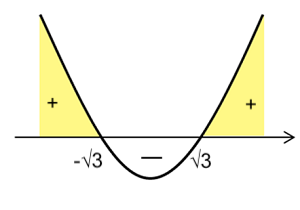
$$ p \le -\sqrt{3} \text{ or } p \ge \sqrt{3} $$
What’s next
- Chapter 3: Surds 🔒 Subscribers
- All chapters of Additional Maths 360 (2nd Edition)
- O Level A Maths past year solutions — free, 2014 to the latest paper