Equation & inequalities: Discriminant, b² - 4ac
Sections:
1) Revision notes
How to use the discriminant to find the number of roots of a quadratic equation
Conditions for a quadratic expression to be always positive or always negative
2) Practice questions
Revision notes
How to use the discriminant to find the number of roots of a quadratic equation
General cases for discriminant
1. If equation has two real and distinct roots, then $b^2 - 4ac$ $ > 0 $
2. If equation has two real and equal roots (or one real root), then $b^2 - 4ac$ $ = 0 $
3. If equation has real roots (either one or two real roots), then $b^2 - 4ac$ $ \ge 0 $
4. If equation has no real roots, then $b^2 - 4ac$ $ < 0 $
1. If equation has two real and distinct roots, then $b^2 - 4ac$ $ > 0 $
2. If equation has two real and equal roots (or one real root), then $b^2 - 4ac$ $ = 0 $
3. If equation has real roots (either one or two real roots), then $b^2 - 4ac$ $ \ge 0 $
4. If equation has no real roots, then $b^2 - 4ac$ $ < 0 $
Conditions for a quadratic expression to be always positive or always negative
Quadratic expression is always positive
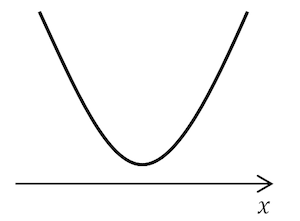
$\text{Condition 1: } $ $ a > 0 $
$\text{Condition 2: } b^2 - 4ac $ $ < 0 $
Quadratic expression is always negative
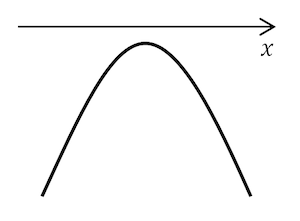
$\text{Condition 1: } $ $ a < 0 $
$\text{Condition 2: } b^2 - 4ac $ $ < 0 $
Practice questions
Find the range of values of k using the discriminant
1. Find the range of values of $k$ such that the equation $(x - 1)^2 = -kx - k$ has real roots.
Answer: $ k \le 0 \text{ or } k \ge 8 $

A quadratic expression is always positive or always negative
2. Find the range of values of $k$ for which the curve $y = 3x + 1 - kx^2 - kx $ lies entirely above the $x$-axis.
Answer: $ -6 < k < 0 $


Open-ended question (i.e. many possible answers)
3. Find a possible set of values of the constants $a$ and $c$ so that the expression $ax^2 + ax + c$ is always negative.
Show question
Discriminant in real-world context
4. The cost in thousands of dollars, $C$, in producing $n$ hundred pairs of a certain type of running shoes is given by the equation $C = 1.2n^2 - 14.4n + 53.7$.
Use the discriminant to show that it is not possible to have a cost of production of $10$ thousand dollars.
(from Additional Maths 360 Ex 1.3)
Use the discriminant to show that the quadratic equation has two real and distinct roots
5. Show that the equation $ p(x + 1) = 3 - {1 \over 2}x^2$ has two real and distinct roots for all real values of $p$.
O Level past year questions on the discriminant
Fully worked, step-by-step solutions to these past-year questions (2016 to 2025) are in the O Level A Maths Solutions page.
| Year & paper | Comments |
|---|---|
| 2023 P1 Question 7 | Quadratic curve lies completely below x-axis |
| Specimen P2 Question 4b | Quadratic expression is always negative (Open-ended question like question 3) |
| 2020 P2 Question 2b | Quadratic expression is always negative |
| 2018 P2 Question 9ii | Quadratic expression cannot be negative |
| 2015 P1 Question 4 | Quadratic expression is always negative (Open-ended question like question 3) |
| 2011 P2 Question 1i | Quadratic curve is completely above x-axis |
| 2008 P1 Question 10 | Quadratic expression is (a) always positive (b) always negative |
← Solve quadratic inequality Intersection(s) between line and curve →