Revision notes
Conditions for increasing and decreasing functions using dy/dx
Increasing function
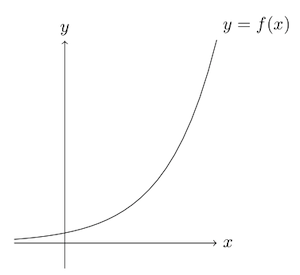
For an increasing function (as $x$ increases, $y$ increases), ${dy \over dx}$ $ > 0 $
Decreasing function
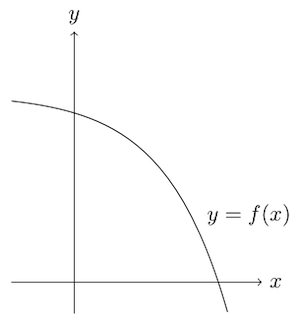
For a decreasing function (as $x$ increases, $y$ decreases), ${dy \over dx}$ $ < 0 $
Practice questions
Find the range of values of x for which a function is increasing or decreasing
1. The equation of a curve is $y = {5 \over 2}x^2 - {1 \over 3}x^3 + 4$. Find the range of values of $x$ for which $y$ is decreasing.
Answer:
$ 0 < x < 5 $
Solutions
\begin{align*}
y & = {5 \over 2}x^2 - {1 \over 3}x^3 + 4 \\
\\
{dy \over dx} & = {5 \over 2}(2)(x) - {1 \over 3}(3)(x^2) + 0 \\
& = 5x - x^2 \\
\\
\text{For an } & \text{decreasing function, } {dy \over dx} > 0 \\
\\
& 5x - x^2 > 0 \\
& x^2 - 5x < 0 \\
& x(x - 5) < 0
\end{align*}

$$ 0 < x < 5 $$
2. Given that $f(x) = \ln (2x^2 + 3)$, find the range of values of $x$ where $f(x)$ is increasing.
Answer:
$ x > 0 $
Solutions
\begin{align*}
f(x) & = \ln (2x^2 + 3) \\
\\
f'(x) & = {4x \over 2x^2 + 3} \phantom{000000} \left[ {d \over dx} [ \ln f(x) ] = {f'(x) \over f(x)} \right] \\
\\
f'(x) & > 0 \phantom{0000000000000} [\text{Increasing function}] \\
{4x \over 2x^2 + 3} & > 0 \\
\\
\text{For all } & \text{real values of } x , \\
x^2 & \ge 0 \\
2x^2 & \ge 0 \\
2x^2 + 3 & \ge 3 \\
\\
\therefore 4x & > 0 \\
x & > 0
\end{align*}
Show that a function is always increasing or always decreasing
3. Explain why the curve $y = \ln (e^{2x} + 1) $ is an increasing function for all real values of $x$.
Solutions
\begin{align*}
y & = \ln (e^{2x} + 1) \\
\\
{dy \over dx} & = { 2e^{2x} \over e^{2x} + 1}
\phantom{000000} \left[ {d \over dx} [ \ln f(x) ] = {f'(x) \over f(x)} \text{ and } {d \over dx} [ e^{f(x)} ] = f'(x) e^{f(x)} \right] \\
\\
\text{For all} & \text{ real values of } x, e^{2x} > 0 \\
\implies & {2e^{2x} \over e^{2x} + 1} >0 \\
\implies & \phantom{00} {dy \over dx} > 0 \\
\\
\therefore y = \ln (e^{2x} + 1) & \text{ is an increasing function for all real values of } x
\end{align*}
4. Show that the curve $y = -x^3 + 3x^2 - 5x + 1$ is a decreasing function for all real values of $x$.
Solutions
\begin{align*}
y & = -x^3 + 3x^2 - 5x + 1 \\
\\
{dy \over dx} & = - 3x^2 + 3(2)(x) - 5 \\
& = -3x^2 + 6x - 5 \\
& = - 3 (x^2 - 2x) - 5 \\
& = - 3 \left[ x^2 - 2x + \left(2 \over 2\right)^2 - \left(2 \over 2\right)^2 \right] - 5
\phantom{000000} [\text{Complete the square}] \\
& = -3 [ (x - 1)^2 - 1 ] - 5 \\
& = - 3(x - 1)^2 + 3 - 5 \\
& = - 3(x - 1)^2 - 2
\end{align*}
\begin{align*}
\text{For all real } & \text{values of } x , \\
(x - 1)^2 & \ge 0 \\
-3(x - 1)^2 & \le 0 \\
-3(x - 1)^2 - 2 & \le -2 \\
\\
\implies {dy \over dx} < 0 & \text{ for all real values of } x \\
\\
\therefore y \text{ is a decreasing } & \text{function for all real values of } x
\end{align*}
Find values of constants given the increasing/decreasing range
5. The equation of a curve is $y = {2 \over 3}x^3 + ax^2 + bx + 4$, where $a$ and $b$ are integers. The curve is an increasing function for $x < - 3$ or $x > 2$.
Find the value of $a$ and of $b$.
Answer:
$ a = 1, b = -12 $
Solutions
\begin{align*}
y & = {2 \over 3}x^3 + ax^2 + bx + 4 \\
\\
{dy \over dx} & = {2 \over 3}(3)(x^2) + a(2)(x) + b \\
& = 2x^2 + 2ax + b \\
\\
2x^2 &+ 2ax + b > 0 \phantom{000000} [\text{Increasing function}] \\
\\ \\
\text{Given }& x < -3 \text{ or } x > 2,
\end{align*}

\begin{align*}
(x + 3)(x - 2) & > 0 \\
x^2 - 2x + 3x - 6 & > 0 \\
x^2 + x - 6 & > 0 \\
2x^2 + 2x - 12 & > 0 \\
\\
\text{Comparing to } & 2x^2 + 2ax + b > 0, \\
2a & = 2 \\
a & = 1 \\
\\
b & = -12
\end{align*}
O Level past year questions on increasing and decreasing functions
Fully worked, step-by-step solutions to these past-year questions (2016 to 2025) are in the O Level A Maths Solutions page. For 2015 and earlier, selected questions and their solutions are available to subscribers, linked individually in the table below.
| Year & paper |
Comments |
| 2025 P2 Question 5 |
Show question |
| 2023 P1 Question 6 |
Work backwards |
| 2022 P1 Question 9 |
Show question |
| 2020 P1 Question 4 |
|
| 2018 P1 Question 11ii, iii |
(Look out for part iii) |
| 2016 P2 Question 6ii |
|
| 2015 P1 Question 1 |
|
| 2013 P1 Question 3 |
Work backwards (Link 🔒 Subscribers) |
| 2011 P1 Question 1 |
Link 🔒 Subscribers |
| 2010 P1 Q8i |
|
| 2009 P1 Question 2 |
Link 🔒 Subscribers |
← Tangent to the curve, normal to the curve
Stationary points →