Kinematics
Sections:
1) Revision notes
2) Practice questions
Revision notes
Displacement, velocity and acceleration: ds/dt and dv/dt relationships
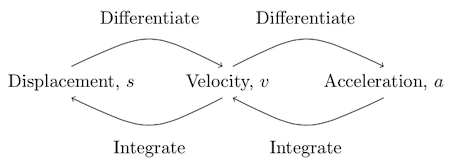
Conversion between displacement, velocity and acceleration
Displacement, $s$
Displacement is the shortest distance between the initial position and the current position of an object.

If the object's initial position is at $O$, then
Displacement at $A = 200$ m
Displacement at $B = -300$ m
Key terms:
- Initial displacement refers to the value of $s$ when $t = 0$
- Object is at starting/reference point, $O$, implies $s = 0$
- Object reaches maximum displacement means $ {ds \over dt} = 0 \text{ and } {d^2 s \over dt^2} < 0 $
- Object reaches minimum displacement means $ {ds \over dt} = 0 \text{ and } {d^2 s \over dt^2} > 0 $
Velocity, $v$
Velocity, $v = {ds \over dt}$, is the rate of change of displacement.
If $v > 0$, the object is moving in the positive direction. If $v < 0$, the object is moving in the opposite direction.
Key terms:
- Initial velocity refers to the value of $v$ when $t = 0$
- Object is momentarily at rest means $v = 0$ (note: object may change direction)
- Object reaches maximum velocity means $ {dv \over dt} = 0 \text{ and } {d^2 v \over dt^2} < 0 $
- Object reaches minimum velocity means $ {dv \over dt} = 0 \text{ and } {d^2 v \over dt^2} > 0 $
Acceleration, $a$
Acceleration, $a = {dv \over dt}$, is the rate of change of velocity.
If $a = 0$, then the object is moving at constant velocity (or at rest). If $a > 0$, the object is accelerating (i.e. velocity is increasing). If $a < 0$, the object is decelerating (i.e. velocity is decreasing).
Key terms:
- Initial acceleration refers to the value of $a$ when $t = 0$
- Object reaches maximum acceleration means $ {da \over dt} = 0 \text{ and } {d^2 a \over dt^2} < 0 $
- Object reaches minimum acceleration means $ {da \over dt} = 0 \text{ and } {d^2 a \over dt^2} > 0 $
Practice questions
Find velocity and displacement using integration
1. An object leaves point $O$ with a velocity of $10$ m/s and moves with a constant deceleration of $2$ m/s2, where $t$ seconds is the time since leaving $O$.
(i) Find the velocity of the object in terms of $t$.
Answer: $ v = 10 - 2t $
(ii) Find the displacement of the object at $t$ seconds, leaving your answer in terms of $t$.
Answer: $ s = 10t - t^2 $
Kinematics with trigonometric functions
2. A particle moves in a straight line so that $t$ seconds after leaving a fixed point $O$, its velocity, $v$ m/s, is given by $v = 5 \sin \left(t \over 2\right) - 1$.
(i) State the maximum velocity and minimum velocity of the particle.
Answer: $ \text{Max.} = 4 \text{ m/s}, \text{Min.} = -6 \text{ m/s} $

(ii) Find the time at which the particle first has a velocity of $1.5$ m/s.
Answer: $ t = {\pi \over 3} \approx 1.05 \text{ s} $
(iii) Find the initial acceleration of the particle.
Answer: $ 2.5 \text{ m/s}^2 $
(iv) Find an expression, in terms of $t$, for the displacement of particle from $O$.
Answer: $ s = -10 \cos {1 \over 2}t - t + 10 $
Find total distance travelled when particle changes direction
3. A particle $P$ leaves a fixed point $O$ and moves in a straight line so that, $t$ s after leaving $O$, its displacement, $s$ m, from $O$ is given by:
$$ s = 3t^2 - 12t $$
(from think! A Maths Workbook Review Ex 16)
(i) Find the time at which the particle is instantaneously at rest.
Answer: $ t = 2 \text{ s} $
(ii) Find the total distance travelled by the particle in the first 5 seconds.
Answer: $ 39 \text{ m} $

4. A particle travels in a straight line so that, $t$ seconds after leaving a fixed point $O$, its velocity, $v$ m/s, is given by $v = t^2 - 6kt +4k$, where $k$ is a constant. The minimum velocity of the particle occurs when $t = 9$.
(from think! A Maths Workbook Review Ex 16)
(i) Show that $k = 3$.
(ii) Determine whether the particle will return to $O$ during its journey.
Answer: $ \text{Yes, will return} $
(iii) Find the distance travelled by the particle during the 6th second.
Answer: $ 56{2 \over 3} \text{ m} $
O Level past year questions on kinematics
Fully worked, step-by-step solutions to these past-year questions (2016 to 2025) are in the O Level A Maths Solutions page. For 2015 and earlier, selected questions and their solutions are available to subscribers, linked individually in the table below.
| Year & paper | Comments |
|---|---|
| 2025 P2 Question 7 | |
| 2024 P2 Question 8 | |
| 2023 P2 Question 7b | Part i (need to use trigonometry concept) Part ii: Distance travelled in third second |
| 2022 P1 Question 12 | (Involves trigonometry) Part b: Find maximum speed of object |
| 2021 P2 Question 8 | |
| 2020 P1 Question 11 | |
| 2019 P1 Question 11 | (Particle changes direction) |
| 2018 P2 Question 7 | |
| 2017 P1 Question 9 | (Confusing question) |
| 2016 P2 Question 10 | |
| 2015 P1 Question 10 | |
| 2014 P2 Question 8 | (Pay attention to part iii) |
| 2013 P2 Question 9 | |
| 2012 P1 Question 9 | |
| 2011 P1 Question 12 | |
| 2010 P2 Question 8 | Link 🔒 Subscribers |
| 2009 P2 Question 8 | |
| 2008 P1 Question 6 | |
| 2007 P2 Question 12 Either | |
| 2005 P1 Question 6 | |
| 2004 P2 Question 12 Either | |
| 2003 P2 Question 6 | |
| 2002 P1 Question 3 | Link 🔒 Subscribers |
| 2002 P2 Question 11 | Link 🔒 Subscribers |