O Level A Maths 2015 Solutions
Please email me if you spot any mistakes or have any questions.
Additional materials:
- Provided formula sheet
- A Maths revision notes and questions — chapter-by-chapter explanations, worked examples and past year trends
- A Maths formulas and identities reference — quick reference for all formulas you'll need
Paper 1 Solutions
Click to display or to hide. ★ marks a notable question.
Question 1 - Differentiation: Increasing function
\begin{align} f(x) & = x^2(1 - x) \\ & = x^2 - x^3 \\ \\ f'(x) & = 2x - 3x^2 \\ \\ f'(x) & > 0 \phantom{00000000} [\text{Increasing function}] \\ 2x - 3x^2 & > 0 \\ 3x^2 - 2x & < 0 \\ x(3x - 2) & < 0 \end{align}

$$ 0 < x < {2 \over 3} $$
Question 2 - Logarithms: Find a, b and c, then sketch graph
(i)
\begin{align} y & = \log_a x \\ \\ \text{Using } & (8, 3), \\ 3 & = \log_a 8 \\ a^3 & = 8 \\ a & = \sqrt[3]{8} \\ a & = 2 \\ \\ y & = \log_2 x \\ \\ \text{Using } & (1, b), \\ b & = \log_2 1 \\ 2^b & = 1 \\ 2^b & = 2^0 \\ b & = 0 \\ \\ \text{Using } & (c, -2), \\ -2 & = \log_2 c \\ 2^{-2} & = c \\ {1 \over 4} & = c \\ \\ \therefore a & = 2, b = 0, c = {1 \over 4} \end{align}
(ii)

Question 3 - Exponential function (real-life problem)★ Notable
\begin{align} N & = N_0 e^{kt} \\ \\ \text{When } & t = 0, \\ N & = N_0 e^{k(0)} \\ N & = N_0 (1) \\ N & = N_0 \phantom{00000000000000000.} [\text{Initial number of bacteria}] \\ \\ \text{When } & t = 3 \text{ and } N = 2 N_0, \phantom{000000} [\text{After 3 hours, number of bacteria doubles}] \\ 2 N_0 & = N_0 e^{k(3)} \\ {2 N_0 \over N_0} & = e^{3k} \\ 2 & = e^{3k} \\ \ln 2 & = \ln e^{3k} \\ \ln 2 & = (3k) \ln e \phantom{0000000000000} [\text{Power law (logarithms)}] \\ \ln 2 & = (3k)(1) \\ \ln 2 & = 3k \\ \\ k & = {\ln 2 \over 3} \\ k & \approx 0.231 \end{align}
Question 4 - Equation and inequalities (Open-ended question)
(i)
\begin{align} \text{Condition 1: } & a < 0 \\ \\ b^2 - 4ac & = 6^2 - 4(a)(c) \\ & = 36 -4ac \\ \\ \text{Condition 2: } b^2 -4ac & < 0 \\ 36 - 4ac & < 0 \\ -4ac & < -36 \\ ac & > {-36 \over -4} \\ ac & > 9 \end{align}
(ii)
\begin{align} \text{Condition 1: } & a < 0 \\ \text{Condition 2: } & ac > 9 \\ \\ \text{Let } & a = -1, \\ (-1)c & > 9 \\ -c & > 9 \\ c & < - 9 \\ \\ \therefore a & = -1, c = -10 \end{align}
Question 5 - Parabola (Old syllabus)★ Notable
(i)

(ii)
\begin{align}
y^2 & = 4x \phantom{00} \text{--- (1)} \\
\\
y & = x - 1 \phantom{00} \text{--- (2)} \\
\\
\text{Substitute } & \text{(2) into (1),} \\
(x - 1)^2 & = 4x \\
\underbrace{x^2 - 2(x)(1) + 1^2}_{(a - b)^2 = a^2 - 2ab + b^2} & = 4x \\
x^2 - 2x + 1 & = 4x \\
x^2 - 6x + 1 & = 0 \\
\\
x & = {-b \pm \sqrt{b^2 - 4ac} \over 2a} \\
& = {-(-6) \pm \sqrt{ (-6)^2 - 4(1)(1)} \over 2(1)} \\
& = {6 \pm \sqrt{32} \over 2} \\
& = {6 \pm \sqrt{16} \sqrt{2} \over 2} \\
& = {6 \pm 4 \sqrt{2} \over 2} \\
& = 3 \pm 2 \sqrt{2}
\end{align}
\begin{align}
\text{Substitute } & x = 3 + 2 \sqrt{2} \text{ into (2),}
&&&
\text{Substitute } & x = 3 - 2 \sqrt{2} \text{ into (2),} \\
y & = 3 + 2 \sqrt{2} - 1 &&& y & = 3 - 2 \sqrt{2} - 1 \\
y & = 2 + 2 \sqrt{2} &&& y & = 2 - 2 \sqrt{2} \\
\\
\therefore & \phantom{.} A(3 + 2 \sqrt{2}, 2 + 2 \sqrt{2}) &&& \therefore & \phantom{.} B(3 - 2 \sqrt{2}, 2 - 2 \sqrt{2})
\end{align}
\begin{align}
\text{Midpoint of } AB & = \left( {x_1 + x_2 \over 2}, {y_1 + y_2 \over 2} \right) \\
& = \left( {3 + 2 \sqrt{2} + 3 - 2 \sqrt{2} \over 2}, {2 + 2 \sqrt{2} + 2 - 2 \sqrt{2} \over 2} \right) \\
& = \left( {6 \over 2}, {4 \over 2} \right) \\
& = (3, 2) \\
\\
\text{Substitute } & x = 3 \text{ into } x + y = 5, \\
3 + y & = 5 \\
y & = 2 \\
\\
\therefore \text{Midpoint of } & AB, (3, 2), \text{ lies on the line } x + y = 5
\end{align}
Question 6 - Trigonometry: Double angle formula, greatest/least values, period and amplitude★ Notable
(i)
\begin{align} f(x) & = 4 \cos^2 x - 2 \sin^2 x \\ & = 2(2 \cos^2 x) - 2 \sin^2 x \\ & = 2(\cos 2x + 1) - 2 \sin^2 x \phantom{000000000} [ \cos 2A = 2 \cos^2 A - 1 \implies 2 \cos^2 A = \cos 2A + 1] \\ & = 2 \cos 2x + 2 - (1 - \cos 2x) \phantom{000000} [ \cos 2A = 1 - 2 \sin^2 A \implies 2 \sin^2 A = 1 - \cos 2A] \\ & = 2 \cos 2x + 2 - 1 + \cos 2x \\ & = 3 \cos 2x + 1 \\ \\ \therefore a & = 3, b = 1 \end{align}
(ii)
\begin{align} y = f(x) & = 4 \cos^2 x - 2 \sin^2 x \\ y = f(x) & = 3 \cos 2x + 1 \\ \\ \text{Center line: } & y = 1 \\ \\ \text{Amplitude} & = 3 \\ \\ \text{Max. value} & = 1 + 3 = 4 \\ \\ \text{Min. value} & = 1 - 3 = -2 \end{align}
(iii)
\begin{align} y = f(x) & = 4 \cos^2 x - 2 \sin^2 x \\ y = f(x) & = 3 \cos 2x + 1 \\ \\ \text{Amplitude} & = 3 \\ \\ \text{Period} & = {360^\circ \over b} \\ & = {360^\circ \over 2} \\ & = 180^\circ \end{align}
Question 7 - Modulus function (Old syllabus)★ Notable
(i)
\begin{align} y & = |2x - 4| \\ \\ \text{Let } &x =0, \\ y & = |2(0) - 4| \\ y & = |-4| \\ y & = 4 \\ \\ \text{Let } & y = 0, \\ 0 & = |2x - 4| \\ 0 & = 2x - 4 \\ 4 & = 2x \\ {4 \over 2} & = x \\ 2 & = x \end{align}

(ii)
\begin{align}
y & = mx + c \\
y & = 3x + c \\
\\
\text{Using } & (0, -1), \\
-1 & = 3(0) + c \\
-1 & = 0 + c \\
-1 & = c \\
\\
\text{Eqn of line: } & y = 3x - 1 \phantom{0} \text{--- (1)} \\
\\
y & = |2x - 4| \phantom{0} \text{--- (2)} \\
\\
\text{Substitute } & \text{(2) into (1),} \\
|2x - 4| & = 3x - 1
\end{align}
\begin{align}
2x - 4 & = 3x - 1 &&& 2x - 4 & = -(3x - 1) \\
2x - 3x & = -1 + 4 &&& 2x - 4 & = -3x + 1 \\
-x & = 3 &&& 2x + 3x & = 1 + 4 \\
x & = -3 &&& 5x & = 5 \\
& &&& x & = 1 \\
\\
\text{Substitute } & \text{into (1),} &&& \text{Substitute } & \text{into (1),} \\
y & = 3(-3) - 1 &&& y & = 3(1) - 1 \\
y & = -10 \text{ (Reject, since } y > 0 ) &&& y & = 2
\end{align}
$$ \therefore \text{Point of intersection is } (1, 2) $$
(iii)
\begin{align} y & = mx + c \\ \\ \text{Using } & (0, -1), \\ -1 & = m(0) + c \\ -1 & = 0 + c \\ -1 & = c \\ \\ y & = mx - 1 \\ \\ \\ \text{Gradient} & = {0 - (-1) \over 2 - 0} \phantom{000000} [\text{Gradient between } (0, -1), (2, 0)] \\ & = {1 \over 2} \end{align}

$$ {1 \over 2} < m < 2 $$
Question 8 - Solve trigonometric equation★ Notable
(i)
\begin{align} 4 \tan \theta + 2 \cot \theta & = 5 \sec \theta \\ 4 \left(\sin \theta \over \cos \theta\right) + 2 \left(\cos \theta \over \sin \theta\right) & = 5 \left(1 \over \cos \theta\right) \\ {4 \sin \theta \over \cos \theta} + {2 \cos \theta \over \sin \theta} & = {5 \over \cos \theta} \\ {4 \sin \theta \over \cos \theta} - {5 \over \cos \theta} & = - {2 \cos \theta \over \sin \theta} \\ {4 \sin \theta - 5 \over \cos \theta} & = -{2 \cos \theta \over \sin \theta} \\ \sin \theta (4 \sin \theta - 5) & = \cos \theta (-2 \cos \theta) \\ 4 \sin^2 \theta - 5 \sin \theta & = - 2 \cos^2 \theta \\ 4 \sin^2 \theta - 5 \sin \theta & = - 2 (1 - \sin^2 \theta) \phantom{000000} [ \sin^2 A + \cos^2 A = 1 \implies \cos^2 A = 1 - \sin^2 A] \\ 4 \sin^2 \theta - 5 \sin \theta & = - 2 + 2 \sin^2 \theta \\ 2 \sin^2 \theta - 5 \sin \theta + 2 & = 0 \phantom{0} \text{ (Shown)} \end{align}
(ii)
\begin{align} 4 \tan 2x + 2 \cot 2x & = 5 \sec 2x \\ \\ \text{Using result } & \text{from (i),} \\ 2 \sin^2 2x - 5 \sin 2x + 2 & = 0 \\ (\sin 2x - 2)(2 \sin 2x - 1) & = 0 \\ \\ \sin 2x - 2 = 0 \phantom{0} \text{ or } & \phantom{0} 2 \sin 2x - 1 =0 \\ \\ \\ \sin 2x - 2 & =0 \\ \sin 2x & = 2 \text{ (No solutions since } -1 \le \sin 2x \le 1 ) \\ \\ \\ 2 \sin 2x - 1 & =0 \\ 2 \sin 2x & = 1 \\ \sin 2x & = {1 \over 2} \phantom{000000} [\text{1st or 2nd quadrant since } \sin 2x > 0] \\ \\ \text{Basic angle, } \alpha & = \sin^{-1} \left(1 \over 2\right) \\ & = 30^\circ \end{align}
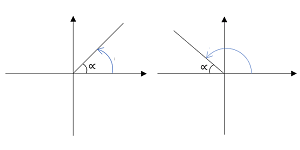
\begin{align} \text{Since } & 0^\circ < x < 360^\circ, \phantom{0} 0^\circ < 2x < 720^\circ \\ \\ 2x & = 30^\circ, 180^\circ - 30^\circ \\ & = 30^\circ, 150^\circ, 30^\circ + 360^\circ, 150^\circ + 360^\circ \\ & = 30^\circ, 150^\circ, 390^\circ, 510^\circ \\ \\ x & = 15^\circ, 75^\circ, 195^\circ, 255^\circ \end{align}
(i)
\begin{align} \angle DAX & = \angle ACD \phantom{0} (\text{Alternate segment theorem}) \\ & = \angle BAC \phantom{0} (\text{Alternate angles, } BA \phantom{.} // \phantom{.} CD) \\ & = \angle BCA \phantom{0} (\text{Base angles of isosceles triangle } BAC) \end{align}
(ii)
\begin{align} \text{Let } \angle DAX & = \angle BCA = \theta \\ \\ \angle ABC & = 180^\circ - \theta - \theta \phantom{0} (\text{Angle sum of triangle}) \\ & = 180^\circ - 2\theta \\ \\ \angle ADC & = 180^\circ - \angle ABC \phantom{0} (\text{Angles in opposite segments}) \\ & = 180^\circ - (180^\circ - 2 \theta) \\ & = 180^\circ - 180^\circ + 2 \theta \\ & = 2 \theta \\ \\ \angle ADX & = 180^\circ - 2 \theta \phantom{0} (\text{Adjacent angles on a straight line}) \\ \\ \angle DXA & = 180^\circ - (180^\circ - 2\theta) - \theta \phantom{0} (\text{Angle sum of triangle}) \\ & = 180^\circ - 180^\circ + 2 \theta - \theta \\ & = \theta \\ \\ \text{Since } & \angle DAX = \angle DXA, \text{ triangle } ADX \text{ is isosceles} \end{align}
(i)
\begin{align} v & = \int a \phantom{.} dt \\ & = \int kt - 2 \phantom{.} dt \\ & = k \left(t^2 \over 2\right) - 2t + c \\ & = {1 \over 2} k t^2 - 2t + c \\ \\ \text{When } & t = 0 \text{ and } v = 30, \phantom{000000} [\text{Initially } (t = 0) \text{ at } X \text{ with speed 30 m/s}] \\ 30 & = {1 \over 2}k(0)^2 - 2(0) + c \\ 30 & = 0 - 0 + c \\ 30 & = c \\ \\ v & = {1 \over 2}kt^2 -2t + 30 \\ \\ \text{When } & t = 20 \text{ and } v = 10, \\ 10 & = {1 \over 2} k(20)^2 - 2(20) + 30 \\ 10 & = {1 \over 2} k(400) - 40 + 30 \\ 10 & = 200k - 10 \\ -200k & = -10 -10 \\ -200k & = -20 \\ k & = {-20 \over -200} \\ k & = 0.1 \phantom{0} \text{ (Shown)} \end{align}
(ii)
\begin{align} v & = {1 \over 2} kt^2 - 2t + 30 \\ & = {1 \over 2} (0.1) t^2 - 2t + 30 \\ & = {1 \over 20} t^2 - 2t + 30 \\ \\ s & = \int v \phantom{.} dt \\ & = \int {1 \over 20} t^2 - 2t + 30 \phantom{.} dt \\ & = {1 \over 20} \left(t^3 \over 3\right) - 2 \left(t^2 \over 2\right) + 30t + c \\ & = {1 \over 60} t^3 - t^2 + 30t + c \\ \\ \text{When } & t = 0 \text{ and } s = 0, \\ 0 & = {1 \over 60}(0)^3 - (0)^2 + 30(0) + c \\ 0 & = 0 - 0 + 0 + c \\ 0 & = c \\ \\ s & = {1 \over 60} t^3 - t^2 + 30t \\ \\ \text{When } & t = 20, \\ s & = {1 \over 60} (20)^3 - (20)^2 + 30(20) \\ & = 333{1 \over 3} \\ \\ \text{Distance} & = 333{1 \over 3} \text{ m} \end{align}
Question 11 - Applications of Differentiation: Maximisation problem (with trigonometry)★ Notable
(i)

\begin{align} \sin \angle QPT & = {QT \over QP} \phantom{000000} \left[{Opp \over Hyp}\right] \\ \sin \theta & = {QT \over 20} \\ 20 \sin \theta & = QT \\ \\ \cos \angle QPT & = {PT \over PQ} \phantom{000000} \left[{Adj \over Hyp}\right] \\ \cos \theta & = {PT \over 20} \\ 20 \cos \theta & = PT \\ \\ \text{Area of trapezium, } A & = {1 \over 2} \times \text{Sum of parallel sides} \times \text{Height} \\ & = {1 \over 2} \times (QR + PS) \times QT \\ & = {1 \over 2} \times (30 + 30 + 20 \cos \theta + 20 \cos \theta) \times 20 \sin \theta \\ & = {1 \over 2} \times (60 + 40 \cos \theta) \times 20 \sin \theta \\ & = (30 + 20 \cos \theta) \times 20 \sin \theta \\ & = 600 \sin \theta + 400 \sin \theta \cos \theta \\ & = 600 \sin \theta + 200 (2 \sin \theta \cos \theta) \\ & = 600 \sin \theta + 200 \sin 2 \theta \phantom{0} \text{ (Shown)} \phantom{0000000} [\sin 2A = 2 \sin A \cos A] \end{align}
(ii)
\begin{align} A & = 600 \sin \theta + 200 \sin 2 \theta \\ \\ {dA \over d\theta} & = 600 \cos \theta + 200 (2 \cos 2 \theta) \phantom{000000} \left[ {d \over dx} [ \sin f(x)] = f'(x) . \cos f(x) \right] \\ & = 600 \cos \theta + 400 \cos 2 \theta \\ \\ \text{Let } & {dA \over d\theta} = 0, \\ 0 & = 600 \cos \theta + 400 \cos 2 \theta \\ 0 & = 600 \cos \theta + 400 (2 \cos^2 \theta - 1) \phantom{000000} [ \cos 2A = 2 \cos^2 A - 1 ] \\ 0 & = 600 \cos \theta + 800 \cos^2 \theta - 400 \\ 0 & = 3 \cos \theta + 4 \cos^2 \theta - 2 \\ 0 & = 4 \cos^2 \theta + 3 \cos \theta - 2 \\ \\ \cos \theta & = {-b \pm \sqrt{b^2 - 4ac} \over 2a} \\ & = {-3 \pm \sqrt{3^2 - 4(4)(-2)} \over 2(4)} \\ & = {-3 \pm \sqrt{41} \over 8} \\ & = 0.42539 \text{ or } -1.1754 \\ \\ \\ \cos \theta & = 0.42539 \phantom{000000} [\text{1st or 4th quadrant}] \\ \\ \text{Basic angle, } \alpha & = \cos^{-1} (0.42539) \phantom{000000} [\text{Radian mode!}] \\ & = 1.1314 \end{align}
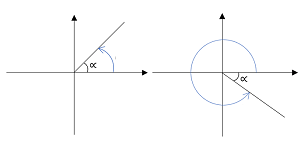
\begin{align} \theta & = 1.1314, 2\pi - 1.1314 \\ & = 1.1314, 5.1518 \text{ (N.A, since } \theta < {\pi \over 2} ) \\ \\ \\ \cos \theta & = -1.1754 \text{ (No solutions since } -1 \le \cos \theta \le 1) \\ \\ \\ {d^2 A \over d \theta^2} & = 600 (- \sin \theta) + 400 (- 2 \sin 2 \theta) \phantom{000000} \left[ {d \over dx} [ \cos f(x)] = f'(x). - \sin f(x) \right ] \\ & = -600 \sin \theta - 800 \sin 2 \theta \\ \\ \text{When } & \theta = 1.1314, \\ {d^2 A \over d \theta^2} & = -600 \sin 1.1314 - 800 \sin [2(1.1314)] \\ & = -1159 < 0 \\ \\ \therefore \text{When } \theta & \approx 1.13, \text{ the trough holds a maximum amount of water} \end{align}
(i)
\begin{align} y & = {36 \over (2x + 1)^2} \\ y & = 36 (2x + 1)^{-2} \\ \\ {dy \over dx} & = 36(-2) (2x + 1)^{-3} . (2) \phantom{000000} [\text{Chain rule}] \\ & = -144 (2x + 1)^{-3} \\ & = - {144 \over (2x + 1)^3} \\ \\ {dy \over dt} & = {dy \over dx} \times {dx \over dt} \\ -0.36 & = -{144 \over (2x + 1)^3} \times 0.02 \\ {-0.36 \over 0.02} & = -{144 \over (2x + 1)^3} \\ -18 & = -{144 \over (2x + 1)^3} \\ 18 & = {144 \over (2x + 1)^3} \\ 18(2x + 1)^3 & = 144 \\ (2x + 1)^3 & = {144 \over 18} \\ (2x + 1)^3 & = 8 \\ 2x + 1 & = \sqrt[3]{8} \\ 2x + 1 & = 2 \\ 2x & = 1 \\ x & = 0.5 \end{align}
(ii)
\begin{align} y & = 36(2x + 1)^{-2} \\ \\ \text{Area of region } A & = \int_1^a 36(2x + 1)^{-2} \phantom{.} dx \\ & = 36 \int_1^a (2x +1)^{-2} \phantom{.} dx \\ & = 36 \left[ {(2x + 1)^{-1} \over (2)(-1)} \right]_1^a \phantom{000000} \left[ \int [f(x)]^n = {f(x)^{n +1} \over f'(x) . (n + 1)} \right] \\ & = 36 \left[ {(2x + 1)^{-1} \over -2} \right]_1^a \\ & = 36 \left[ - {1 \over 2(2x + 1)} \right]_1^a \\ & = 36 \left[ - {1 \over 2(2a + 1)} + {1 \over 2[2(1) + 1]} \right] \\ & = 36 \left[ - {1 \over 4a + 2} + {1 \over 6} \right] \\ & = -{36 \over 4a + 2} + 6 \\ \\ \text{Area of region } B & = \int_a^4 36(2x + 1)^{-2} \phantom{.} dx \phantom{000000} [\text{Same integration as above}] \\ & = 36 \left[ - {1 \over 2(2x + 1)} \right]_a^4 \\ & = 36 \left[ - {1 \over 2[2(4)+1]} + {1 \over 2(2a + 1)} \right] \\ & = 36 \left[ - {1 \over 18} + {1 \over 4a + 2} \right] \\ & = -2 + {36 \over 4a + 2} \\ \\ \text{Area of region } A & = \text{Area of region } B \\ -{36 \over 4a + 2} + 6 & = -2 + {36 \over 4a + 2} \\ -{36 \over 4a + 2} - {36 \over 4a + 2} & = -2 - 6 \\ -{72 \over 4a + 2} & = -8 \\ -72 & = -8(4a + 2) \\ -72 & = -32a - 16 \\ 32a & = -16 + 72 \\ 32a & = 56 \\ a & = {56 \over 32} \\ a & = 1.75 \end{align}
Paper 2 Solutions
Click to display or to hide. ★ marks a notable question.
Question 1 - (i) Applications of Differentiation: Stationary points (ii) Obtain equation of curve by integration★ Part (i): Explanation
(i)
\begin{align} \text{For all real values of } x, & \phantom{.} e^x > 0 \text{ and } e^{-2x} > 0 \\ \\ \implies {dy \over dx} = f'(x) & > 0 \\ \\ \therefore {dy \over dx} \ne 0 \text{ and the curve } & y = f(x) \text{ has no stationary points} \end{align}
(ii)
\begin{align} {dy \over dx} & = 2 e^x + e^{-2x} \\ \\ y & = \int 2 e^x + e^{-2x} \phantom{.} dx \\ & = 2 e^x + {e^{-2x} \over -2} + c \phantom{000000} \left[ \int e^{f(x)} \phantom{.} dx = {e^{f(x)} \over f'(x)} \right] \\ & = 2 e^x - {1 \over 2} e^{-2x} + c \\ \\ \text{Using } & (0, 2), \\ 2 & = 2 e^0 - {1 \over 2} e^{-2(0)} + c \\ 2 & = 2(1) - {1 \over 2}(1) + c \\ 2 & = 2 - {1 \over 2} + c \\ 2 & = {3 \over 2} + c \\ {1 \over 2} & = c \\ \\ \therefore y & = f(x) = 2 e^x - {1 \over 2}e^{-2x} + {1 \over 2} \end{align}
Question 2 - Integration as reverse of differentiation★ Notable
(i)
\begin{align} {d \over dx} [ \ln (\cos x) ] & = { - \sin x \over \cos x } \phantom{000000} \left[ {d \over dx} [\ln f(x)] = {f'(x) \over f(x)} \text{ and } {d \over dx} [ \cos f(x) ] = f'(x). - \sin f(x) \right] \\ & = - \tan x \phantom{0} \text{ (Shown)} \end{align}
(ii)
\begin{align}
u & = x &&& v & = \tan x \\
{du \over dx} & = 1 &&& {dv \over dx} & = \sec^2 x
\end{align}
\begin{align}
{d \over dx} (x \tan x)
& = u{dv \over dx} + v {du \over dx}
\phantom{000000} [\text{Product rule}] \\
& = (x)(\sec^2 x) + (\tan x)(1) \\
& = x \sec^2 x + \tan x
\end{align}
(iii)
\begin{align} \text{From (i), } {d \over dx} [ \ln (\cos x)] & = - \tan x \\ \\ \implies \int - \tan x \phantom{.} dx & = \ln (\cos x) \\ \\ \\ \text{From (ii), } {d \over dx} (x \tan x) & = x \sec^2 x + \tan x \\ \\ \implies \int x \sec^2 x + \tan x \phantom{.} dx & = x \tan x \\ \int x \sec^2 x \phantom{.} dx + \int \tan x \phantom{.} dx & = x \tan x \\ \int x \sec^2 x \phantom{.} dx & = x \tan x - \int \tan x \phantom{.} dx \\ & = x \tan x + \int - \tan x \phantom{.} dx \\ & = x \tan x + \ln (\cos x) + c \\ \\ \\ \int_0^{\pi \over 4} x \sec^2 x \phantom{.} dx & = \left[ x \tan x + \ln (\cos x) \right]_0^{\pi \over 4} \\ & = \left[ {\pi \over 4} \tan {\pi \over 4} + \ln \left(\cos {\pi \over 4}\right) \right] - \left[ (0) \tan 0 + \ln (\cos 0) \right] \\ & = {\pi \over 4} + \ln {1 \over \sqrt{2} } - 0 - \ln 1 \\ & = {\pi \over 4} + \ln 2^{-{1 \over 2}} - 0 - 0 \\ & = {\pi \over 4} - {1 \over 2} \ln 2 \phantom{0} \text{ (Shown)} \phantom{000000} [\text{Power law (logarithms)}] \end{align}
Question 3 - Applications of Differentiation: Tangent and normal to the curve
(i)
\begin{align} \text{Substitute } & x = 1 \text{ into eqn of curve,} \\ y & = -(1)^2 + 4(1) - 6 \\ y & = -3 \\ \\ \therefore & \phantom{.} P(1, -3) \\ \\ {dy \over dx} & = - 2x + 4 \\ \\ \text{When } & x = 1, \\ {dy \over dx} & = -2(1) + 4 \\ & = 2 \\ \\ \text{Gradient of tangent at } P & = 2 \\ \\ y & = mx + c \\ y & = 2x + c \\ \\ \text{Using } & P(1, -3), \\ -3 & = 2(1) + c \\ -3 & = 2 + c \\ -5 & = c \\ \\ \text{Eqn of tangent at } P: & \phantom{0} y = 2x - 5 \\ \\ \text{Let } & x = 0, \\ y & = 2(0) - 5 \\ y & = -5 \\ \\ \therefore & \phantom{.} B(0, -5) \\ \\ \text{Let } & y = 0, \\ 0 & = 2x -5 \\ -2x & = -5 \\ x & = {-5 \over -2} \\ x & = {5 \over 2} \\ \\ \therefore & \phantom{.} A \left({5 \over 2}, 0 \right) \\ \\ \text{Area of triangle } AOB & = {1 \over 2} \times AO \times OB \\ & = {1 \over 2} \times {5 \over 2} \times 5 \\ & = 6{1 \over 4} \text{ units}^2 \end{align}
(ii)
\begin{align} \text{Gradient of normal at } Q & = \text{Gradient of tangent at } P \\ & = 2 \\ \\ \text{Gradient of tangent at } Q & = {-1 \over \text{Gradient of normal at } Q} \phantom{000000} [m_1 \times m_2 = -1] \\ & = {-1 \over 2} \\ & = -{1 \over 2} \\ \\ \text{Let } & {dy \over dx} = -{1 \over 2}, \\ -{1 \over 2} & = -2x + 4 \\ 2x & = 4 + {1 \over 2} \\ 2x & = 4{1 \over 2} \\ x & = 4{1 \over 2} \div 2 \\ x & = 2{1 \over 4} \\ \\ \text{Substitute } & x = 2{1 \over 4} \text{ into eqn of curve,} \\ y & = -\left(2{1 \over 4}\right)^2 + 4 \left(2{1 \over 4}\right) - 6 \\ y & = -2{1 \over 16} \\ \\ \therefore & \phantom{.} Q \left(2{1 \over 4}, -2{1 \over 16}\right) \end{align}
Question 4 - Binomial theorem★ Part (b): General term
(a)(i)
\begin{align} (1 + x)^9 & = 1^9 + {9 \choose 1} (1)^8 (x)^1 + {9 \choose 2} (1)^7 (x)^2 + {9 \choose 3} (1)^6 (x)^3 + ... \\ & = 1 + (9)(1)(x) + (36)(1)(x^2) + (84)(1)(x^3) + ... \\ & = 1 + 9x + 36x^2 + 84x^3 + ... \end{align}
(a)(ii)
\begin{align} (1 + x)^9 & = 1 + 9x + 36x^2 + 84x^3 + ... \\ \\ \text{Replace } & x \text{ by } z - z^2, \\ (1 + z - z^2)^9 & = 1 + 9(z - z^2) + 36(z - z^2)^2 + 84(z - z^2)^3 + ... \\ & = ... + 36(z - z^2)(z - z^2) + 84(z - z^2)(z - z^2)(z - z^2) + ... \\ & = ... + 36(z^2 - z^3 - z^3 + z^4) + 84(z^2 - ...)(z - z^2) + ... \\ & = ... + 36(... - 2z^3 + ...) + 84 (z^3 - ...) + ... \\ & = ... - 72 z^3 + 84 z^3 + ... \\ & = ... + 12 z^3 + ... \\ \\ \text{Coefficient of } z^3 & = 12 \end{align}
(b)(i)
\begin{align} T_{r + 1} & = {n \choose r} a^{n - r} b^r \\ & = {10 \choose r} (2x)^{10 - r} \left(1 \over 3x^3\right)^r \\ & = {10 \choose r} (2)^{10 - r} (x)^{10 - r} \left(1 \over 3\right)^r \left(1 \over x^3\right)^r \\ & = {10 \choose r} (2^{10 - r}) (x^{10 - r}) \left(1 \over 3\right)^r (x^{-3})^r \\ & = {10 \choose r} (2^{10 - r}) (x^{10 - r}) \left(1 \over 3\right)^r (x^{-3r}) \\ & = {10 \choose r} (2^{10 - r}) \left(1 \over 3\right)^r (x^{10 - r + (-3r)}) \phantom{000000} [a^m \times a^n = a^{m + n} ] \\ & = {10 \choose r} (2^{10 - r}) \left(1 \over 3\right)^r (x^{10 - 4r}) \end{align}
(b)(ii)
\begin{align} T_{r + 1} & = {10 \choose r} (2^{10 - r}) \left(1 \over 3\right)^r (x^{10 - 4r}) \\ \\ \text{Power of } x & = 10 - 4r \end{align}
(b)(iii)
\begin{align} \text{Let } 10 - 4r & = 2 \\ -4r & = 2- 10 \\ -4r & = -8 \\ r & = {-8 \over -4} \\ r & = 2 \\ \\ T_{2 + 1} & = {10 \choose 2} (2^{10 - 2}) \left(1 \over 3\right)^2 (x^{10 - 4(2)}) \\ T_3 & = (45) (256)\left(1 \over 9\right) (x^2) \\ & = 1280x^2 \\ \\ \text{Coefficient of } x^2 & = 1280 \end{align}
(i)
\begin{align} {11 \sqrt{3} \over 2 \sqrt{3} + 1} \times {2 \sqrt{3} - 1 \over 2 \sqrt{3} - 1} & = {22(3) - 11 \sqrt{3} \over (2 \sqrt{3} + 1)(2 \sqrt{3} - 1)} \\ & = {66 - 11 \sqrt{3} \over (2 \sqrt{3})^2 - 1^2 } \phantom{000000} [(a + b)(a - b) = a^2 - b^2] \\ & = {66 - 11 \sqrt{3} \over 11} \\ & = {66 \over 11} - {11 \sqrt{3} \over 11} \\ & = 6 - \sqrt{3} \end{align}
(ii)
\begin{align} \text{By Py}& \text{thagoras theorem,} \\ AC^2 & = AB^2 + BC^2 \\ \\ BC^2 & = AC^2 - AB^2 \\ & = (6 - \sqrt{3})^2 - (\sqrt{3} + 1)^2 \phantom{0000000000000000000000000} \left[ AC = {11 \sqrt{3} \over 2 \sqrt{3} + 1} = 6 - \sqrt{3} \right] \\ & = \underbrace{6^2 - 2(6)(\sqrt{3}) + (\sqrt{3})^2}_{(a - b)^2 = a^2 - 2ab + b^2} - \underbrace{[ (\sqrt{3})^2 + 2(\sqrt{3})(1) + 1^2 ]}_{(a + b)^2 = a^2 + 2ab + b^2} \\ & = 36 - 12 \sqrt{3} + 3 - (3 + 2 \sqrt{3} + 1) \\ & = 39 - 12 \sqrt{3} - (4 + 2 \sqrt{3}) \\ & = 39 - 12 \sqrt{3} - 4 - 2 \sqrt{3} \\ & = 35 - 14 \sqrt{3} \end{align}
(iii)
\begin{align} \text{Let length of square base} & = x \text{ cm} \\ \\ \text{Area of square base} & = x \times x = x^2 \text{ cm}^2 \\ \\ \text{By Pyth} & \text{agoras theorem,} \\ BC^2 & = x^2 + x^2 \\ 35 - 14 \sqrt{3} & = 2 x^2 \\ {1 \over 2} (35 - 14 \sqrt{3}) & = x^2 \\ \\ \implies \text{Area of square base} & = {1 \over 2} (35 - 14 \sqrt{3}) \text{ cm}^2 \\ \\ \text{Volume of cuboid} & = \text{Base area} \times \text{Height} \\ & = {1 \over 2} (35 - 14 \sqrt{3}) \times (\sqrt{3} + 1) \\ & = {1 \over 2} (35 - 14 \sqrt{3})(\sqrt{3} + 1) \\ & = {1 \over 2} [35 \sqrt{3} + 35 - 14(3) - 14\sqrt{3}] \\ & = {1 \over 2} (21\sqrt{3} - 7) \\ & = {1 \over 2} (7) (3 \sqrt{3} - 1) \\ & = {7 \over 2} (3 \sqrt{3} - 1) \text{ cm}^3 \end{align}
Question 6 - Applications of Differentiation: Stationary point
(i)
\begin{align}
u & = 2x^2 &&& v & = x - 1 \\
{du \over dx} & = 4x &&& {dv \over dx} & = 1
\end{align}
\begin{align}
{dy \over dx} & = {v {du \over dx} - u {dv \over dx} \over v^2}
\phantom{000000} [\text{Quotient rule}] \\
& = {(x - 1)(4x) - (2x^2)(1) \over (x - 1)^2} \\
& = {4x^2 - 4x - 2x^2 \over (x - 1)^2} \\
& = {2x^2 - 4x \over (x - 1)^2} \\
\\
\text{Let } & {dy \over dx} = 0, \\
0 & = {2x^2 - 4x \over (x - 1)^2} \\
0 & = 2x^2 - 4x \\
0 & = x^2 - 2x \\
0 & = x(x - 2)
\end{align}
\begin{align}
x & = 0 && \text{ or } & x - 2 & = 0 \\
& &&& x & = 2 \\
\\
\text{Substitute } & \text{into eqn of curve,} &&& \text{Substitute } & \text{into eqn of curve,} \\
y & = {2(0)^2 \over 0 - 1} &&& y & = {2(2)^2 \over 2 - 1} \\
y & = 0 &&& y & = 8 \\
\\
\therefore & \phantom{.} (0, 0) &&& \therefore & \phantom{.} (2, 8)
\end{align}
(ii)
\begin{align}
{dy \over dx} & = {2x^2 - 4x \over (x - 1)^2}
\end{align}
\begin{align}
u & = 2x^2 - 4x &&& v & = (x - 1)^2 \\
{du \over dx} & = 4x - 4 &&& {dv \over dx} & = 2(x - 1).(1)
\phantom{000000} [\text{Chain rule}] \\
& &&& & = 2x - 2
\end{align}
\begin{align}
{d^2 y \over dx^2} & = { (x - 1)^2 (4x - 4) - (2x^2 - 4x)(2x - 2) \over [(x - 1)^2]^2 }
\phantom{000000} [\text{Quotient rule}] \\
& = { (x - 1)^2 4 (x - 1) - 2x(x - 2)(2)(x - 1) \over (x - 1)^4} \\
& = { 4 (x - 1)^3 - 4x(x - 2)(x - 1) \over (x - 1)^4} \\
& = { (x - 1) [ 4(x - 1)^2 - 4x(x - 2)] \over (x - 1)^4} \\
& = { 4(x - 1)^2 - 4x(x - 2) \over (x - 1)^3 } \\
& = { 4(x^2 - 2x + 1) - 4x^2 + 8x \over (x - 1)^3 } \\
& = { 4x^2 - 8x + 4 - 4x^2 + 8x \over (x - 1)^3 } \\
& = {4 \over (x - 1)^3}
\end{align}
\begin{align}
\text{When } & x = 0, &&& \text{When } & x = 2, \\
{d^2 y \over dx^2} & = {4 \over (0 - 1)^3} &&& {d^2 y \over dx^2} & = {4 \over (2 - 1)^3} \\
& = -4 < 0 &&& & = 4 > 0 \\
\\
\therefore (0, 0) & \text{ is a max. point} &&& \therefore (2, 8) & \text{ is a min. point}
\end{align}
Question 7 - Circles★ Circle property
(i)

$$ \text{They are both equal to the radius of the circle} $$
(ii)
\begin{align}
\text{Eqn of circle: } (x - a)^2 + (y - b)^2 & = r^2 \\
\\
\text{Since centre is } (r, r), & \\
(x - r)^2 + (y - r)^2 & = r^2 \\
\\
\text{Using } (9, 8), & \\
(9 - r)^2 + (8 - r)^2 & = r^2 \\
9^2 - 2(9)(r) + r^2 + 8^2 - 2(8)(r) + r^2 & = r^2
\phantom{000000} [(a - b)^2 = a^2 - 2ab + b^2] \\
81 - 18r + r^2 + 64 - 16r + r^2 & = r^2 \\
2r^2 - 34r + 145 & = r^2 \\
r^2 - 34r + 145 & = 0 \\
(r - 5)(r - 29) & = 0
\end{align}
\begin{align}
r - 5 & = 0 &&& r - 29 & = 0 \\
r & = 5 &&& r & = 29 \\
\\
\implies \text{Centre: } & (5, 5)
&&&
\implies \text{Centre: } & (29, 29) \text{ (Reject, since centre lies below and to the left of (9, 8))}
\end{align}
\begin{align}
\text{Eqn of circle: } & (x - 5)^2 + (y - 5)^2 = 5^2 \\
& (x - 5)^2 + (y - 5)^2 = 25
\end{align}
(iii)

\begin{align} \text{Let centre (5, 5) be } & A \text{ and (9, 8) be } B \\ \\ \text{Gradient of } AB & = {8 - 5 \over 9 - 5} \\ & = {3 \over 4} \\ \\ \text{Gradient of } T & = {-1 \over \text{Gradient of } AB} \phantom{000000} [m_1 \times m_2 = -1] \\ & = {-1 \over {3 \over 4}} \\ & = - {4 \over 3} \\ \\ y & = mx + c \\ y & = -{4 \over 3}x + c \\ \\ \text{Using } & B(9, 8), \\ 8 & = -{4 \over 3}(9) + c \\ 8 & = - 12 + c \\ 20 & = c \\ \\ \text{Eqn of } T: & \phantom{0} y = -{4 \over 3}x + 20 \end{align}
Question 8 - Polynomials & Partial Fractions
(i)
\begin{align} \text{Let } f(x) & = 2x^3 - 3x^2 - 5 \\ \\ f \left(-{1 \over 2}\right) & = 2 \left(-{1 \over 2}\right)^3 - 3 \left(-{1 \over 2}\right)^2 -5 \\ & = -6 \\ \\ \text{Remainder} & = -6 \end{align}
(ii)
\begin{align}
\text{Let } g(x) & = 2x^3 - 3x^2 + 1 \\
\\
g \left(-{1 \over 2}\right) & = 2 \left(-{1 \over 2}\right)^3 - 3 \left(-{1 \over 2}\right)^2 + 1 \\
& = 0 \\
\\
\therefore 2x + 1 & \text{ is a factor of } g(x)
\end{align}
$$
\require{enclose}
\begin{array}{rll}
x^2 - 2x + 1 \phantom{000000}\\
2x + 1 \enclose{longdiv}{ 2x^3 - 3x^2 + 0x + 1\phantom{0}}\kern-.2ex \\
-\underline{( 2x^3 + x^2){\phantom{000000000}}} \\
-4x^2 + 0x + 1 \phantom{0} \\
-\underline{(-4x^2 - 2x){\phantom{000.}}} \\
2x + 1 \phantom{0} \\
-\underline{(2x + 1){\phantom{.}}} \\
0 \phantom{.}
\end{array}
$$
\begin{align}
2x^3 - 3x^2 + 1 & = (2x + 1)(x^2 - 2x + 1) \\
& = (2x + 1)(x - 1)(x - 1) \\
& = (2x + 1)(x - 1)^2
\end{align}
(iii)
\begin{align} {4 - 5x - 8x^2 \over 2x^3 - 3x^2 + 1} & = {4 - 5x - 8x^2 \over (2x + 1)(x - 1)^2} \\ & = {A \over 2x + 1} + {B \over x - 1} + {C \over (x - 1)^2} \\ & = {A(x - 1)^2 \over (2x + 1)(x - 1)^2} + {B(2x + 1)(x - 1) \over (2x + 1)(x - 1)^2} + {C(2x + 1) \over (2x + 1)(x - 1)^2} \\ & = {A(x - 1)^2 + B(2x + 1)(x - 1) + C(2x + 1) \over (2x + 1)(x - 1)^2} \\ \\ 4 - 5x - 8x^2 & = A(x - 1)^2 + B(2x + 1)(x - 1) + C(2x + 1) \\ \\ \text{Let } & x = 1, \\ 4 - 5(1) - 8(1)^2 & = A(0) + B(3)(0) + C(3) \\ -9 & = 0 + 0 + 3C \\ -9 & = 3C \\ {-9 \over 3} & = C \\ -3 & = C \\ \\ 4 - 5x - 8x^2 & = A(x - 1)^2 + B(2x + 1)(x - 1) - 3 (2x + 1) \\ \\ \text{Let } & x = -0.5, \\ 4 - 5(-0.5) - 8(-0.5)^2 & = A(-1.5)^2 + B(0)(-1.5) - 3(0) \\ 4.5 & = A(2.25) + 0 - 0 \\ 4.5 & = 2.25 A \\ {4.5 \over 2.25} & = A \\ 2 & = A \\ \\ 4 - 5x - 8x^2 & = 2(x - 1)^2 + B(2x + 1)(x - 1) - 3 (2x + 1) \\ \\ \text{Let } & x = 0, \\ 4 - 5(0) - 8(0)^2 & = 2(-1)^2 + B(1)(-1) - 3 (1) \\ 4 & = 2 - B - 3 \\ B & = 2 - 3 - 4 \\ B & = -5 \\ \\ \therefore {4 - 5x - 8x^2 \over 2x^3 - 3x^2 + 1} & = {2 \over 2x + 1} + {-5 \over x - 1} + {-3 \over (x - 1)^2} \\ & = {2 \over 2x + 1} - {5 \over x - 1} - {3 \over (x - 1)^2} \end{align}
Question 9 - Trigonometry: R-formula
(i)
\begin{align} \cos \angle BAD & = {AD \over AB} \phantom{000000} \left[ {Adj \over Hyp} \right] \\ \cos \theta & = {AD \over 80} \\ 80 \cos \theta & = AD \\ \\ \sin \angle BAD & = {BD \over AB} \phantom{000000} \left[ {Opp \over Hyp} \right] \\ \sin \theta & = {BD \over 80} \\ 80 \sin \theta & = BD \\ \\ L & = 80 + 80 + 80 \sin \theta + 2 (80 \cos \theta) \\ & = 160 + 80 \sin \theta + 160 \cos \theta \\ \\ p & = 160, q = 80, r = 160 \end{align}
(ii)
\begin{align} L & = 160 + 80 \sin \theta + 160 \cos \theta \\ \\ a \sin \theta & + b \cos \theta = R \sin (\theta + \alpha) \\ \\ a & = 80, b = 160 \\ \\ R & = \sqrt{a^2 + b^2} \\ & = \sqrt{80^2 + 160^2} \\ & = \sqrt{32 \phantom{.} 000} \\ \\ \alpha & = \tan^{-1} \left(b \over a\right) \\ & = \tan^{-1} \left(160 \over 80\right) \phantom{000000} [\text{Radian mode}] \\ & = 1.1071 \\ \\ \therefore L & = 160 + \sqrt{32 \phantom{.} 000} \sin (\theta + 1.1071) \\ & \approx 160 + \sqrt{32 \phantom{.} 000} \sin (\theta + 1.11) \end{align}
(iii)
\begin{align} L & = 160 + \sqrt{32 \phantom{.} 000} \sin (\theta + 1.1071) \\ \\ \text{Let } & L = 310, \\ 310 & = 160 + \sqrt{32 \phantom{.} 000} \sin (\theta + 1.1071) \\ 150 & = \sqrt{32 \phantom{.} 000} \sin (\theta + 1.1071) \\ {150 \over \sqrt{32 \phantom{.} 000}} & = \sin (\theta + 1.1071) \\ 0.83853 & = \sin (\theta + 1.1071) \phantom{000000} [\text{1st or 2nd quadrant}] \\ \\ \text{Basic angle, } \alpha & = \sin^{-1} (0.83853) \\ & = 0.99457 \end{align}
\begin{align} \theta + 1.1071 & = 0.99457, \pi - 0.99457 \\ & = 0.99457, 2.147 \\ \\ \theta & = -0.11258 \text{ (N.A.)}, 1.0399 \\ \\ \therefore \theta & \approx 1.04 \end{align}
Question 10 - Sum and product of roots of quadratic equation (Old syllabus)★ Notable
(i)
\begin{align} \text{Sum of roots, } \alpha + \beta & = -{b \over a} \\ & = -{-6 \over 2} \\ & = 3 \\ \\ \text{Product of roots, } \alpha \beta & = {c \over a} \\ & = {5 \over 2} \\ \\ \alpha^2 + \beta^2 & = (\alpha + \beta)^2 - 2 \alpha \beta \\ & = (3)^2 - 2\left(5 \over 2\right) \\ & = 4 \end{align}
(ii)
\begin{align} \alpha^3 + \beta^3 & = (\alpha + \beta)(\alpha^2 - \alpha \beta + \beta^2) \\ & = (\alpha + \beta) [ (\alpha^2 + \beta^2) - \alpha \beta ] \\ & = (3) \left( 4 - {5 \over 2} \right) \\ & = {9 \over 2} \phantom{0} \text{ (Shown)} \end{align}
(iii)
\begin{align}
\text{Sum of roots, } \alpha^2 + \beta + \alpha + \beta^2
& = (\alpha^2 + \beta^2) + (\alpha + \beta) \\
& = 4 + 3 \\
& = 7 \\
\\
\text{Product of roots, } (\alpha^2 + \beta)(\alpha + \beta^2)
& = \alpha^3 + \alpha^2 \beta^2 + \alpha \beta + \beta^3 \\
& = (\alpha^3 + \beta^3) + (\alpha \beta)^2 + \alpha \beta \\
& = {9 \over 2} + \left(5 \over 2\right)^2 + {5 \over 2} \\
& = {53 \over 4}
\end{align}
\begin{align}
x^2 - \text{(SOR)}x + \text{(POR)} & = 0 \\
x^2 - 7x + {53 \over 4} & = 0 \\
4x^2 - 28x + 53 & = 0
\end{align}
Question 11 - Linear law★ Parts (ii), (iii)
(i)
\begin{align} V & = \text{Base area} \times \text{Height} \\ V & = (px^2 + q) \times x \\ {V \over x} & = px^2 + q \phantom{000000} [Y = mX + c] \\ \\ Y & = {V \over x}, m = p, X = x^2, c = q \\ \\ & \therefore \text{Plot } {V \over x} \text{ against } x^2 \end{align}
| $$ x^2 $$ | $$ 25 $$ | $$ 100 $$ | $$ 225 $$ | $$ 400 $$ |
|---|---|---|---|---|
| $$ {V \over x} $$ | $$ 35 $$ | $$ 65 $$ | $$ 115 $$ | $$ 185 $$ |

\begin{align} \text{Gradient} & = {185 - 35 \over 400 - 25} \\ p & = 0.4 \\ \\ \text{Vertical intercept} & = 25 \\ q & = 25 \end{align}
On a phone, tap the diagram to see it full size (and tap again to fit).
(ii)
\begin{align}
\text{If cuboid } & \text{is a cube, } V = x^3 \\
\\
x^3 & = (px^2 + q) \times x \\
x^3 & = px^3 + qx \\
\\
\text{Since } & p = 0.4 \text{ and } q = 25, \\
x^3 & = 0.4x^3 + 25x \\
0 & = -0.6x^3 + 25x \\
0 & = x(-0.6x^2 + 25)
\end{align}
\begin{align}
x & = 0 \text{ (Reject)} &&& -0.6x^2 + 25 & = 0 \\
& &&& -0.6x^2 & = -25 \\
& &&& x^2 & = {-25 \over -0.6} \\
& &&& x^2 & = {125 \over 3} \\
& &&& x & = \sqrt{125 \over 3} \\
& &&& x & \approx 6.45
\end{align}
(iii)
\begin{align} \text{Volume of cube, } V & = x^3 \\ {V \over x} & = x^2 \phantom{000000} [Y = X \text{ with } m = 1 \text{ and } c = 0] \\ \\ \text{Draw the line } {V \over x} = x^2 \text{ and find the } & x \text{-coordinate of point of intersection} \end{align}
| $$ x^2 $$ | $$ 0 $$ | $$ 100 $$ | $$ 200 $$ |
|---|---|---|---|
| $$ {V \over x} $$ | $$ 0 $$ | $$ 100 $$ | $$ 200 $$ |
\begin{align} \text{From graph, } x^2 & = 42.5 \\ x & = \sqrt{42.5} \\ x & \approx 6.52 \end{align}