O Level A Maths 2018 Solutions
Please email me if you spot any mistakes or have any questions.
Additional materials:
- Provided formula sheet
- A Maths revision notes and questions — chapter-by-chapter explanations, worked examples and past year trends
- A Maths formulas and identities reference — quick reference for all formulas you'll need
Paper 1 Solutions
Click to display or to hide. ★ marks a notable question.
Question 1 - Exponential functions: Solve equation, then find √125x
\begin{align} \sqrt{125^x} & = {5^{1 - x} \over 25} \\ \sqrt{(5^3)^x} & = {5^{1 - x} \over 5^2} \\ \sqrt{ 5^{3x} } & = 5^{1 - x - 2} \\ (5^{3x})^{1 \over 2} & = 5^{-x - 1} \\ 5^{{3 \over 2}x} & = 5^{-x - 1} \\ {3 \over 2}x & = -x - 1 \\ {5 \over 2}x & = -1 \\ 5x & = -2 \\ x & = -{2 \over 5} \\ \\ \sqrt{125^x} & = \sqrt{125^{-{2 \over 5}}} \\ & = 0.38073 \\ & \approx 0.381 \end{align}
Question 2 - Trigonometry (Addition formulae & special angles)★ Part (i)
(i)
\begin{align} A + B + C & = 180^\circ \phantom{0} (\text{Angle sum of triangle}) \\ \\ A + B & = 180^\circ - C \\ \\ \tan (A + B) & = \tan (180^\circ - C) \\ & = {\tan 180^\circ - \tan C \over 1 + \tan 180^\circ \tan C} \\ & = {0 - \tan C \over 1 + (0)(\tan C)} \\ & = {-\tan C \over 1} \\ & = - \tan C \\ \\ \therefore \tan C & = - \tan (A + B) \end{align}
(ii)
\begin{align} \tan C & = - \tan (A + B) \\ & = - \tan (45^\circ + 60^\circ) \\ & = - {\tan 45^\circ + \tan 60^\circ \over 1 - \tan 45^\circ \tan 60^\circ} \\ & = - {1 + \sqrt{3} \over 1 - (1)(\sqrt{3})} \\ & = - {1 + \sqrt{3} \over 1 - \sqrt{3}} \times {1 + \sqrt{3} \over 1 + \sqrt{3}} \phantom{000000} [\text{Rationalise denominator}] \\ & = - {(1 + \sqrt{3})^2 \over (1)^2 - (\sqrt{3})^2} \phantom{0000000000.} [(a - b)(a + b) = a^2 - b^2] \\ & = - {1^2 + 2(1)(\sqrt{3}) + (\sqrt{3})^2 \over -2} \phantom{00.} [(a + b)^2 = a^2 + 2ab + b^2] \\ & = {1 + 2 \sqrt{3} + 3 \over 2} \\ & = {4 + 2 \sqrt{3} \over 2} \\ & = {4 \over 2} + {2 \sqrt{3} \over 2} \\ & = 2 + \sqrt{3} \end{align}
Question 3 - Partial fractions
\begin{align} {7x^2 - 12x + 17 \over (2x - 1)(x^2 + 4)} & = {A \over 2x - 1} + {Bx + C \over x^2 + 4} \\ & = {A(x^2 + 4) \over (2x - 1)(x^2 + 4)} + {(Bx + C)(2x - 1) \over (2x - 1)(x^2 + 4)} \\ & = {A(x^2 + 4) + (Bx + C)(2x - 1) \over (2x - 1)(x^2 + 4)} \\ \\ 7x^2 - 12x + 17 & = A(x^2 + 4) + (Bx + C)(2x - 1) \\ \\ \text{Let } & x = 0.5, \\ 7(0.5)^2 - 12(0.5) + 17 & = A(0.5^2 + 4) + 0 \\ 12.75 & = A(4.25) \\ {12.75 \over 4.25} & = A \\ 3 & = A \\ \\ 7x^2 - 12x + 17 & = 3(x^2 + 4) + (Bx + C)(2x - 1) \\ \\ \text{Let } & x = 0, \\ 17 & = 3(4) + (C)(-1) \\ 17 & = 12 - C \\ C & = 12 - 17 \\ C & = -5 \\ \\ 7x^2 - 12x + 17 & = 3(x^2 + 4) + (Bx - 5)(2x - 1) \\ \\ \text{Let } & x = 1, \\ 7(1)^2 - 12(1) + 17 & = 3(1^2 + 4) + (B - 5)(2 - 1) \\ 12 & = 15 + (B - 5)(1) \\ 12 & = 15 + B - 5 \\ -B & = 15 - 5 - 12 \\ -B & = -2 \\ B & = 2 \\ \\ \\ \therefore {7x^2 - 12x + 17 \over (2x - 1)(x^2 + 4)} & = {3 \over 2x - 1} + {2x - 5 \over x^2 + 4} \end{align}
(a)
\begin{align}
x^2 + ax + b & = 0 \\
\\
\text{Let } x = 3 + 2 \sqrt{5}, & \\
(3 + 2 \sqrt{5})^2 + a(3 + 2 \sqrt{5}) + b & = 0 \\
\underbrace{ (3)^2 + 2(3)(2\sqrt{5}) + (2\sqrt{5})^2 }_{ (a + b)^2 = a^2 + 2ab + b^2 }
+ 3a + 2a \sqrt{5} + b & = 0 \\
9 + 12 \sqrt{5} + 20 + 3a + 2a \sqrt{5} + b & = 0 \\
3a + b + 2a \sqrt{5} & = -29 - 12 \sqrt{5}
\end{align}
\begin{align}
\text{Comparing } & \text{constants,} &&& \text{Comparing } & \text{terms with } \sqrt{5}, \\
3a + b & = -29 &&& 2a & = -12 \\
b & = -29 - 3a &&& a & = {-12 \over 2} \\
& &&& a & = -6 \\
b & = -29 - 3(-6) \\
b & = -11
\end{align}
$$ \therefore a = -6, b = -11 $$
(b)
\begin{align} \text{Area of rectangle} & = \text{Length} \times \text{Breadth} \\ \\ \text{Breadth} & = {\text{Area} \over \text{Length}} \\ & = {24 + \sqrt{48} \over 6 + \sqrt{12} } \\ & = {24 + \sqrt{16} \sqrt{3} \over 6 + \sqrt{4} \sqrt{3} } \\ & = {24 + 4 \sqrt{3} \over 6 + 2 \sqrt{3}} \\ & = {2(12 + 2 \sqrt{3}) \over 2(3 + \sqrt{3})} \\ & = {12 + 2 \sqrt{3} \over 3 + \sqrt{3}} \times {3 - \sqrt{3} \over 3 - \sqrt{3}} \phantom{000000000.} [\text{Rationalise denominator}] \\ & = {36 - 12 \sqrt{3} + 6 \sqrt{3} - 2(3) \over (3)^2 - (\sqrt{3})^2} \phantom{000000} [(a + b)(a - b) = a^2 - b^2] \\ & = {30 - 6 \sqrt{3} \over 6} \\ & = {30 \over 6} - {6 \sqrt{3} \over 6} \\ & = (5 - \sqrt{3}) \text{ cm} \end{align}
Question 5 - Power functions (old syllabus)★ Notable
(i)

(ii)
\begin{align}
y^2 & = 16x \phantom{00} \text{--- (1)} \\
\\
y & = 6x^{-{1 \over 2}} \phantom{00} \text{--- (2)} \\
\\
\text{Substitute } & \text{(2) into (1),} \\
\left(6x^{-{1 \over 2}}\right)^2 & = 16x \\
\left(6 \over \sqrt{x}\right)^2 & = 16x \\
{36 \over x} & = 16x \\
36 & = 16x^2 \\
{36 \over 16} & = x^2 \\
{9 \over 4} & = x^2 \\
\pm \sqrt{9 \over 4} & = x \\
\pm {3 \over 2} & = x
\end{align}
\begin{align}
x & = {3 \over 2} && \text{ or } & x & = - {3 \over 2} \text{ (Reject, since }
x \text{-coordinate of point of intersection } > 0)
\end{align}
\begin{align}
\text{Substitute } & x = {3 \over 2} \text{ into (2),} \\
y & = 6 \left(3 \over 2\right)^{-{1 \over 2}} \\
y & = 6 \left(2 \over 3\right)^{1 \over 2} \\
y & = 6 \sqrt{2 \over 3} \\
y & = 6 \left(\sqrt{2} \over \sqrt{3}\right) \\
y & = {6 \sqrt{2} \over \sqrt{3}} \times {\sqrt{3} \over \sqrt{3}} \\
y & = {6 \sqrt{6} \over 3} \\
y & = 2 \sqrt{6} \\
\\ \\
\therefore & \phantom{.} \left({3 \over 2}, 2 \sqrt{6}\right)
\end{align}
Question 6 - Logarithms: Change of base, then solve equation
(i)
\begin{align} \text{L.H.S} & = \log_3 x + \log_9 x \\ & = {\lg x \over \lg 3} + {\lg x \over \lg 9} \phantom{0000000} [\text{Change-of-base}] \\ & = {\lg x \over \lg 3} + {\lg x \over \lg 3^2} \\ & = {\lg x \over \lg 3} + {\lg x \over 2 \lg 3} \phantom{000000} [\text{Power law}] \\ & = {2 \lg x \over 2 \lg 3} + {\lg x \over 2 \lg 3} \\ & = {3 \lg x \over 2 \lg 3} \\ & = \text{R.H.S} \end{align}
(ii)
\begin{align} \log_3 x + \log_9 x & = 4 \\ {3 \lg x \over 2 \lg 3} & = 4 \phantom{000000000} [\text{Use result from (i)}] \\ 3 \lg x & = 4(2 \lg 3) \\ 3 \lg x & = 8 \lg 3 \\ \lg x^3 & = \lg 3^8 \phantom{000000} [\text{Power law}] \\ x^3 & = 3^8 \\ x & = \sqrt[3]{3^8} \\ x & = 18.721 \\ x & \approx 18.7 \end{align}
Question 7 - Application of differentiation (connected rate of change)★ Notable
(i) Since water is poured in at a constant rate of 18π cm3/s, the volume of water in the bowl increases by 18π cm3 every second.
\begin{align} V & = {1 \over 3} \pi x^2 (36 - x) \\ \\ \text{Let } & x = 9, \\ V & = {1 \over 3} \pi (9)^2 (36 - 9) \\ V & = 729 \pi \text{ cm}^3 \\ \\ \text{Time taken} & = {729 \pi \over 18\pi} \\ & = 40.5 \text{ s} \end{align}
(ii)
\begin{align} {dx \over dt} & = {dx \over dV} \times {dV \over dt} \\ {dx \over dt} & = {dx \over dV} \times 18 \pi \phantom{000000} [\text{Need } {dx \over dV}] \\ \\ V & = {1 \over 3} \pi x^2 (36 - x) \\ V & = 12 \pi x^2 - {1 \over 3} \pi x^3 \\ \\ {dV \over dx} & = 2(12 \pi x) - 3 \left({1 \over 3} \pi x^2\right) \\ & = 24 \pi x - \pi x^2 \\ \\ {dx \over dV} & = {1 \over 24 \pi x - \pi x^2} \\ \\ {dx \over dt} & = {1 \over 24 \pi x - \pi x^2} \times 18 \pi \\ & = {18 \pi \over 24 \pi x - \pi x^2} \\ \\ \text{When } & x = 9, \\ {dx \over dt} & = {18 \pi \over 24 \pi (9) - \pi (9)^2} \\ & = {2 \over 15} \text{ cm/s} \end{align}
Question 8 - Trigonometry (Double angle formula and graph)★ Part (i)
(i)
\begin{align} 8 \sin^2 x + 2 \cos^2 x & = 4(2 \sin^2 x) + 2 \cos^2 x \\ & = 4(1 - \cos 2x) + 2 \cos^2 x \phantom{000000} [\cos 2A = 1 - 2 \sin^2 A \implies 2 \sin^2 A = 1 - \cos 2A] \\ & = 4(1 - \cos 2x) + \cos 2x + 1 \phantom{0000} [\cos 2A = 2 \cos^2 A - 1 \implies 2 \cos^2 A = \cos 2A + 1] \\ & = 4 - 4 \cos 2x + \cos 2x + 1 \\ & = 5 - 3 \cos 2x \end{align}
(ii)
\begin{align} 8 \sin^2 x + 2 \cos^2 x & = 5 - 3 \cos 2x \\ & = -3 \cos 2x + 5 \\ \\ \text{Amplitude} & = 3 \\ \\ \text{Period} & = {2\pi \over 2} \\ & = \pi \end{align}
(iii)
\begin{align} y & = 8 \sin^2 x + 2 \cos^2 x \\ y & = -3 \cos 2x + 5 \phantom{000000} [\text{Inverted shape}] \\ \\ \text{Center line: } & y = 5 \\ \\ \text{Amplitude} & = 3 \\ \\ \text{Max. value} & = 5 + 3 = 8 \\ \\ \text{Min. value} & = 5 - 3 = 2 \\ \\ \text{Period} & = \pi \end{align}

Question 9 - Coordinate geometry
(i) Note diagonals OB and AC are perpendicular.
\begin{align} \text{Gradient of } AC & = {10 - 0 \over 0 - 5} \\ & = -2 \\ \\ \text{Gradient of } OB & = {-1 \over -2} \phantom{000000} [m_1 \times m_2 = -1] \\ & = {1 \over 2} \\ \\ y & = mx + c \\ y & = {1 \over 2}x + c \\ \\ \text{Using } & O(0, 0), \\ 0 & = {1 \over 2}(0) + c \\ 0 & = c \\ \\ \text{Eqn of } OB: & \phantom{0} y = {1 \over 2}x \end{align}
(ii)
\begin{align}
y & = mx + c \\
y & = -2x + c \\
\\
\text{Using } & A(5, 0), \\
0 & = -2(5) + c \\
0 & = -10 + c \\
10 & = c \\
\\
\text{Eqn of } AC: & \phantom{0} y = -2x + 10 \phantom{00} \text{--- (1)} \\
\\
\text{Eqn of } OB: & \phantom{0} y = {1 \over 2}x \phantom{00} \text{--- (2)} \\
\\
\text{Substitute } & \text{(1) into (2),} \\
-2x + 10 & = {1 \over 2}x \\
-2x - {1 \over 2}x & = -10 \\
-{5 \over 2}x & = -10 \\
-5x & = -20 \\
x & = {-20 \over -5} \\
x & = 4 \\
\\
\text{Substitute } & \text{into (1),} \\
y & = -2(4) + 10 \\
y & = 2 \\
\\
\therefore \text{Midpoint of } & OB: \phantom{0} (4, 2) \\
\\
\text{Let coordinates} & \text{ of } B \text{ be } (d, e) \\
\\
\text{Midpoint of } OB & = \left({0 + d \over 2}, {0 + e \over 2}\right) \\
(4, 2) & = \left({d \over 2}, {e \over 2}\right)
\end{align}
\begin{align}
{d \over 2} & = 4 &&& {e \over 2} & = 2 \\
d & = 8 &&& e & = 4
\end{align}
$$ \therefore B (8, 4) $$
Question 10 - Application of differentiation (Maxima or minima)★ Tedious
(i)
\begin{align} \text{Perimeter of triangle} & = 3x \text{ m} \\ \\ \text{Circumference of circle} & = 2 \pi r \\ \\ 3x + 2 \pi r & = 20 \\ 2 \pi r & = 20 - 3x \\ r & = {20 - 3x \over 2\pi} \end{align}
(ii)
\begin{align} \text{Area of triangle} & = {1 \over 2} ab \sin C \\ & = {1 \over 2} (x)(x) \sin 60^\circ \phantom{000000} [\text{In equilateral triangle, each interior angle} = 60^\circ] \\ & = {1 \over 2} x^2 \left(\sqrt{3} \over 2\right) \\ & = {x^2 \over 2}\left(\sqrt{3} \over 2\right) \\ & = {\sqrt{3} x^2 \over 4} \\ \\ \text{Area of circle} & = \pi r^2 \\ & = \pi \left(20 - 3x \over 2\pi\right)^2 \phantom{000000} [\text{from (i)}] \\ & = \pi \left[ (20 - 3x)^2 \over (2\pi)^2 \right] \\ & = \pi \left[ (20 - 3x)^2 \over 4 \pi^2\right] \\ & = { (20 - 3x)^2 \over 4 \pi } \\ \\ \text{Total area, } A & = {\sqrt{3} x^2 \over 4} + { (20 - 3x)^2 \over 4 \pi } \\ & = {\sqrt{3} \pi x^2 \over 4 \pi} + { (20 - 3x)^2 \over 4 \pi } \\ & = {\sqrt{3} \pi x^2 + (20 - 3x)^2 \over 4\pi} \phantom{00} \text{(Shown)} \end{align}
(iii)
\begin{align} A & = {\sqrt{3} \pi x^2 + (20 - 3x)^2 \over 4\pi} \\ & = {\sqrt{3} \pi x^2 \over 4\pi} + {(20 - 3x)^2 \over 4\pi} \\ & = {\sqrt{3} \over 4} x^2 + {1 \over 4\pi} (20 - 3x)^2 \\ \\ {dA \over dx} & = {\sqrt{3} \over 4}(2x) + \underbrace{{1 \over 4\pi} (2)(20 - 3x)(-3)}_\text{Chain rule} \\ & = {\sqrt{3} \over 2} x - {6 \over 4\pi} (20 - 3x) \\ & = {\sqrt{3} \over 2} x - {30 \over \pi} + {9 \over 2\pi} x \\ \\ \text{Let } & {dA \over dx} = 0, \phantom{0000000000000} [\text{Stationary value}] \\ 0 & = {\sqrt{3} \over 2}x - {30 \over \pi} + {9 \over 2\pi} x \\ 0 & = \sqrt{3}x - {60 \over \pi} + {9 \over \pi} x \\ 0 & = \sqrt{3} \pi x - 60 + 9 x \\ -\sqrt{3} \pi x - 9x & = -60 \\ x (-\sqrt{3} \pi - 9) & = -60 \\ x & = {-60 \over -\sqrt{3} \pi - 9} \\ x & = 4.1547 \\ x & \approx 4.15 \end{align}
(iv)
\begin{align} {dA \over dx} & = {\sqrt{3} \over 2} x - {30 \over \pi} + {9 \over 2\pi} x \\ \\ {d^2 A \over dx^2} & = {\sqrt{3} \over 2} - 0 + {9 \over 2\pi} \\ & = 2.2984 > 0 \\ \\ \implies \text{When } x = 4.1547, & \text{ area of flower bed is at its minimum value} \\ \\ \therefore \text{Gardener may be disa} & \text{ppointed since the least number of flowers can be grown} \end{align}
Question 11 - Differentiation and integration (including increasing/decreasing function)★ Notable
(i)
$$
\require{enclose}
\begin{array}{rll}
5 \phantom{000000}\\
2x - 3 \enclose{longdiv}{ 10x - 9\phantom{00}}\kern-.2ex \\
-\underline{( 10x - 15){\phantom{}}} \\
6 \phantom{0}
\end{array}
$$
\begin{align}
f'(x) & = {10x - 9 \over 2x - 3} \\
& = 5 + {6 \over 2x - 3}
\end{align}
(ii)
\begin{align} f'(x) & = 5 + {6 \over 2x - 3} \\ \\ \text{For } x > {3 \over 2}, & \phantom{0} 2x - 3 > 0 \text{ and } {6 \over 2x - 3} > 0 \\ \\ \therefore f'(x) > 0 & \text{ and } f(x) \text{ is an increasing function} \end{align}
(iii)
\begin{align} f'(x) & = 5 + {6 \over 2x - 3} \\ & = 5 + 6 (2x - 3)^{-1} \\ \\ f''(x) & = 6(-1)(2x - 3)^{-2} (2) \phantom{000000} [\text{Chain rule}] \\ & = -12(2x - 3)^{-2} \\ & = - {12 \over (2x - 3)^2} \\ \\ \text{For } x > {3 \over 2}, & \phantom{0} (2x - 3)^2 > 0 \text{ and } -{12 \over (2x - 3)^2} < 0 \\ \\ \therefore f''(x) < 0 & \text{ and } f'(x) \text{ is a decreasing function} \end{align}
(iv)
\begin{align} f(x) & = \int f'(x) \phantom{.} dx \\ & = \int 5 + {6 \over 2x - 3} \phantom{.} dx \\ & = \int 5 + 6 \left(1 \over 2x - 3\right) \phantom{.} dx \\ & = 5x + 6 \left[ {\ln (2x - 3) \over 2} \right] + c \phantom{000000} \left[ \int {1 \over f(x)} \phantom{.} dx = {\ln [f(x)] \over f'(x)} \right] \\ & = 5x + 3 \ln (2x - 3) + c \\ \\ \text{Since } & f(2) = 8, \\ 8 & = 5(2) + 3 \ln [2(2) - 3] + c \\ 8 & = 10 + 3 \ln 1 + c \\ 8 & = 10 + 0 + c \\ -2 & = c \\ \\ \therefore f(x) & = 5x + 3 \ln (2x - 3) - 2 \end{align}
Question 12 - Modulus function (old syllabus)★ Notable
(i)
\begin{align} x \text{-coordinate of } P & = -2 \\ x \text{-coordinate of } Q & = 0 \\ \\ x \text{-coordinate of } R & = -2 + (2 \times 5) \phantom{000000} [PQ: QR = 1:4 \implies PQ: PR = 1:5] \\ & = 8 \\ \\ \text{Since } a > 0, \text{ line segment } & PQR \text{ is obtained by reflection about the } x \text{-axis} \\ \\ \implies PR = SR \text{ and triangle } & PRS \text{ is isosceles} \\ \\ \therefore x \text{-coordinate of } S & = 8 + 10 \\ & = 18 \end{align}
(ii)
\begin{align} \text{Gradient of } RS & = {15 - 0 \over 18 - 8} \\ & = {3 \over 2} \\ \\ y & = mx + c \\ y & = {3 \over 2}x + c \\ \\ \text{Using } & R(8, 0), \\ 0 & = {3 \over 2}(8) + c \\ 0 & = 12 + c \\ -12 & = c \\ \\ \text{Eqn of } RS: & \phantom{0} y = {3 \over 2}x - 12 \\ \\ \\ \therefore a & = {3 \over 2}, b = 12 \end{align}
Paper 2 Solutions
Click to display or to hide. ★ marks a notable question.
Question 1 - Sum and product of roots of quadratic equation (old syllabus)★ Notable
(i)
\begin{align} x^2 + 3x & + 5 = 0 \\ \\ \text{Sum of roots, } \alpha + \beta & = -{b \over a} \\ & = -{3 \over 1} \\ & = -3 \\ \\ \text{Product of roots, } \alpha \beta & = {c \over a} \\ & = {5 \over 1} \\ & = 5 \\ \\ (\alpha + 1)(\beta + 1) & = \alpha \beta + \alpha + \beta + 1 \\ & = 5 + (-3) + 1 \\ & = 3 \phantom{00} \text{(Shown)} \end{align}
(ii)
\begin{align} \text{Sum of roots, } {2 \over \alpha + 1} + {2 \over \beta + 1} & = {2(\beta + 1) \over (\alpha + 1)(\beta + 1)} + {2(\alpha + 1) \over (\alpha + 1)(\beta + 1)} \\ & = {2(\beta + 1) + 2(\alpha + 1) \over (\alpha + 1)(\beta + 1)} \\ & = {2 \beta + 2 + 2 \alpha + 2 \over 3} \\ & = {2 (\alpha + \beta) + 4 \over 3} \\ & = {2 (-3) + 4 \over 3} \\ & = -{2 \over 3} \\ \\ \text{Product of roots, } \left(2 \over \alpha + 1\right)\left(2 \over \beta + 1\right) & = {4 \over (\alpha + 1)(\beta + 1)} \\ & = {4 \over 3} \\ \\ x^2 - (\text{SOR})x + \text{POR} & = 0 \\ x^2 - \left(-{2 \over 3}\right)x + {4 \over 3} & = 0 \\ x^2 + {2 \over 3}x + {4 \over 3} & = 0 \\ 3x^2 + 2x + 4 & = 0 \end{align}
Question 2 - Binomial theorem: Find a and b from the first three terms
\begin{align} (2 + ax)^6 & = 2^6 + {6 \choose 1}(2)^5 (ax) + {6 \choose 2} (2)^4 (ax)^2 + ... \\ & = 64 + (6)(32)(ax) + (15)(16)(a^2 x^2) + ... \\ & = 64 + 192 ax + 240 a^2 x^2 + ... \\ \\ (1 - 4x)(2 + ax)^6 & = (1 - 4x)(64 + 192 ax + 240 a^2 x^2 + ...) \\ & = 64 + 192 ax + 240 a^2 x^2 - 256x - 768 ax^2 + ... \\ & = 64 + (192a - 256)x + (240a^2 - 768a)x^2 + ... \\ \\ 64 - 160x + bx^2 & = 64 + (192a - 256)x + (240a^2 - 768a)x^2 \\ \\ \text{Comparing } & \text{coefficients of } x, \\ -160 & = 192a - 256 \\ -192a & = -256 + 160 \\ -192a & = -96 \\ a & = {-96 \over -192} \\ a & = {1 \over 2} \\ \\ \text{Comparing } & \text{coefficients of } x^2, \\ b & = 240a^2 - 768a \\ b & = 240 \left(1 \over 2\right)^2 - 768 \left(1 \over 2\right) \\ b & = -324 \\ \\ \\ \therefore a & = {1 \over 2}, b = -324 \end{align}
Question 3 - Plane geometry★ Prove line bisects angle
\begin{align} \angle AQP & = \angle APQ \phantom{0} (\text{Isosceles triangle } APQ \text{ with } AP = AQ) \\ \\ \angle BPQ & = \angle APQ - \angle APB \\ & = \angle APQ - \angle PCB \phantom{0} (\text{Alternate segment theorem}) \\ & = \angle AQP - \angle PCB \\ & = 180^\circ - \angle PQC - \angle PCB \phantom{0} (\text{Adjacent angles on a straight line}) \\ & = \angle CPQ \phantom{0} (\text{Angle sum of triangle}) \\ \\ \text{Since } & \angle BPQ = \angle CPQ, \phantom{.} PQ \text{ bisects } \angle BPC \end{align}
(i)
| $$t$$ | $$20$$ | $$40$$ | $$60$$ | $$80$$ |
|---|---|---|---|---|
| $$\ln m$$ | $$3.59$$ | $$3.10$$ | $$2.60$$ | $$2.09$$ |

On a phone, tap the diagram to see it full size (and tap again to fit).
(ii)
\begin{align} \text{From graph, when } & t = 0, \ln m = 4.1 \\ \\ \ln m & = 4.1 \\ \log_e m & = 4.1 \\ m & = e^{4.1} \phantom{000000} [\text{Exponential form}] \\ m & = 60.340 \\ m & \approx 60.3 \text{ g} \end{align}
(iii)
\begin{align} m & = m_0 e^{-kt} \\ \ln m & = \ln (m_0 e^{-kt}) \\ \ln m & = \ln m_0 + \ln e^{-kt} \phantom{00000000.} [\text{Product law (logarithms)}] \\ \ln m & = \ln m_0 + (-kt) \ln e \phantom{000000} [\text{Power law (logarithms)}] \\ \ln m & = \ln m_0 + (-kt)(1) \\ \ln m & = \ln m_0 - kt \\ \ln m & = -kt + \ln m_0 \phantom{00000000000} [Y = mX + c] \\ \\ \text{Gradient, } m & = {2.35 - 4.1 \over 70 - 0} \\ -k & = -0.025 \\ k & = 0.025 \end{align}
(iv)
\begin{align} \text{Half of original mass} & = 60.340 \times {1 \over 2} \\ & = 30.17 \text{ g} \\ \\ \ln 30.17 & = 3.4069 \\ \\ \text{From graph, when } & \ln m = 3.4069, t = 28 \end{align}
Question 5 - Trigonometry (R-formulae)
(i)
\begin{align} \tan \angle CAB & = {BC \over BA} \phantom{000000} \left[ {Opp \over Adj} \right] \\ \tan \theta^\circ & = {BC \over 800} \\ 800 \tan \theta^\circ & = BC \\ \\ \\ CD & = 1200 - 800 \tan \theta^\circ \end{align}
(ii)
\begin{align} \angle ACB & = 180^\circ - 90^\circ - \theta^\circ \phantom{0} (\text{Angle sum of triangle}) \\ & = 90^\circ - \theta^\circ \\ \\ \angle DCE & = 90^\circ - \theta^\circ \phantom{0} (\text{Vertically opposite angles}) \\ \\ \angle CDE & = 180^\circ - 90^\circ - (90^\circ - \theta^\circ ) \phantom{0} (\text{Angle sum of triangle}) \\ & = 90^\circ - 90^\circ + \theta^\circ \\ & = \theta^\circ \\ \\ \cos \angle CDE & = {DE \over CD} \phantom{000000} \left[ {Adj \over Hyp} \right] \\ \cos \theta^\circ & = {DE \over 1200 - 800 \tan \theta^\circ} \\ \\ DE & = \cos \theta^\circ (1200 - 800 \tan \theta^\circ) \\ & = 1200 \cos \theta^\circ - 800 \tan \theta^\circ \cos \theta^\circ \\ & = 1200 \cos \theta^\circ - 800 \left( \sin \theta^\circ \over \cos \theta^\circ\right) \cos \theta^\circ \\ & = 1200 \cos \theta^\circ - 800 \sin \theta^\circ \end{align}
(iii)
\begin{align} a \cos \theta - b \sin \theta & = R \cos (\theta + \alpha) \\ \\ a = 1200, b & = 800 \\ \\ R & = \sqrt{a^2 + b^2} \\ & = \sqrt{ 1200^2 + 800^2} \\ & = \sqrt{ 2 \phantom{.} 080 \phantom{.} 000 } \\ \\ \alpha & = \tan^{-1} \left(b \over a\right) \\ & = \tan^{-1} \left(800 \over 1200\right) \\ & = 33.69^\circ \\ \\ DE = 1200 \cos \theta^\circ - 800 \sin \theta^\circ & = \sqrt{ 2 \phantom{.} 080 \phantom{.} 000 } \cos (\theta + 33.69^\circ) \\ \\ \sqrt{ 2 \phantom{.} 080 \phantom{.} 000 } \cos (\theta + 33.69^\circ) & = 200 \\ \cos (\theta + 33.69^\circ) & = {200 \over \sqrt{ 2 \phantom{.} 080 \phantom{.} 000 }} \\ \cos (\theta + 33.69^\circ) & = 0.13868 \phantom{000000} [\text{1st or 4th quadrant}] \\ \\ \text{Basic angle, } \alpha & = \cos^{-1} (0.13868) \\ & = 82.029^\circ \end{align}
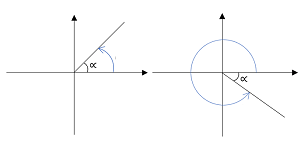
\begin{align} \theta + 33.69^\circ & = 82.029^\circ, 360^\circ - 82.029^\circ \\ & = 82.029^\circ, 277.971^\circ \\ \\ \theta & = 48.339^\circ, 244.281^\circ \text{ (N.A.)} \\ & \approx 48.3^\circ \end{align}
Question 6 - Integration as reverse of differentiation★ Notable
(i)
\begin{align}
u & = x &&& v & = \cos x \\
{du \over dx} & = 1 &&& {dv \over dx} & = - \sin x
\end{align}
\begin{align}
{d \over dx} (uv) & = u {dv \over dx} + v {du \over dx}
\phantom{000000} [\text{Product rule}] \\
{d \over dx} (x \cos x) & = (x)(- \sin x) + (\cos x)(1) \\
& = - x \sin x + \cos x
\end{align}
(ii)
\begin{align} \text{From (i), } {d \over dx} (x \cos x) & = - x \sin x + \cos x \\ \\ \implies \int - x \sin x + \cos x \phantom{.} dx & = x \cos x \\ - \underbrace{\int x \sin x \phantom{.} dx}_\text{Need this} + \int \cos x \phantom{.} dx & = x \cos x \\ - \int x \sin x \phantom{.} dx & = x \cos x - \int \cos x \phantom{.} dx \\ - \int x \sin x \phantom{.} dx & = x \cos x - \sin x \\ \int x \sin x \phantom{.} dx & = - x \cos x + \sin x + c \end{align}
(iii)
\begin{align}
u & = x^2 &&& v & = \sin x \\
{du \over dx} & = 2x &&& {dv \over dx} & = \cos x
\end{align}
\begin{align}
{d \over dx} (x^2 \sin x) & = (x^2)(\cos x) + (\sin x)(2x)
\phantom{000000} [\text{Product rule}] \\
& = x^2 \cos x + 2x \sin x \\
\\ \\
\implies \int x^2 \cos x + 2x \sin x \phantom{.} dx & = x^2 \sin x \\
\underbrace{\int x^2 \cos x \phantom{.} dx}_\text{Need this} + \int 2x \sin x \phantom{.} dx & = x^2 \sin x \\
\int x^2 \cos x \phantom{.} dx & = x^2 \sin x - \int 2x \sin x \phantom{.} dx \\
& = x^2 \sin x - 2 \underbrace{\int x \sin x \phantom{.} dx}_\text{Solved in (ii)} \\
& = x^2 \sin x - 2 (-x \cos x + \sin x) + c \\
& = x^2 \sin x + 2x \cos x - 2 \sin x + c
\end{align}
(i)
\begin{align} d & = 840 (1 - e^{-{t \over 80}}) - 2t \\ d & = 840 - 840 e^{-{1 \over 80}t} - 2t \\ \\ v & = {d \over dt} (840 - 840 e^{-{1 \over 80}t} - 2t) \\ & = 0 - 840 \left(-{1 \over 80}\right)e^{-{1 \over 80}t} - 2 \phantom{000000} \left[ {d \over dx} [e^{f(x)}] = f'(x) . e^{f(x)} \right] \\ & = {21 \over 2} e^{-{1 \over 80}t} - 2 \\ \\ \text{When } & t = 10, \\ v & = {21 \over 2} e^{-{1 \over 80}(10)} - 2 \\ & = 7.2662 \\ & \approx 7.27 \text{ m/s} \\ \\ \\ a & = {d \over dt} \left( {21 \over 2} e^{-{1 \over 80}t} - 2 \right) \\ & = {21 \over 2} \left(-{1 \over 80}\right) e^{-{1 \over 80}t} - 0 \\ & = -{21 \over 160} e^{-{1 \over 80}t} \\ \\ \text{When } & t = 10, \\ a & = -{21 \over 160} e^{-{1 \over 80}(10)} \\ & = -0.11583 \\ & \approx -0.116 \text{ m/s}^2 \end{align}
(ii)
$$ \text{Since } a < 0, \text{ the girl is decelerating (i.e. slowing down)} $$
(iii)
\begin{align} \text{Substitute } v = 1.5 & \text{ into } v = {21 \over 2} e^{-{1 \over 80}t} - 2, \\ 1.5 & = {21 \over 2} e^{-{1 \over 80}t} - 2 \\ - {21 \over 2} e^{-{1 \over 80}t} & = -2 - 1.5 \\ - {21 \over 2} e^{-{1 \over 80}t} & = - 3.5 \\ 21 e^{-{1 \over 80}t} & = 7 \\ e^{-{1 \over 80}t} & = {7 \over 21} \\ e^{-{1 \over 80}t} & = {1 \over 3} \\ \ln e^{-{1 \over 80}t} & = \ln {1 \over 3} \\ -{1 \over 80}t \ln e & = \ln {1 \over 3} \phantom{000000} [\text{Power law (logarithms)}] \\ -{1 \over 80}t (1) & = \ln {1 \over 3} \\ -{1 \over 80}t & = \ln {1 \over 3} \\ t & = -80 \ln {1 \over 3} \\ t & = 87.889 \\ \\ \text{Substitute } t = 87.889 & \text{ into } d = 840 (1 - e^{-{t \over 80}}) - 2t, \\ d & = 840 (1 - e^{-{87.889 \over 80}}) - 2(87.889) \\ & = 384.22 \text{ m} \phantom{000000} [\text{This is distance between A and B}] \\ \\ \text{Distance to push} & = 500 - 384.22 \\ & = 115.78 \\ & \approx 116 \text{ m} \end{align}
(i)
\begin{align} p(-2) & = 2(-2)^3 + 5(-2)^2 - 18 \\ & = -14 \\ \\ \text{Remainder} & = -14 \end{align}
(ii)
\begin{align} p\left(3 \over 2\right) & = 2 \left(3 \over 2\right)^3 + 5\left(3 \over 2\right)^2 - 18 \\ & = 0 \\ \\ \therefore 2x - 3 & \text{ is a factor of } p(x) \end{align}
(iii)
$$
\require{enclose}
\begin{array}{rll}
x^2 + 4x + 6 \phantom{0000000.}\\
2x - 3 \enclose{longdiv}{ 2x^3 + 5x^2 + 0x - 18\phantom{0}}\kern-.2ex \\
-\underline{( 2x^3 - 3x^2){\phantom{000000000}}} \\
8x^2 + 0x - 18 \phantom{0} \\
-\underline{( 8x^2 - 12x){\phantom{000.}}} \\
12x - 18 \phantom{0} \\
-\underline{( 12x - 18){\phantom{.}}} \\
0 \phantom{0}
\end{array}
$$
\begin{align}
2x^3 + 5x^2 - 18 & = (2x - 3)(x^2 + 4x + 6) \\
\\
(2x - 3)(x^2 + 4x + 6) & = 0
\end{align}
\begin{align}
2x - 3 & = 0 && \text{ or } & x^2 & + 4x + 6 = 0 \\
2x & = 3 &&& x & = {-b \pm \sqrt{b^2 - 4ac} \over 2a} \\
x & = {3 \over 2} &&& & = {-4 \pm \sqrt{(4)^2 - 4(1)(6)} \over 2(1)} \\
& &&& & = {-4 \pm \sqrt{-8} \over 2} \phantom{00} (\text{No real solutions})
\end{align}
$$ \therefore x = {3 \over 2} \text{ is the only root of the equation} $$
(iv)
\begin{align} 2x^3 + 5x^2 - 18 & = 0 \\ \\ \text{Replace } x \text{ by } & 2^y, \\ 2(2^y)^3 + 5(2^y)^2 - 18 & = 0 \\ 2(2^{3y}) + 5(2^{2y}) & = 18 \\ 2^{1 + 3y} + 5(2^{2y}) & = 18 \\ \\ \text{From (iii), solution of } & 2x^3 + 5x^2 - 18 = 0 \text{ is } x = {3 \over 2} \\ \\ \therefore 2^y & = {3 \over 2} \\ \lg 2^y & = \lg {3 \over 2} \\ y \lg 2 & = \lg {3 \over 2} \phantom{000000} [\text{Power law (logarithms)}] \\ y & = { \lg {3 \over 2} \over \lg 2} \\ y & \approx 0.585 \end{align}
Question 9 - Equation & inequalities★ Part (ii): Discriminant
(i)
\begin{align} y & = 2x^2 + (k + 2)x + k \\ y & = 2x^2 + (5 + 2)x + 5 \\ y & = 2x^2 + 7x + 5 \phantom{00} \text{--- (1)} \\ \\ y & = 19x - 13 \phantom{00} \text{--- (2)} \\ \\ \text{Substitute } & \text{(1) into (2),} \\ 2x^2 + 7x + 5 & = 19x - 13 \\ 2x^2 - 12x + 18 & = 0 \\ x^2 - 6x + 9 & = 0 \\ (x - 3)(x - 3) & = 0 \\ (x - 3)^2 & = 0 \\ x - 3 & = 0 \\ x & = 3 \\ \\ \text{Substitute } & \text{into (2),} \\ y & = 19(3) - 13 \\ y & = 44 \\ \\ \text{Coordinates: } & (3, 44) \end{align}
(ii) If y cannot be negative, it can be positive or be equal to 0. This means the graph of the curve is either entirely above the x-axis (b2 - 4ac < 0) or meets the x-axis only once (b2 - 4ac = 0)
\begin{align} y & = 2x^2 + (k + 2)x + k \\ \\ a & = 2 > 0 \phantom{000000} [\text{Minimum curve } \cup] \\ \\ b^2 - 4ac & = (k + 2)^2 - 4(2)(k) \\ & = \underbrace{ k^2 + 2(k)(2) + 2^2}_{ (a + b)^2 = a^2 + 2ab + b^2 } - 8k \\ & = k^2 + 4k + 4 - 8k \\ & = k^2 - 4k + 4 \\ & = (k - 2)(k - 2) \\ & = (k - 2)^2 \\ \\ b^2 - 4ac & \le 0 \phantom{000000000.} [1 \text{ or no real roots}] \\ (k - 2)^2 & \le 0 \\ \\ \text{For real values of } & k \text{ except } k = 2, (k - 2)^2 > 0 \\ \\ \text{When } k = 2, \phantom{0} (k &- 2)^2 = 0 \\ \\ \therefore \text{Only value of } k & = 2 \end{align}
Question 10 - Area of region bounded by curve and tangent★ Tedious
(i)
\begin{align} y & = 2 \sqrt{7 - 3x} \\ y & = 2 (7 - 3x)^{1 \over 2} \\ \\ {dy \over dx} & = 2 \left(1 \over 2\right) (7 - 3x)^{-{1 \over 2}} (-3) \phantom{000000} [\text{Chain rule}] \\ & = -3 (7 - 3x)^{-{1 \over 2}} \\ & = - {3 \over \sqrt{7 - 3x}} \\ \\ \text{When } & x = k, \\ {dy \over dx} & = -{3 \over \sqrt{7 - 3k}} \\ \\ \text{Gradient of tangent at } P & = -{3 \over \sqrt{7 - 3k}} \\ \\ \text{Gradient of normal at } P & = -1 \div -{3 \over \sqrt{7 - 3k}} \phantom{000000} [m_1 \times m_2 = -1] \\ & = -1 \times -{\sqrt{7 - 3k} \over 3} \\ & = {\sqrt{7 - 3k} \over 3} \\ \\ \text{Gradient of } NP & = { 2\sqrt{7 - 3k} - 0 \over k - (-5)} \\ & = { 2 \sqrt{7 - 3k} \over k + 5} \\ \\ \therefore { 2 \sqrt{7 - 3k} \over k + 5} & = {\sqrt{7 - 3k} \over 3} \\ 6 \sqrt{7 - 3k} & = (k + 5) \sqrt{7 - 3k} \\ 6 & = k + 5 \\ -k & = 5 - 6 \\ -k & = -1 \\ k & = 1 \phantom{0} \text{(Shown)} \end{align}
(ii)
\begin{align} \text{Gradient of tangent at } P & = -{3 \over \sqrt{7 - 3(1)}} \\ & = -{3 \over 2} \\ \\ P(1, 2 \sqrt{7 - 3(1)}) & = P(1, 4) \\ \\ y & = mx + c \\ y & = -{3 \over 2}x + c \\ \\ \text{Using } & P(1 , 4) \\ 4 & = -{3 \over 2}(1) + c \\ 4 & = -{3 \over 2} + c \\ {11 \over 2} & = c \\ \\ \text{Eqn of } PT: & \phantom{.} y = -{3 \over 2}x + {11 \over 2} \\ \\ \text{Let } & y = 0, \\ 0 & = -{3 \over 2}x + {11 \over 2} \\ {3 \over 2}x & = {11 \over 2} \\ 3x & = 11 \\ x & = {11 \over 3} \phantom{00} \text{(Shown)} \end{align}
(iii)

\begin{align} \text{Area of triangle } RPT & = {1 \over 2} \times RT \times RP \\ & = {1 \over 2} \times \left({11 \over 3} - 1\right) \times 4 \\ & = {16 \over 3} \text{ units}^2 \\ \\ \text{Area of region } A & = \int_1^{7 \over 3} 2 \sqrt{7 - 3x} \phantom{.} dx \phantom{000000} [\text{Area bounded by curve & } x \text{-axis}] \\ & = \int_1^{7 \over 3} 2 (7 - 3x)^{1 \over 2} \phantom{.} dx \\ & = \left[ 2 \left( (7 - 3x)^{3 \over 2} \over \left(3 \over 2\right)(-3)\right) \right]_1^{7 \over 3} \phantom{000000} \left[ \text{If } n \ne -1, \int [f(x)]^n \phantom{.} dx = { [f(x)]^{n + 1} \over (n + 1)[f'(x)] } \right]\\ & = \left[ 2 \left( (7 - 3x)^{3 \over 2} \over -{9 \over 2}\right) \right]_1^{7 \over 3} \\ & = \left[ -{4 \over 9} (7 - 3x)^{3 \over 2} \right]_1^{7 \over 3} \\ & = - {4 \over 9} \left[ 7 - 3 \left(7 \over 3\right)\right]^{3 \over 2} - \left[ - {4 \over 9} [ 7 - 3(1)]^{3 \over 2} \right] \\ & = {32 \over 9} \text{ units}^2 \\ \\ \text{Area of shaded region } PXT & = {16 \over 3} - {32 \over 9} \\ & = {16 \over 9} \text{ units}^2 \end{align}
Question 11 - Circles★ Circle properties
(i)
\begin{align} \text{Gradient of } AB & = {8 - 4 \over 9 - 1} \\ & = {1 \over 2} \\ \\ \text{Gradient of } BC & = {12 - 8 \over 7 - 9} \\ & = -2 \\ \\ {1 \over 2} \times -2 & = -1 \\ \\ \implies AB \text{ is perp} & \text{endicular to } BC \\ \\ \therefore \angle ABC & = 90^\circ \end{align}
(ii)

$$ \angle ABC \text{ is a right-angle in a semi-circle, thus } AC \text{ is the diameter of the circle} $$
(iii)
\begin{align} \text{Midpoint of } AC & = \left( {1 + 7 \over 2}, {4 + 12 \over 2} \right) \\ & = (4, 8) \\ \\ \text{Centre: } & (4, 8) \\ \\ AC & = \sqrt{ (x_2 - x_1)^2 + (y_2 - y_1)^2 } \\ & = \sqrt{ (7 - 1)^2 + (12 - 4)^2 } \\ & = 10 \text{ units} \\ \\ \text{Radius} & = {10 \over 2} = 5 \text{ units} \\ \\ \text{Eqn: } & (x - 4)^2 + (y - 8)^2 = 5^2 \\ & (x - 4)^2 + (y - 8)^2 = 25 \end{align}
(iv)

\begin{align} & B(9, 8) \text{ is the right-most point of the circle} \\ \\ & \text{Thus the tangent to the circle at } B(9, 8) \text{ is a vertical line } (x = 9) \text{ that is parallel to the } y \text{-axis} \end{align}
(v) Tangent to the circle at C is perpendicular to the radius/diameter (circle property)
\begin{align} \text{Gradient of } AC & = {12 - 4 \over 7 - 1} \\ & = {4 \over 3} \\ \\ \text{Gradient of tangent at } C & = {-1 \over {4 \over 3}} \phantom{000000} [m_1 \times m_2 = -1] \\ & = -{3 \over 4} \\ \\ y & = mx + c \\ y & = -{3 \over 4}x + c \\ \\ \text{Using } & C(7, 12), \\ 12 & = -{3 \over 4}(7) + c \\ 12 & = -{21 \over 4} + c \\ {69 \over 4} & = c \\ \\ \text{Eqn of tangent: } & y = -{3 \over 4}x + {69 \over 4} \end{align}