New Discovering Mathematics 4A Chapter 1: Set Language and Notation — Solutions
Please email me if you spot a mistake or have a question.
Choose an exercise, then tap a question to show its worked solution.
Try it yourself 1–19
Try it yourself 1
(a)
\begin{align} C & = \{ \text{s, t, u, d, e, n} \} \end{align}
(b)
\begin{align} n(C) & = 6 \end{align}
(c)(i)
$$ \text{Yes} $$
(c)(ii)
$$ \text{No} $$
Try it yourself 2
(a)
\begin{align} B & = \{ \text{Jan, Feb, Mar, Apr, May, Jun} \} \end{align}
(b)
\begin{align} n(B) & = 6 \end{align}
(c)
\begin{align} \text{June} \in B \end{align}
Try it yourself 3
(a)
\begin{align} R & = \{ 3, 5, 7, 11, 13, 17, 19 \} \end{align}
(b)
\begin{align} S & = \{ 5, 10, 15, 20 \} \\ \\ n(S) & = 4 \end{align}
(c)
\begin{align} \text{Yes, since 5 is a prime number and a multiple of 5} \end{align}
Try it yourself 4
\begin{align} C & = \{ \text{s, t, r, e, d } \} \\ \\ D & = \{ \text{d, e, s, r, t } \} \\ \\ \therefore C & = D \end{align}
Try it yourself 5
(a)
\begin{align}
x^2 - 2x - 3 & = 0 \\
(x + 1)(x - 3) & = 0
\end{align}
\begin{align}
x + 1 & = 0 && \text{ or } & x - 3 & =0 \\
x & = -1 &&& x & = 3
\end{align}
\begin{align}
P & = \{ -1, 3 \}
\end{align}
(b)(i)
\begin{align} Q & \not \subset P \end{align}
(b)(ii)
\begin{align} P & \subset R \end{align}
(c)(i)
\begin{align} S & = \{ -1, 0, 1, 2, 3, 4 \} \end{align}
(c)(ii)
\begin{align} n(S) & = 6 \end{align}
Try it yourself 6
\begin{align} M & = \{ 4, 8, 12, 16, 20, 24, ... \} \\ \\ N & = \{ 12, 24, ... \} \\ \\ \text{Every multiple of 12 is} & \text{ a multiple of 4} \\ \\ \text{Hence every element of } N & \text{ belongs to } M \\ \\ 4 & \in M \text{ but } 4 \notin N \\ \\ \therefore N & \subset M \end{align}
Try it yourself 7
(a)
\begin{align} \xi & = \{ x: x \text{ is a tool} \} \end{align}
(b)
\begin{align} \xi & = \{ x: x \text{ is an odd number} \} \end{align}
Try it yourself 8
(a)
\begin{align} & \text{Since } \emptyset \text{ has no elements, it is a proper subset of } B \\ \\ & \text{Since every element in } B \text{ is in } \xi \text{ and } B \ne \xi, B \subset \xi \\ \\ & \phantom{000000} \therefore \emptyset \subset B \subset \xi \end{align}
(b)
\begin{align} \{ \}, \{ 1 \}, \{ 2 \}, \{ 4 \}, \{ 1, 2 \}, \{ 1, 4 \}, \{ 2, 4 \} \end{align}
Try it yourself 9
(a)(i)
\begin{align} P & = \{ 2, 4, 6, 8, 10, 12, 14, 16, 18, 20 \} \end{align}
(a)(ii)
\begin{align} Q & = \{ 6, 12, 18 \} \end{align}
(b)(i)
\begin{align} \text{True, since there are no elements in } \emptyset \end{align}
(b)(ii)
\begin{align} \text{False, since every element in } Q \text{ is in } P \text{ and } Q \ne P \end{align}
(b)(iii)
\begin{align} \text{True, since } P & = \{ 2, 4, 6, 8, 10, 12, 14, 16, 18, 20 \} \end{align}
(b)(iv)
\begin{align} \text{True, since every element in } \{ 12, 18 \} \text{ is in } Q \text{ and } \{ 12, 18 \} \ne Q \end{align}
Try it yourself 10
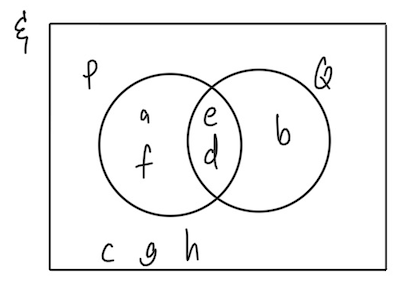
Try it yourself 11
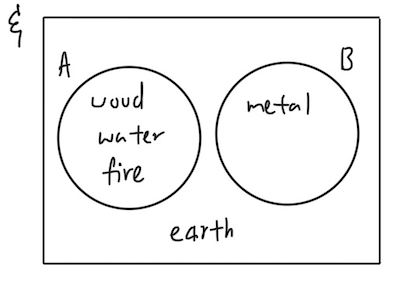
Try it yourself 12
(a)
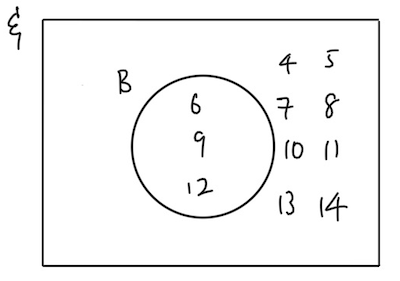
\begin{align} B & = \{ 6, 9, 12 \} \\ \\ B' & = \{ 4, 5, 7, 8, 10, 11, 13, 14 \} \end{align}
(b)
(c)
\begin{align} B' \text{ is the set of integers from 4 to 14 inclusive that are not multiples of 3} \end{align}
Try it yourself 13
(a)
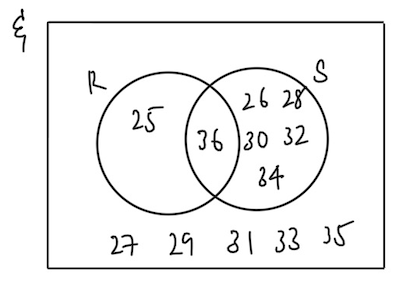
\begin{align} R & = \{ 25, 36 \} \phantom{000000} [5^2 , 6^2] \\ \\ S & = \{ 26, 28, 30, 32, 34, 36 \} \end{align}
(b)
\begin{align} \text{No, since } 25 \notin S \end{align}
(c)(i)
\begin{align} R' & = \{ 26, 27, 28, 29, 30, 31, 32, 33, 34, 35 \} \end{align}
(c)(ii)
\begin{align} S' & = \{ 25, 27, 29, 31, 33, 35 \} \end{align}
Try it yourself 14
(a)
\begin{align} P \cap Q & = \{ \} \end{align}
(b)
\begin{align} P \cap R & = \{ 6, 8 \} \end{align}
(c)
\begin{align} Q \cap R & = \{ 4 \} \end{align}
Try it yourself 15
(a)
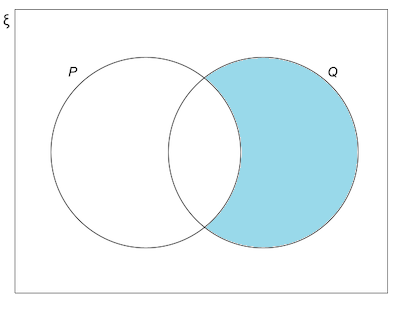
(b)(i)
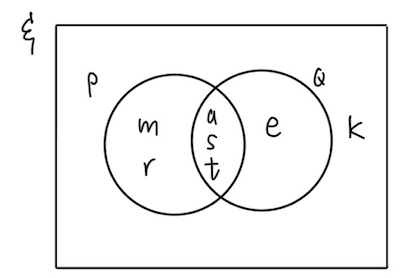
(b)(ii)
\begin{align} P' \cap Q & = \{ e \} \end{align}
(c)
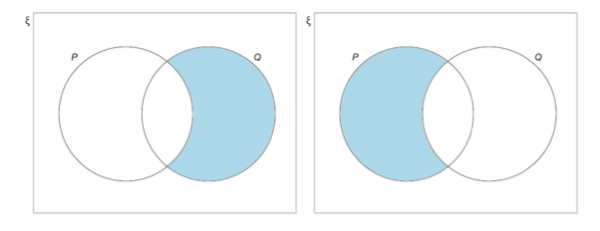
$$ \therefore P' \cap Q \ne P \cap Q' $$
Try it yourself 16
(a)
\begin{align} C \cup D & = \{ \text{b, r, e, a, t, h, d, i, w} \} \end{align}
(b)
\begin{align} \text{Yes, as all elements in } D \text{ are in } C \cup D \text{ and } D \ne (C \cup D) \end{align}
Try it yourself 17
(a)
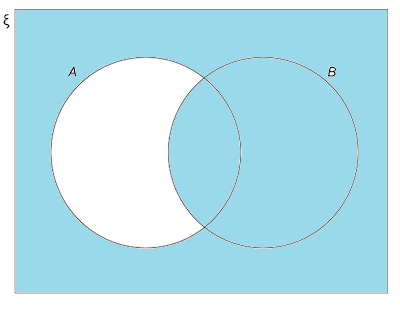
(b)
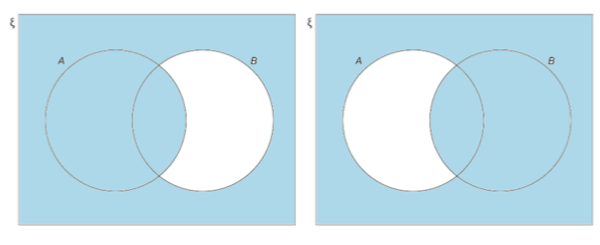
$$ \therefore A \cup B' \ne A' \cup B $$
Try it yourself 18
(a)
\begin{align} ( A \cup B)' \end{align}
(b)
\begin{align} P \cup Q' \end{align}
Try it yourself 19
(a)
\begin{align} \xi & = \{ 1, 2, 3, 4, 5, 6, 7, 8, 9, 10, 11 \} \\ \\ M & = \{ 2, 3, 5, 7, 11 \} \\ \\ N & = \{ 1, 2, 3, 5, 6, 10 \} \end{align}
(b)
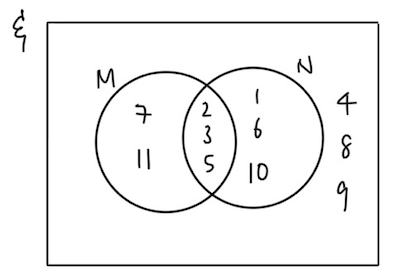
(c)(i)
\begin{align} M' \cap N & = \{ 1, 6, 10 \} \end{align}
(c)(ii)
\begin{align} M \cup N' & = \{ 2, 3, 5, 7, 11, 4, 8, 9 \} \end{align}
Ex 1.1: Set Language
Question 1
(a)
\begin{align} A & = \{ \text{m, a, t, h, e, i, c, s} \} \\ \\ n(A) & = 8 \end{align}
(b)
\begin{align} B & = \{ \text{red, white} \} \\ \\ n(B) & = 2 \end{align}
(c)
\begin{align} C & = \{ \text{o} \} \\ \\ n(C) & = 1 \end{align}
(d)
\begin{align} D & = \{ \text{} \} \\ \\ n(D) & = 0 \end{align}
Question 2
(a)
\begin{align} P & = \{ 5, 0, 1, 3, 4 \} \\ \\ P & \text{ is a finite set} \end{align}
(b)
\begin{align} 2x - 1 & < 5 \\ 2x & < 5 + 1 \\ 2x & < 6 \\ x & < {6 \over 2} \\ x & < 3 \\ \\ Q & = \{ 2, 1, 0, -1, ... \} \\ \\ Q & \text{ is an infinite set} \end{align}
(c)
\begin{align}
(x + 2)(x - 5) & = 0
\end{align}
\begin{align}
x + 2 & = 0 && \text{ or } & x - 5 & = 0 \\
x & = -2 &&& x & = 5
\end{align}
\begin{align}
R & = \{ -2, 5 \} \\
\\
R & \text{ is a finite set}
\end{align}
(d)
\begin{align} S & = \{ 0, 1, 2, 3, ... \} \\ \\ S & \text{ is an infinite set} \end{align}
Question 3
(a)
\begin{align} \{x:x \text{ is a factor of 12} \} \end{align}
(b)
\begin{align} \{x:x \text{ is a multiple of 3} \} \end{align}
(c)
\begin{align} \{x:x \text{ is a prime number} \} \end{align}
(d)
\begin{align} 1^3, 2^3, 3^3, 4^3, ... & = 1, 8, 27, 64, ... \\ \\ \{x:x & \text{ is a perfect cube} \} \end{align}
Question 4
(a)
$$ \text{True} $$
(b)
$$ \text{False (since } \{12, 16\} \text{ is a set)} $$
(c)
$$ \text{False} $$
(d)
$$ \text{False} $$
Question 5
(a)
$$ \text{True} $$
(b)
$$ \text{True} $$
(c)
$$ \text{True} $$
(d)
$$ \text{False (since } \{ \text{a} \} \text{ is a set)} $$
(e)
$$ \text{True} $$
(f)
$$ \text{True} $$
Question 6
(a)
\begin{align} \{ \}, \{ 3 \}, \{ 6 \}, \{ 9 \}, \{ 3, 6 \}, \{3, 9 \}, \{ 6, 9 \} \end{align}
(b)(i)
$$ 1 $$
(b)(ii)
$$ 3 $$
(b)(iii)
$$ 3 $$
Question 7
(a)
\begin{align}
A & = \{ 1, 2, 3 \} \\
\\
(x - 1)(x - 2) & = 0
\end{align}
\begin{align}
x - 1 & = 0 && \text{ or } & x - 2 & = 0 \\
x & = 1 &&& x & = 2
\end{align}
\begin{align}
B & = \{ 1, 2 \} \\
\\
\therefore B & \subset A
\end{align}
(b)
\begin{align} A & = C \end{align}
(c)
\begin{align} B & \subset D \end{align}
(d)
\begin{align} C & \not\subset D \end{align}
Question 8
(a)
\begin{align} \xi & = \{ 2, 4, 6, 8, 10, 12, 14, ... \} \\ \\ A & = \{ 2, 4, 6, 8, 12, 24 \} \end{align}
(b)
\begin{align} B & = \{ 2, 4, 6, 12, 18, 36 \} \\ \\ n(B) & = 6 \end{align}
(c)
\begin{align} A & = \{ 2, 4, 6, 8, 12, 24 \} \\ \\ B & = \{ 2, 4, 6, 12, 18, 36 \} \\ \\ A & \not \subset B \end{align}
(d)
\begin{align} A & = \{ 2, 4, 6, 8, 12, 24 \} \\ \\ B & = \{ 2, 4, 6, 12, 18, 36 \} \\ \\ B & \not \subset A \end{align}
Question 9
(a)
\begin{align} 2x + 1 & < 5 \\ 2x & < 5 - 1 \\ 2x & < 4 \\ x & < {4 \over 2} \\ x & < 2 \\ \\ \xi & = \{ -3, -2, -1, 0, 1, 2, 3 \} \\ \\ A & = \{ -3, -2, -1, 0, 1 \} \end{align}
(b)
$$ \text{No since } A = \{ -3, -2, -1, 0, 1 \} $$
(c)
\begin{align} \xi & = \{ -3, -2, -1, 0, 1, 2, 3 \} \\ \\ B & = \{ -3, 0, 3 \} \\ \\ n(B) & = 3 \end{align}
(d)
\begin{align} A & = \{ -3, -2, -1, 0, 1 \} \\ \\ B & = \{ -3, 0, 3 \} \\ \\ \text{Common elements: } & -3, 0 \end{align}
Question 10
(a)(i)
\begin{align} 3^2 + 4^2 & = 25 \\ \\ 5^2 & = 25 \\ \\ \text{By converse of Pythagoras'} & \text{ theorem, triangle is right-angled and in } A \end{align}
(a)(ii)
\begin{align} 2^2 + 2^2 & = 8 \\ \\ 3^2 & = 9 \\ \\ \text{Triangle is not} & \text{ right-angled and not in } A \end{align}
(b)(i)
\begin{align} & \text{Yes, since all right-angled triangles are triangles and } A \ne U \end{align}
(b)(ii)
\begin{align} & \text{Yes, since all right-angled triangles are 3-sided polygons and } A \ne V \end{align}
Question 11
(a)
\begin{align} & \text{False, since } \{ \text{a, b} \} \text{ is a set} \end{align}
(b)
\begin{align} & \text{False, since } A \text{ and } \xi \text{ are sets} \end{align}
(c)
\begin{align} & \text{False, since } A = A \end{align}
(d)
\begin{align} & \text{True} \end{align}
(e)
\begin{align} & \text{False, since } \{ \emptyset \} \text{ is a set with an element } \emptyset \end{align}
Question 12
(a)(i)
\begin{align} & \text{False, since } A \subset B \text{ and } x \text{ may not be in } A \end{align}
(a)(ii)
\begin{align} & \text{True, since } B \subset C \end{align}
(b)(i)
$$ A \subset C $$
(b)(ii)
$$ n(A) < n(B) < n(C) $$
Question 13
(a)
\begin{align} R & = \{ \text{red, orange, yellow, green, blue, indigo, violet} \} \end{align}
(b)
\begin{align} \text{white } \notin R \end{align}
(c)
\begin{align} P \not \subset R \end{align}
(d)
\begin{align} \xi & = \{x : x \text{ is a colour} \} \end{align}
Question 14
(a)(i)
\begin{align} F & = \{ \text{chicken, fish} \} \end{align}
(a)(ii)
\begin{align} D & = \{ \text{coffee, tea, fruit juice} \} \end{align}
(b)
$$ F \subset E $$
Question 15
(a)
\begin{align} V \subset Z \text{ and } W \subset Z & \implies Z \text{ contains } 1, 3, 4, 5, 6, 8 \\ \\ \text{If } n(Z) = 6, & \text{ then } Z = \{1, 3, 4, 5, 6, 8\} \subset Y \\ \\ & \text{This contradicts } Z \not \subset Y \\ \\ \therefore n(Z) & \ge 7 \\ \\ \text{Taking } Z = Y & = \{1, 3, 4, 5, 6, 7, 8\} \\ & \text{satisfies all four conditions:} \\ & V \subset Z, \quad W \subset Z, \quad X \not \subset Z, \quad Z \not \subset Y \\ & [2 \notin Z \text{ and } Z = Y] \\ \\ \therefore \text{Minimum value of } n(Z) & = 7 \end{align}
(b)
\begin{align} Z & = \{ 1, 3, 4, 5, 6, 7, 8 \} \phantom{000000} [Z = Y \text{ such that } Z \not \subset Y] \end{align}
Question 16
(a)
\begin{align} A & = \{ \text{mushrooms, bacon, pineapple} \} \end{align}
(b)
\begin{align} B & = \{ \text{mushrooms, bacon, pineapple, onions, sausage} \} \end{align}
Question 17
(a)(i)
\begin{align} P & = \{ \text{M1, M2, M3, M4} \} \end{align}
(a)(ii)
\begin{align} Q & = \{ \text{M1, M5} \} \end{align}
(a)(iii)
\begin{align} R & = \{ \text{M5, M6} \} \end{align}
(b)
\begin{align} P & = \{ \text{M1, M2, M3, M4} \} \\ \\ R & = \{ \text{M5, M6} \} \\ \\ \therefore P & \not \subset R \end{align}
(c)
$$ \text{No common elements} $$
Question 18
\begin{align} A & = \{ 1, 2 \} \\ \\ B & = \{ 1, 2, 3 \} \phantom{0000000} [A \subset B] \\ \\ C & = \{ 1, 2, 4 \} \phantom{0000000} [A \subset C, B \not \subset C, C \not \subset B] \end{align}
Ex 1.2: Venn Diagrams and Complement of a Set
Question 1
(a)
(b)
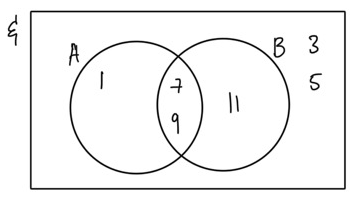
\begin{align} \text{No, since the element } 1 \notin B \end{align}
Question 2
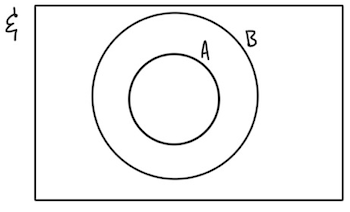
(a)
(b)
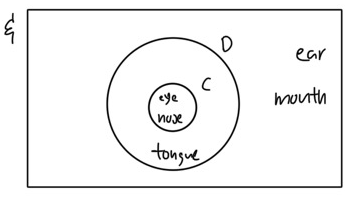
\begin{align} \text{Yes, since every element in } C \text{ is in } D \text{ and } C \ne D \end{align}
Question 3
(a)
(b)
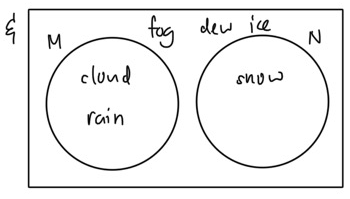
\begin{align} M \text{ and } N \text{ are disjoint sets} \end{align}
Question 4
(a)
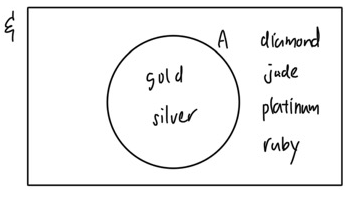
\begin{align} A' & = \{ \text{diamond, jade, platinum, ruby} \} \end{align}
(b)
Question 5
(a)
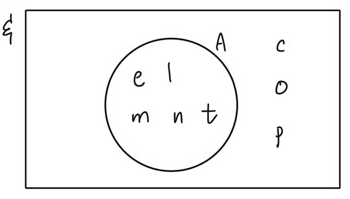
\begin{align} \xi & = \{ \text{c, o, m, p, l, e, n, t} \} \\ \\ A & = \{ \text{e, l, m, n, t} \} \end{align}
(b)
(c)
\begin{align} A' & = \{ \text{c, o, p} \} \end{align}
Question 6
(a)
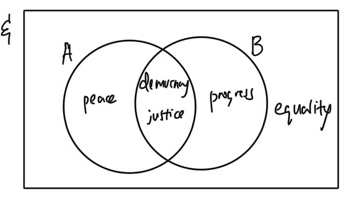
\begin{align} A & = \{ \text{democracy, justice, peace} \} \\ \\ B & = \{ \text{democracy, justice, progress} \} \end{align}
(b)
Question 7
(a)(i)
\begin{align} 11 \in A \end{align}
(a)(ii)
\begin{align} \{ 13, 15 \} \not \subset B \end{align}
(b)
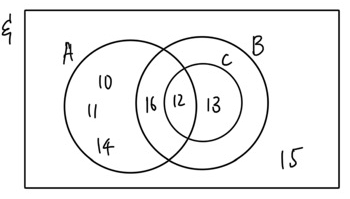
Question 8
(a)
\begin{align} & \text{Yes, since all triangles with three equal sides have at least two equal sides, but} \\ & \text{not all triangles with at least two equal sides have three equal sides} \end{align}
(b)
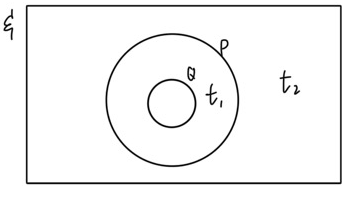
Question 9
(a)
\begin{align}
2x^2 - 7x + 3 & = 0 \\
(2x - 1)(x - 3) & = 0
\end{align}
\begin{align}
2x - 1 & = 0 && \text{ or } & x - 3 & = 0 \\
2x & = 1 &&& x & = 3 \\
x & = {1 \over 2}
\end{align}
\begin{align}
\therefore A & = \{ 3 \} \\
\\ \\
5^{x^2} & = 125^x \\
5^{x^2} & = (5^3)^x \\
5^{x^2} & = 5^{3x}
\phantom{000000} [ (a^m)^n = a^{mn}] \\
\\
x^2 & = 3x \\
x^2 - 3x & = 0 \\
x(x - 3) & = 0
\end{align}
\begin{align}
x & = 0 && \text{ or } & x - 3 & = 0 \\
& &&& x & = 3
\end{align}
$$ \therefore B = \{ 0, 3 \} $$
(b)
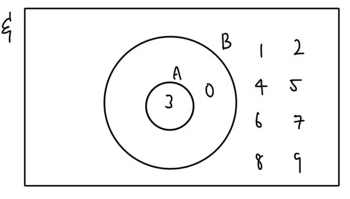
Question 10
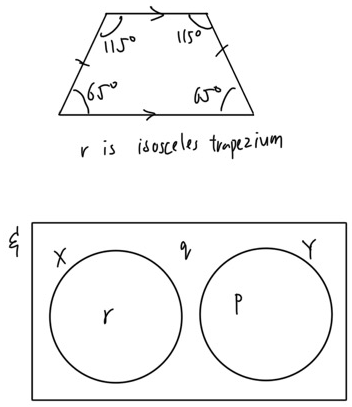
Question 11
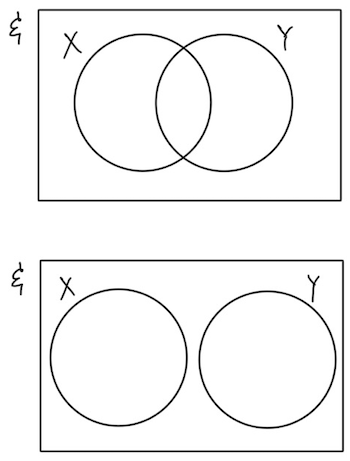
Question 12
(a)(i)
\begin{align} A' & = \{ x : x \text{ is not an odd integer} \} \end{align}
(a)(ii)
\begin{align} A' & = \{ 0, 2, 4, 6, ... \} \end{align}
(b) Note: All multiples of 4 are even numbers (i.e. not odd numbers)
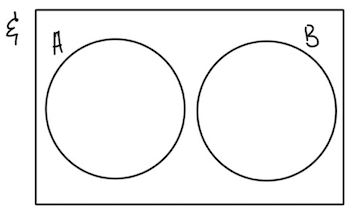
Question 13
(a)
\begin{align} A' & = \{ \text{sodium, potassium, magnesium, iron} \} \end{align}
(b)
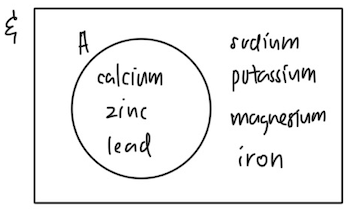
(c)(i)
\begin{align} n(A) + n(A') & = 3 + 4 = 7 \end{align}
(c)(ii)
\begin{align} n(A) + n(A') & = n(\xi) \end{align}
(c)(iii)
\begin{align} \text{Yes. For a finite universal set, every element not in } A \text{ must be in } A' \end{align}
Question 14
(a)(i)
\begin{align} Q \subset R \end{align}
(a)(ii)
\begin{align} \{1 , 2 \} \subset P \phantom{000000} [\text{Note } \{ 1, 2 \} \text{ is a set} ] \end{align}
(a)(iii)
\begin{align} 2 \in R \end{align}
(a)(iv)
\begin{align} 9 \notin P \end{align}
(b)
\begin{align} P: k & = 3 \times 8 = 24 \\ \\ Q: k & = 1 \times 5 = 5 \\ \\ R: k & = 1 \times 10 = 10 \end{align}
(c)
\begin{align} & \text{Find the greatest element common to the two factor sets} \\ \\ & \text{For example, the common factors of 24 and 10 are 1 and 2} \\ & \text{Their HCF is therefore } 2 \end{align}
Question 15
Note: Only 1 prime number (2) is even and some perfect squares (4, 16, 36, ..) are even
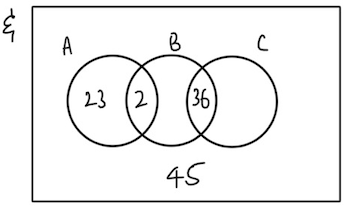
Question 16
(a)
$$ \text{True} $$
(b)
Question 17
(a)
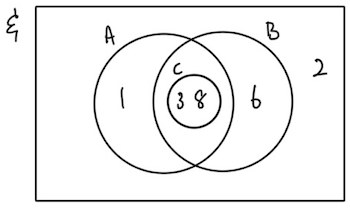
\begin{align} \xi & = \{ 1, 2, 3, 6, 8 \} \end{align}
(b)
\begin{align} C & = \{ 3, 8 \} \end{align}
(c)
Ex 1.3: Intersection and Union of Sets
Question 1
(a)
\begin{align} A \cup B & = \{ 1, 3, 6, 7, 8, 9, 12 \} \end{align}
(b)
\begin{align} A \cup C & = \{ 3, 4, 6, 8, 9, 12 \} \end{align}
(c)
\begin{align} B \cup C & = \{ 1, 3, 4, 6, 7, 8, 9 \} \end{align}
Question 2
(a)
\begin{align} D \cap E & = \{ \text{b, d} \} \end{align}
(b)
\begin{align} D \cap F & = \{ \text{} \} \end{align}
(c)
\begin{align} E \cap F & = \{ \text{g} \} \end{align}
Question 3
(a)
\begin{align} X \cap Y & = \{ \text{line} \} \end{align}
(b)
\begin{align} X \cap Z & = \{ \text{line, ray} \} \end{align}
(c)
\begin{align} Y \cap Z & = \{ \text{line} \} \end{align}
Question 4
(a)
\begin{align} P \cup Q & = \{ \text{hop, jog, run, walk} \} \end{align}
(b)
\begin{align} P \cup R & = \{ \text{hop, jog, run, walk, skip} \} \end{align}
(c)
\begin{align} Q \cup R & = \{ \text{jog, walk, hop, run, skip} \} \end{align}
Question 5
(a)
\begin{align} 2x & < 9 \\ x & < {9 \over 2} \\ x & < 4.5 \\ \\ P & = \{ 1, 2, 3, 4 \} \\ \\ Q & = \{ -3, -2, -1, 0, 1, 2 \} \\ \\ P \cup Q & = \{ -3, -2, -1, 0, 1, 2, 3, 4 \} \end{align}
(b)
\begin{align} P \cap Q & = \{ 1, 2 \} \end{align}
Question 6
(a)
\begin{align} X' & = \{ \text{joy, love, trust} \} \end{align}
(b)
\begin{align} X \cup X' & = \{ \text{care, joy, love, peace, trust} \} \end{align}
(c)
\begin{align} X \cap X' & = \{ \text{} \} \end{align}
(d)
\begin{align} X \cup \xi & = \xi = \{ \text{care, joy, love, peace, trust} \} \end{align}
(e)
\begin{align} X \cap \xi & = X = \{ \text{care, peace} \} \end{align}
Question 7
(a)
\begin{align} -9 & < 2x < 6 \\ -4.5 & < x < 3 \\ \\ \xi & = \{ -4, -3, -2, -1, 0, 1, 2 \} \\ \\ \\ x^2 - 4 & = 0 \\ x^2 & = 4 \\ x & = \pm \sqrt{4} \\ x & = \pm 2 \\ \\ A & = \{ -2, 2 \} \\ \\ \\ 1 - 3x & \le 7 \\ -3x & \le 7 - 1 \\ -3x & \le 6 \\ x & \ge {6 \over -3} \\ x & \ge -2 \\ \\ B & = \{ -2, -1, 0, 1, 2 \} \\ \\ \\ \therefore A & \subset B \end{align}
(b)(i)
\begin{align} A \cup B & = B = \{ -2, -1, 0, 1, 2 \} \end{align}
(b)(ii)
\begin{align} A \cap B & = A = \{ -2, 2 \} \end{align}
Question 8
(a)
(b)(i)
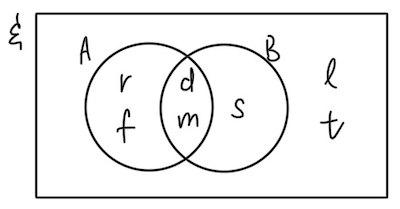
\begin{align} A \cup B & = \{ \text{r, f, d, m, s} \} \end{align}
(b)(ii)
\begin{align} (A \cup B)' & = \{ \text{l, t} \} \end{align}
(b)(iii)
\begin{align} A \cap B & = \{ \text{d, m} \} \end{align}
(b)(iv)
\begin{align} (A \cap B)' & = \{ \text{r, f, s, l, t} \} \end{align}
(b)(v)
\begin{align} A' \cup B' & = \{ \text{r, f, s, l, t} \} \end{align}
(b)(vi)
\begin{align} A' \cap B' & = \{ \text{l, t} \} \end{align}
(c)
\begin{align} (A \cup B)' = A' \cap B' \text{ and } (A \cap B)' = A' \cup B' \end{align}
Question 9
(a)
\begin{align} Q & = \{ 8^2 , 9^2 , 10^2 \} \\ & = \{ 64, 81, 100 \} \\ \\ \text{Statement is false} & \text{ since the element 81 is not a multiple of 4} \end{align}
(b)
\begin{align} Q & = \{ 64, 81, 100 \} \\ \\ R & = \{ 4^3 \} = \{ 64 \} \\ \\ Q \cap R & = \{ 64 \} \text{ and statement is false} \end{align}
(c)
\begin{align} R & = \{ 64 \} \\ \\ \text{Since 64 is a } & \text{multiple of 4, } R \subset P \\ \\ \therefore P \cup R & = P \text{ is true} \end{align}
(d)
\begin{align} \text{False since } 60 \notin \xi \end{align}
Question 10
(a)
(b)(i)
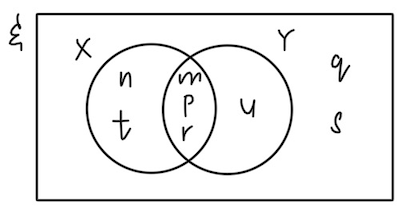
\begin{align} X \cup Y & = \{ \text{n, t, m, p, r, u} \} \end{align}
(b)(ii)
\begin{align} X' \cup Y' & = \{ \text{n, t, u, q, s} \} \end{align}
(b)(iii)
\begin{align} X' \cap Y' & = \{ \text{q, s} \} \end{align}
(b)(iv)
\begin{align} X' \cap Y & = \{ \text{u} \} \end{align}
Question 11
(a)
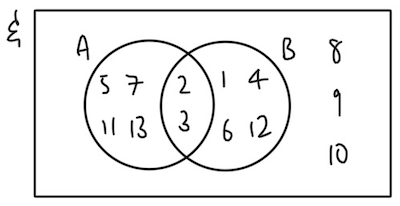
(b)(i)
\begin{align} A \cup B' & = \{ 2, 3, 5, 7, 11, 13, 8, 9, 10 \} \end{align}
(b)(ii)
\begin{align} A' \cap B & = \{ 1, 4, 6, 12 \} \end{align}
Question 12
(a)(i)
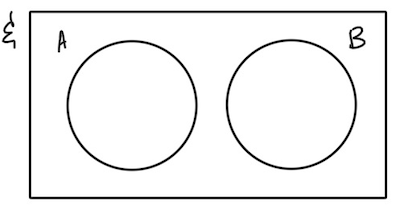
(a)(ii)
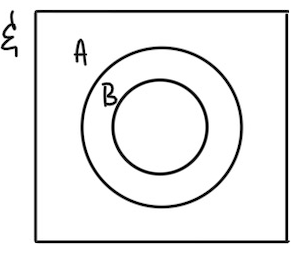
(a)(iii)
(b)
\begin{align} A \cap B = \emptyset \text{ and } B \subset A' \text{ are equivalent} \end{align}
Question 13
(a)
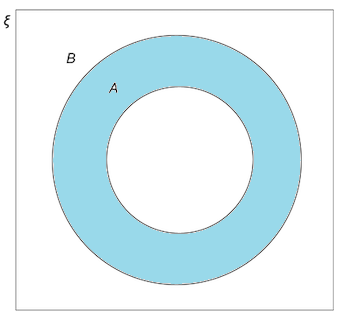
(b)
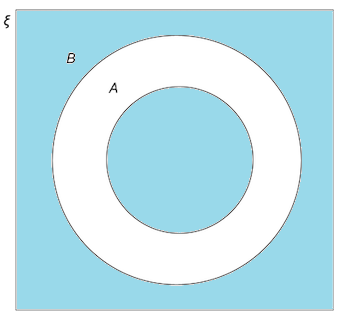
(c)
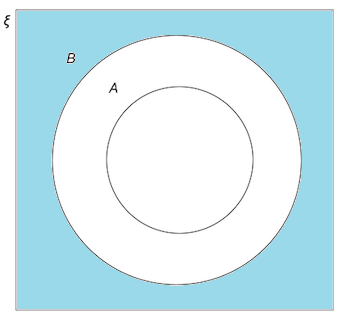
(d)
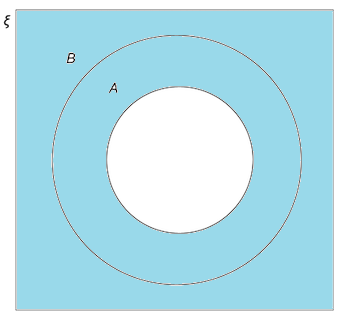
Question 14
(a)(i)
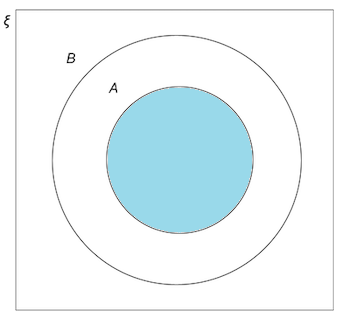
(a)(ii)
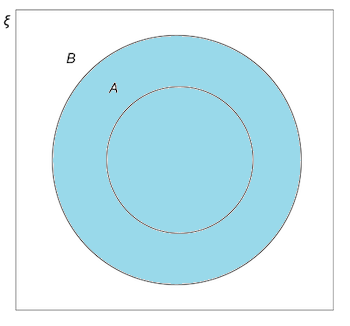
(b)
\begin{align} \text{For (a)(i), } A \cap B & = A \\ \\ \text{For (a)(ii), } A \cup B & = B \end{align}
Question 15
(a)(i)
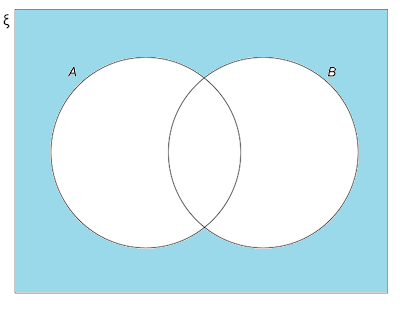
(a)(ii)
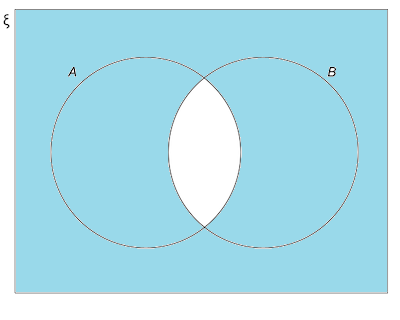
(a)(iii)
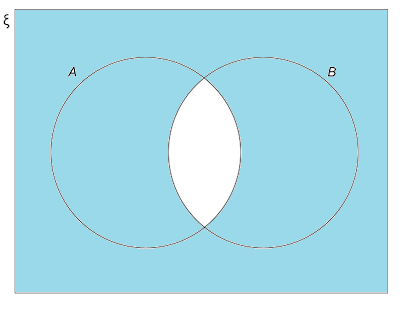
(a)(iv)
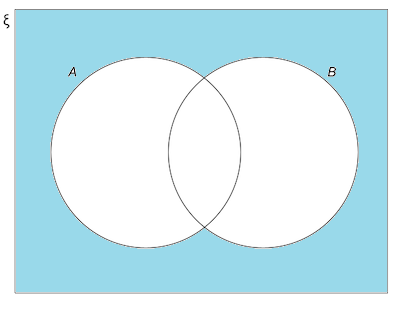
(b)
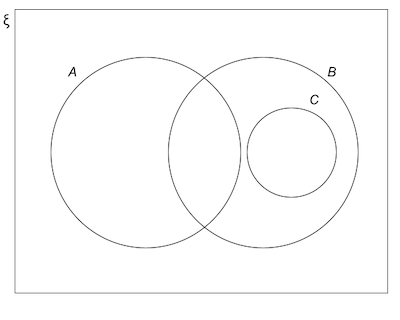
Question 16
(a)
\begin{align} \xi & = \{ 1, 2, 3, 4, 5, 6, 7, 8, ... \} \\ \\ A & = \{ 4, 8, 12, 16, 20, ... \} \\ \\ B & = \{ 6, 12, 18, 24, 30, ... \} \end{align}
(b)(i)
\begin{align} A \cup B & = \{ 4, 6, 8, 12, 16, 18, ... \} \end{align}
(b)(ii)
\begin{align} A \cap B & = \{ 12, 24, 36, 48, 60, ... \} \phantom{000000} [\text{Lowest common multiple of 4 and 6 is 12}] \end{align}
(c)
\begin{align} A \cap B & = \{ x : x \text{ is a multiple of 12} \} \end{align}
Question 17
(a)
$$ X' $$
(b)
\begin{align} \underbrace{ (P \cup Q)' }_\text{'Outside part'} \cup (P \cap Q) \end{align}
Question 18
(a)
\begin{align} \xi & = \{ x : x \text{ is a day of the week} \} \end{align}
(b)
\begin{align} A \cup B & = \{ \text{Monday, Tuesday, Wednesday, Friday, Saturday, Sunday} \} \\ \\ \text{It re} & \text{presents the days of the week that have at least one helper} \end{align}
(c)
\begin{align} A \cap B & = \{ \text{Saturday, Sunday} \} \\ \\ \text{It re} & \text{presents the days of the week that have two helpers} \end{align}
(d)
\begin{align} (A \cup B)' & = \{ \text{Thursday} \} \\ \\ \text{Assume the stall needs at least} & \text{ one helper to operate, } \text{stall does not operate on Thursday} \end{align}
Question 19
(a)
\begin{align} X \cap Y & = \{ \text{Ben} \} \\ \\ \text{Ben is the only brand } & \text{preferred by both Mr and Mrs Singh} \end{align}
(b)
\begin{align} X' \cap Y' & = \{ \text{Mit, Nis} \} \\ \\ \text{The two brands preferred by } & \text{neither Mr Singh nor Mrs Singh} \end{align}
(c)
\begin{align} \text{Assuming other family member(s) have no say, the couple will buy Ben} \end{align}
Question 20
(a)
\begin{align} G \cap S' \text{ represents the students in uniformed group but not in sports team} \end{align}
(b)(i)
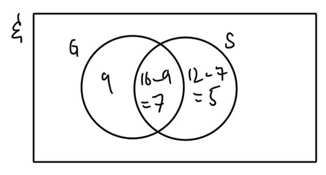
\begin{align} \text{No. of students} & = 7 \end{align}
(b)(ii)
\begin{align} \text{No. of students} & = 38 - 9 - 7 - 5 \\ & = 17 \end{align}
Question 21
(a)
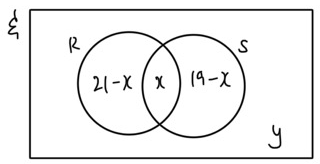
\begin{align} \text{Let } & y = 0, \\ 21 - x + x + 19 - x & = 36 \\ -x + x - x & = 36 - 21 - 19 \\ -x & = -4 \\ x & = 4 \end{align}
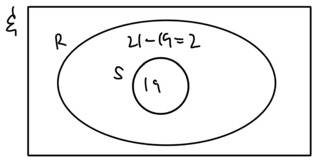
\begin{align} n(R \cap S) & = n(S) = 19 \\ \\ \\ \therefore \text{Max.} & = 19, \text{Min.} = 4 \end{align}
(b)
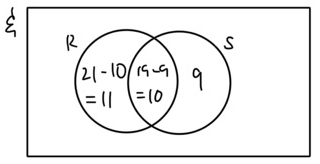
\begin{align} n ( R \cap S) & = 10 \end{align}
Question 22
\begin{align} A & = \{ 3, 6, 1, 2 \} \\ \\ B & = \{ 3, 6, 4, 5 \} \end{align}
Question 23
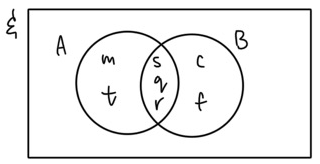
\begin{align} \xi & = \{ \text{s, m, a, r, t, c, f} \} \end{align}
Question 24
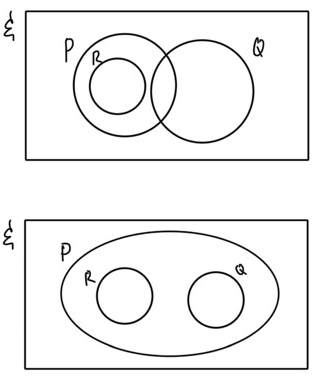
Review Exercise 1
Question 1
(a)
\begin{align} \text{pen} \notin A \end{align}
(b)
\begin{align} \text{Yes, } \{ \text{marker} \} \text{ is a proper subset of } A \end{align}
(c)
\begin{align} \xi & = \{ x : x \text{ is an item of stationery} \} \end{align}
(d)
\begin{align} B & = \{ \text{ruler, pencil, marker} \} \end{align}
Question 2
(a)(i)
\begin{align} A & = \{ \text{l, a, t, e, r} \} \end{align}
(a)(ii)
\begin{align} B & = \{ \text{l, a, t, e, r} \} \end{align}
(a)(iii)
\begin{align} C & = \{ \text{l, t, e, r} \} \end{align}
(b)(i)
\begin{align} n(A) & = 5 \end{align}
(b)(ii)
\begin{align} n(B) & = 5 \end{align}
(b)(iii)
\begin{align} n(C) & = 4 \end{align}
(c)(i)
\begin{align} A & = B \end{align}
(c)(ii)
\begin{align} C & \subset B \end{align}
Question 3
(a)(i)
\begin{align} \xi & = \{ \text{m, a, e, t, k, p, g, d, n, y} \} \end{align}
(a)(ii)
\begin{align} A & = \{ \text{m, a, e, t} \} \end{align}
(a)(iii)
\begin{align} B' & = \{ \text{m, a, d, n, y} \} \end{align}
(a)(iv)
\begin{align} A \cap B & = \{ \text{e, t} \} \end{align}
(b)
\begin{align} \{ \text{m, a} \} \notin A \phantom{00000} [ \{ \text{m, a} \} \text{ is a set} ] \end{align}
(c)
\begin{align} A & = C \end{align}
(d)
\begin{align} D & = \{ \text{k, p, g} \} \end{align}
Question 4
(a)(i)
\begin{align} P & = \{ 1, 2, 3, 4, 6, 12 \} \end{align}
(a)(ii)
\begin{align} P \cup Q & = \{ 1, 2, 3, 4, 5, 6, 12 \} \end{align}
(b) Note: Since x is an integer, R includes zero and negative integers. The answer key is incorrect.
\begin{align} 2x & < 12 \\ x & < {12 \over 2} \\ x & < 6 \\ \\ R & = \{ 5, 4, 3, 2, 1, 0, -1, ... \} \\ \\ \therefore R \not \subset Q & \text{ since } 0 \in R \text{ but } 0 \notin Q \end{align}
Question 5
(a)
\begin{align} \xi & = \{ x : x \text{ is a quadrilateral} \} \end{align}
(b)
\begin{align} A \cap B & = \{ \text{square} \} \end{align}
(c)
\begin{align} B & \subset C \end{align}
(d)
\begin{align} \text{trapezium} & \notin C \text{ (since trapezium has only 1 pair of parallel sides)} \end{align}
Question 6
(a)
\begin{align} \text{No right-angled triangle has 3 equal sides} \end{align}
(b) Note: A scalene triangle has all sides of different lengths
\begin{align} & \text{Since } P \in \xi, \text{ triangle } P \text{ has a right-angle} \\ \\ & \text{Since } P \in X' \text{ and } Y = \emptyset, \text{ triangle } P \text{ is isosceles} \\ \\ & \text{Acute angle in } P = {180^\circ - 90^\circ \over 2} = 45^\circ \end{align}
Question 7
(a)(i)
\begin{align} A & = \{ 1, 3, 5, 7, 9, 11, 13, 15, 17, 19 \} \\ \\ A' & = \{ 2, 4, 6, 8, 10, 12, 14, 16, 18, 20 \} \end{align}
(a)(ii)
\begin{align} B & = \{ 1^2, 2^2, 3^2, 4^2 \} \\ B & = \{ 1, 4, 9, 16 \} \\ \\ A \cap B' & = \{ 3, 5, 7, 11, 13, 15, 17, 19 \} \end{align}
(a)(iii)
\begin{align} A \cup B & = \{ 1, 3, 4, 5, 7, 9, 11, 13, 15, 16, 17, 19 \} \\ \\ (A \cup B)' & = \{ 2, 6, 8, 10, 12, 14, 18, 20 \} \end{align}
(b)
\begin{align} A \cap B \text{ is the set of odd integers that are perfect squares} \end{align}
Question 8
(a)
\begin{align} A & = \{ 2, 3, 5, 7, 11, 13 \} \end{align}
(b)
\begin{align} B & = \{ 3, 6, 9, 12 \} \\ \\ B' & = \{ 2, 4, 5, 7, 8, 10, 11, 13, 14 \} \end{align}
(c)
\begin{align} A \cap B' & = \{ 2, 5, 7, 11, 13 \} \end{align}
(d)
\begin{align} A \cup B' & = \{ 2, 3, 4, 5, 7, 8, 10, 11, 13, 14 \} \\ \\ (A \cup B')' & = \{ 6, 9, 12 \} \end{align}
Question 9
(a)
\begin{align} 3x - 1 & < 2 \\ 3x & < 2 + 1 \\ 3x & < 3 \\ x & < 1 \\ \\ P & = \{ -4, -3, -2, -1, 0 \} \\ \\ P' & = \{ 1, 2 \} \end{align}
(b)
\begin{align}
2x^2 + 7x + 3 & = 0 \\
(2x + 1)(x + 3) & = 0
\end{align}
\begin{align}
2x + 1 & = 0 && \text{ or } & x + 3 & = 0 \\
2x & = -1 &&& x & = -3 \\
x & = -{1 \over 2}
\end{align}
\begin{align}
Q & = \{ -3 \} \\
\\
P \cap Q & = \{ -3 \}
\end{align}
(c)
\begin{align} Q' & = \{ -4, -2, -1, 0, 1, 2 \} \\ \\ P \cup Q' & = \{ -4, -3, -2, -1, 0, 1, 2 \} \end{align}
Question 10
(a)(i)
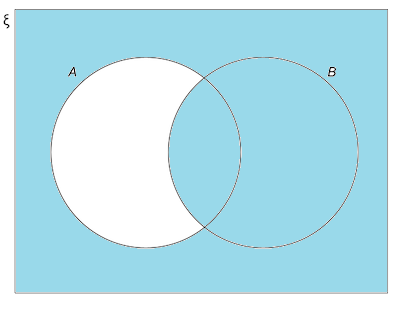
(a)(ii)
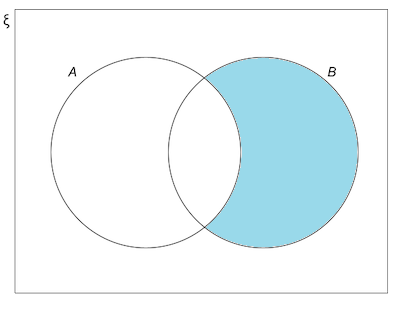
(b)(i)
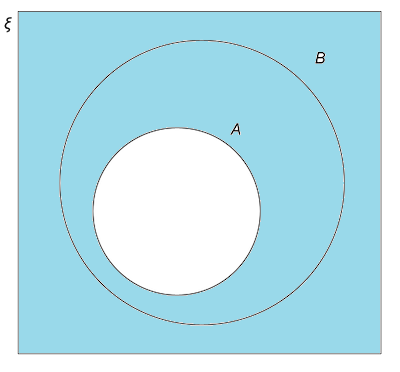
(b)(ii)
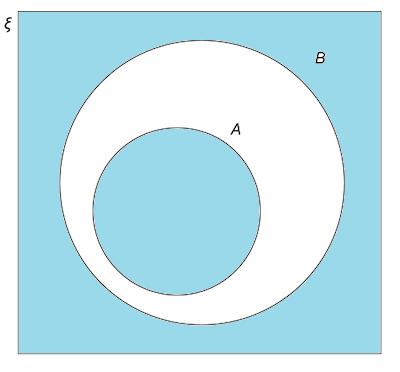
Question 11
(a)
\begin{align} ( A \cup B)' \end{align}
(b)
\begin{align} A' \cap B \end{align}
Question 12
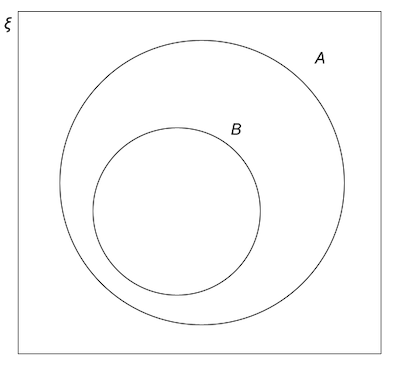
(a)
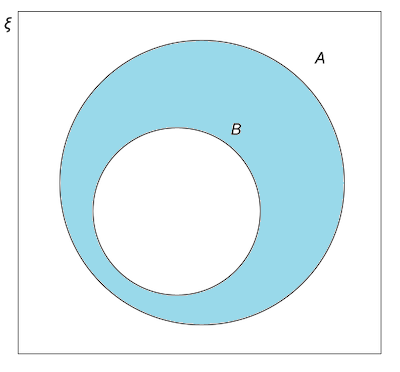
(b)(i)
(b)(ii)
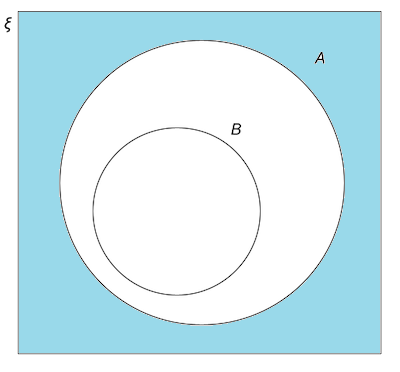
(b)(iii)
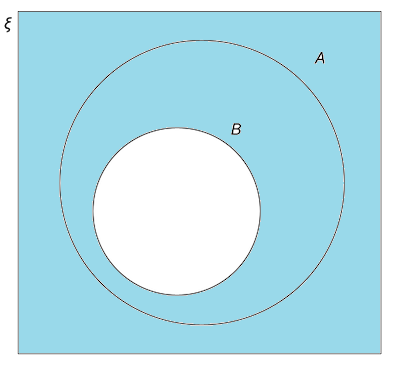
(b)(iv)
Question 13
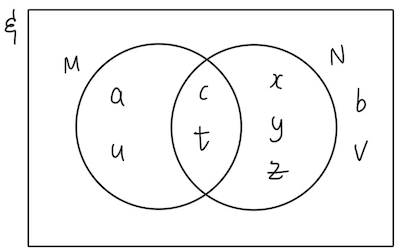
(a)(i)
\begin{align} M' & = \{ \text{b, v, x, y, z} \} \end{align}
(a)(ii)
\begin{align} N' & = \{ \text{a, b, u, v} \} \end{align}
(a)(iii)
\begin{align} M \cup N & = \{ \text{a, c, t, u, x, y, z} \} \end{align}
(a)(iv)
\begin{align} M \cap N & = \{ \text{c, t} \} \end{align}
(a)(v)
\begin{align} M \cup N' & = \{ \text{a, b, c, t, u, v} \} \end{align}
(a)(vi)
\begin{align} M' \cap N & = \{ \text{x, y, z} \} \end{align}
(b)
Question 14
(a)
\begin{align} \xi & = \{x:x \text{ is an MRT station} \} \end{align}
(b)
\begin{align} E \cap N & = \{ \text{City Hall, Raffles Place, Jurong East} \} \end{align}
(c)
\begin{align} & \{ \}, \{ \text{City Hall} \}, \{ \text{Raffles Place} \}, \{ \text{Jurong East} \}, \{ \text{City Hall, Raffles Place} \}, \\ & \{ \text{City Hall, Jurong East} \}, \{ \text{Raffles Place, Jurong East} \} \end{align}
What’s next
- Chapter 2: Data Analysis – Measures of Spread 🔒 Subscribers
- All chapters of New Discovering Mathematics 4A & 4B
- O Level E Maths past year solutions — free, 2016 to the latest paper