think! Additional Mathematics Workbook (10th Ed) Chapter 2: Equations and Inequalities — Solutions
Please email me if you spot a mistake or have a question.
Choose an exercise, then tap a question to show its worked solution.
Worksheet 2A: Solving quadratic equations by completing the square or Quadratic Formula
Question 1
(a)
\begin{align} 4x^2 + 9x + 1 & = 0 \\ 4 \left( x^2 + {9 \over 4}x \right) + 1 & = 0 \\ 4 \left[ x^2 + {9 \over 4}x + \left(9 \over 8\right)^2 - \left(9 \over 8\right)^2 \right] + 1 & = 0 \\ 4 \left[ \left(x + {9 \over 8}\right)^2 - {81 \over 64} \right] + 1 & = 0 \\ 4 \left(x + {9 \over 8}\right)^2 - {81 \over 16} + 1 & = 0 \\ 4 \left(x + {9 \over 8}\right)^2 - {65 \over 16} & = 0 \\ 4 \left(x + {9 \over 8}\right)^2 & = {65 \over 16} \\ \left(x + {9 \over 8}\right)^2 & = {65 \over 64} \\ x + {9 \over 8} & = \pm \sqrt{65 \over 64} \\ x & = \pm \sqrt{65 \over 64} - {9 \over 8} \\ x & = -0.11722 \text{ or } -2.1328 \\ x & \approx -0.12 \text{ or } -2.13 \text{ (2 d.p.)} \end{align}
(b)
\begin{align} 2 - 11x + 6x^2 & = 0 \\ 6x^2 - 11x + 2 & = 0 \\ 6 \left(x^2 - {11 \over 6} x \right) + 2 & = 0 \\ 6 \left[ x^2 - {11 \over 6}x + \left(11 \over 12\right)^2 - \left(11 \over 12\right)^2 \right] + 2 & = 0 \\ 6 \left[ \left(x - {11 \over 12}\right)^2 - {121 \over 144} \right] + 2 & = 0 \\ 6 \left(x - {11 \over 12}\right)^2 - {121 \over 24} + 2 & = 0 \\ 6 \left(x - {11 \over 12}\right)^2 - {73 \over 24} & = 0 \\ 6 \left(x - {11 \over 12}\right)^2 & = {73 \over 24} \\ \left(x - {11 \over 12}\right)^2 & = {73 \over 144} \\ x - {11 \over 12} & = \pm \sqrt{73 \over 144} \\ x & = \pm \sqrt{73 \over 144} + {11 \over 12} \\ x & = 1.6287 \text{ or } 0.20467 \\ x & \approx 1.63 \text{ or } 0.20 \text{ (2 d.p.)} \end{align}
(c)
\begin{align} -{1 \over 5}x^2 & = x - 8 \\ -5 \left(-{1 \over 5}x^2\right) & = -5(x - 8) \\ x^2 & = -5x + 40 \\ x^2 + 5x - 40 & = 0 \\ x^2 + 5x + \left(5 \over 2\right)^2 - \left(5 \over 2\right)^2 - 40 & = 0 \\ \left(x + {5 \over 2}\right)^2 - {25 \over 4} - 40 & = 0 \\ \left(x + {5 \over 2}\right)^2 - {185 \over 4} & = 0 \\ \left(x + {5 \over 2}\right)^2 & = {185 \over 4} \\ x + {5 \over 2} & = \pm \sqrt{185 \over 4} \\ x & = \pm \sqrt{185 \over 4} - {5 \over 2} \\ x & = 4.3007 \text{ or } -9.3007 \\ x & \approx 4.30 \text{ or } -9.30 \text{ (2 d.p.)} \end{align}
(d)
\begin{align} (3x + 1)(2x - 4) & = 7 \\ 6x^2 - 12x + 2x - 4 & = 7 \\ 6x^2 - 10x - 4 & = 7 \\ 6x^2 - 10x - 4 - 7 & = 0 \\ 6x^2 - 10x - 11 & = 0 \\ 6 \left( x^2 - {5 \over 3}x \right) - 11 & = 0 \\ 6 \left[ x^2 - {5 \over 3}x + \left(5 \over 6\right)^2 - \left(5 \over 6\right)^2 \right] - 11 & = 0 \\ 6 \left[ \left(x - {5 \over 6}\right)^2 - {25 \over 36} \right] - 11 & = 0 \\ 6 \left(x - {5 \over 6}\right)^2 - {25 \over 6} - 11 & = 0 \\ 6 \left(x - {5 \over 6}\right)^2 - {91 \over 6} & = 0 \\ 6 \left(x - {5 \over 6}\right)^2 & = {91 \over 6} \\ \left(x - {5 \over 6}\right)^2 & = {91 \over 36} \\ x - {5 \over 6} & = \pm \sqrt{91 \over 36} \\ x & = \pm \sqrt{91 \over 36} + {5 \over 6} \\ x & = 2.4232 \text{ or } -0.75657 \\ x & \approx 2.42 \text{ or } -0.76 \text{ (2 d.p.)} \end{align}
Question 2
(a)
\begin{align} 5x^2 & - x - 12 = 0 \\ \\ x & = {-b \pm \sqrt{b^2 - 4ac} \over 2a} \\ & = {-(-1) \pm \sqrt{(-1)^2 - 4(5)(-12)} \over 2(5)} \\ & = {1 \pm \sqrt{241} \over 10} \\ & = 1.6524 \text{ or } -1.4524 \\ & \approx 1.65 \text{ or } -1.45 \end{align}
(b)
\begin{align} 7x & = 9 - 2x^2 \\ 2x^2 + 7x - 9 & = 0 \\ \\ x & = {-b \pm \sqrt{b^2 - 4ac} \over 2a} \\ & = {-7 \pm \sqrt{(7)^2 - 4(2)(-9)} \over 2(2)} \\ & = {-7 \pm \sqrt{121} \over 2(2)} \\ & = 1 \text{ or } -4.5 \end{align}
(c)
\begin{align} 1.4x(x + 3) + 1 & = 0 \\ 1.4x^2 + 4.2x + 1 & = 0 \\ \\ x & = {-b \pm \sqrt{b^2 - 4ac} \over 2a} \\ & = {-4.2 \pm \sqrt{(4.2)^2 - 4(1.4)(1)} \over 2(1.4)} \\ & = {-4.2 \pm \sqrt{12.04} \over 2.8} \\ & = -0.26076 \text{ or } -2.7392 \\ & \approx -0.261 \text{ or } -2.74 \end{align}
(d)
\begin{align} (6x - 5)(x + 4) & = 3x^2 \\ 6x^2 + 24x - 5x - 20 & = 3x^2 \\ 6x^2 + 19x - 20 & = 3x^2 \\ 3x^2 + 19x - 20 & = 0 \\ \\ x & = {-b \pm \sqrt{b^2 - 4ac} \over 2a} \\ & = {-19 \pm \sqrt{(19)^2 - 4(3)(-20)} \over 2(3)} \\ & = {-19 \pm \sqrt{601} \over 6} \\ & = 0.91922 \text{ or } -7.2526 \\ & \approx 0.919 \text{ or } -7.25 \end{align}
Question 3
\begin{align} x^2 - 9x + 22 & = x^2 - 9x + \left(9 \over 2\right)^2 - \left(9 \over 2\right)^2 + 22 \\ & = \left(x - {9 \over 2}\right)^2 - {81 \over 4} + 22 \\ & = \left(x - {9 \over 2}\right)^2 + {7 \over 4} \\ \\ \text{For all real} & \text{ values of } x, \\ \left(x - {9 \over 2}\right)^2 & \ge 0 \\ \left(x - {9 \over 2}\right)^2 + {7 \over 4} & \ge {7 \over 4} > 0 \\ \\ & \text{So } x^2 - 9x + 22 \text{ can never equal 0} \\ \\ \therefore x^2 - 9x + 22 = 0 & \text{ has no real solutions} \end{align}
Question 4
(i)
\begin{align}
5x + 1 & = {18 \over x} \\
x(5x + 1) & = 18 \\
5x^2 + x & = 18 \\
5x^2 + x - 18 & = 0 \\
\\
(5x - 9)(x + 2) & = 0
\phantom{0000000} [\text{Factorise}]
\end{align}
\begin{align}
5x - 9 & = 0 && \text{ or } & x + 2 & = 0 \\
5x & = 9 &&& x & = -2 \\
x & = {9 \over 5} \\
x & = 1.8
\end{align}
\begin{align}
5x^2 & + x - 18 = 0 \\
\\
x & = {-b \pm \sqrt{b^2 - 4ac} \over 2a} \\
& = {-1 \pm \sqrt{(1)^2 - 4(5)(-18)} \over 2(5)} \\
& = {-1 \pm \sqrt{361} \over 10} \\
& = 1.8 \text{ or } -2
\end{align}
(ii)
\begin{align}
5x^2 + x - 18 & = 0
&&&
\text{Roots: } x & = 1.8, -2 \\
\\
\text{Replace } x & \text{ by } \sqrt{x}, \\
5(\sqrt{x})^2 + \sqrt{x} - 18 & = 0
&&&
\text{Roots: } \sqrt{x} & = 1.8, -2 \\
5x + \sqrt{x} - 18 & = 0
\end{align}
\begin{align}
\sqrt{x} & = 1.8
&& \text{ or } &
\sqrt{x} & = -2 \text{ (Reject, since } \sqrt{x} \ge 0) \\
x & = 1.8^2 \\
x & = 3.24
\end{align}
Question 5
\begin{align}
ax^2 + bx + c & = a \left(x^2 + {b \over a}x\right) + c \\
& = a \left[ x^2 + {b \over a}x + \left(b \over 2a\right)^2 - \left(b \over 2a\right)^2 \right] + c \\
& = a \left[ \left(x + {b \over 2a}\right)^2 - {b^2 \over 4a^2} \right] + c \\
& = a \left(x + {b \over 2a}\right)^2 - {ab^2 \over 4a^2} + c \\
& = a \left(x + {b \over 2a}\right)^2 - {b^2 \over 4a} + c \\
\\
\text{Comparing } & \text{with } a(x - h)^2 + k,
\end{align}
\begin{align}
-h & = {b \over 2a} &&& k & = -{b^2 \over 4a} + c \\
h & = -{b \over 2a} \phantom{0} \text{ (Shown)}
&&&
k & = {-b^2 \over 4a} + {c \over 1} \\
&&&& k & = {-b^2 \over 4a} + {4ac \over 4a} \\
&&&& k & = {-b^2 + 4ac \over 4a} \\
&&&& k & = -{b^2 - 4ac \over 4a} \phantom{0} \text{ (Shown)}
\end{align}
Question 6
\begin{align} 3x^2 - bx + 16 & = 3 \left(x^2 - {b \over 3}x \right) + 16 \\ & = 3 \left[ x^2 - {b \over 3}x + \left(b \over 6\right)^2 - \left(b \over 6\right)^2 \right] + 16 \\ & = 3 \left[ \left(x - {b \over 6}\right)^2 - {b^2 \over 36} \right] + 16 \\ & = 3 \left(x - {b \over 6}\right)^2 - {3b^2 \over 36} + 16 \\ & = 3 \left(x - {b \over 6}\right)^2 - {b^2 \over 12} + 16 \\ \\ \text{For all real} & \text{ values of } x, \\ 3\left(x - {b \over 6}\right)^2 & \ge 0 \\ 3\left(x - {b \over 6}\right)^2 - {b^2 \over 12} + 16 & \ge -{b^2 \over 12} + 16 \\ \\ \text{For } 3x^2 - bx + 16 = 0 & \text{ to have no real solutions,} \\ -{b^2 \over 12} + 16 & > 0 \\ -{b^2 \over 12} & > - 16 \\ {b^2 \over 12} & < 16 \\ b^2 & < 12(16) \\ b^2 & < 192 \\ \\ \text{Possible values} & \text{ of } b: 8, -12 \\ \\ \text{Check: } & 8^2 = 64 < 192, \phantom{0} (-12)^2 = 144 < 192 \end{align}
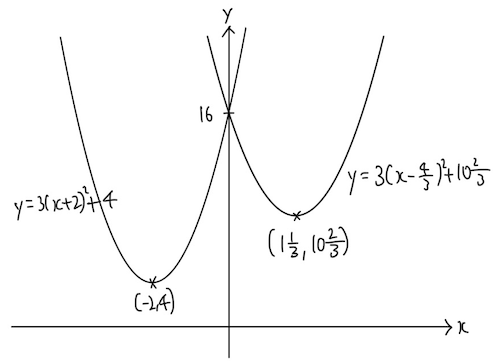
\begin{align} & \text{For } b = 8, &&& & \text{For } b = -12, \\ y & = 3 \left(x - {8 \over 6}\right)^2 - {(8)^2 \over 12} + 16 &&& y & = 3 \left(x - {-12 \over 6}\right)^2 - {(-12)^2 \over 12} + 16 \\ y & = 3 \left(x - {4 \over 3}\right)^2 + 10{2 \over 3} &&& y & = 3 (x + 2)^2 + 4 \\ \\ \text{Turning} & \text{ point: } \left({4 \over 3}, 10{2 \over 3}\right) &&& \text{Turning} & \text{ point: } (-2, 4) \\ \\ & \text{Let } x = 0, &&& & \text{Let } x = 0, \\ y & = 3 \left(0 - {4 \over 3}\right)^2 + 10{2 \over 3} &&& y & = 3 (0 + 2)^2 + 4 \\ y & = 16 &&& y & = 16 \end{align}
Worksheet 2B: Nature of roots of quadratic equation
Question 1
(a)
\begin{align} b^2 - 4ac & = (6)^2 - 4(1)(-3) \\ & = 48 > 0 \\ \\ \implies \text{Equation } & \text{has two real and distinct roots} \end{align}
(b)
\begin{align} b^2 - 4ac & = (-11)^2 - 4(2)(40) \\ & = -199 < 0 \\ \\ \implies \text{Equation } & \text{has no real roots} \end{align}
(c)
\begin{align} -72x^2 + 49x - 5 & = 0 \\ \\ b^2 - 4ac & = (49)^2 - 4(-72)(-5) \\ & = 961 > 0 \\ \\ \implies \text{Equation } & \text{has two real and distinct roots} \end{align}
(d)
\begin{align} {9 \over 8}x^2 - 6x + 8 & = 0 \\ \\ b^2 - 4ac & = (-6)^2 - 4\left(9 \over 8\right)(8) \\ & = 0 \\ \\ \implies \text{Equation } & \text{has two real and equal roots} \end{align}
Question 2
\begin{align} 3x^2 + 2px & = -(18 + p) \\ 3x^2 + 2px + (18 + p) & = 0 \\ \\ b^2 - 4ac & = (2p)^2 - 4(3)(18 + p) \\ & = 4p^2 - 12(18 + p) \\ & = 4p^2 - 216 - 12p \\ \\ b^2 - 4ac & = 0 \phantom{000000} [\text{Equal roots}] \\ 4p^2 - 216 - 12p & = 0 \\ p^2 - 54 - 3p & = 0 \\ p^2 - 3p - 54 & = 0 \\ (p - 9)(p + 6) & = 0 \end{align} \begin{align} p - 9 & = 0 && \text{ or } & p + 6 & = 0 \\ p & = 9 &&& p & = -6 \end{align}
Question 3
\begin{align} hx^2 - 9x + 4 & = 0 \\ \\ b^2 - 4ac & = (-9)^2 - 4(h)(4) \\ & = 81 - 16h \\ \\ b^2 - 4ac & < 0 \phantom{000000} [\text{No real roots}] \\ 81 - 16h & < 0 \\ -16h & < -81 \\ h & > {-81 \over -16} \\ h & > {81 \over 16} \end{align}
Question 4
\begin{align} {1 \over 7}hx^2 + 2x + 14 & = 0 \\ \\ b^2 - 4ac & = (2)^2 - 4\left({1 \over 7}h\right)(14) \\ & = 4 - {4 \over 7}h (14) \\ & = 4 - 8h \\ \\ b^2 - 4ac & > 0 \phantom{000000} [\text{Two distinct real roots}] \\ 4 - 8h & > 0 \\ -8h & > -4 \\ h & < {-4 \over -8} \\ h & < {1 \over 2}, \; h \ne 0 \phantom{000000} [h = 0 \text{ gives } 2x + 14 = 0 \text{, which has only one root}] \end{align}
Question 5
(i)
\begin{align} -4x^2 + 13x - 5h & = 1 \\ -4x^2 + 13x - 5h - 1 & = 0 \\ \\ b^2 - 4ac & = (13)^2 - 4(-4)(-5h-1) \\ & = 169 + 16(-5h - 1) \\ & = 169 - 80h - 16 \\ & = 153 - 80h \\ \\ b^2 - 4ac & \ge 0 \phantom{000000} [\text{Two (distinct/equal) real roots}] \\ 153 - 80h & \ge 0 \\ -80h & \ge - 153 \\ h & \le {-153 \over -80} \\ h & \le {153 \over 80} \end{align}
(ii)
\begin{align} b^2 - 4ac & = 153 - 80h \\ \\ b^2 - 4ac & > 0 \phantom{000000} [\text{Two distinct real roots}] \\ 153 - 80h & > 0 \\ -80h & > - 153 \\ h & < {-153 \over -80} \\ h & < {153 \over 80} \end{align}
(iii)
\begin{align} b^2 - 4ac & = 153 - 80h \\ \\ b^2 - 4ac & < 0 \phantom{000000} [\text{No real roots}] \\ 153 - 80h & < 0 \\ -80h & < - 153 \\ h & > {-153 \over -80} \\ h & > {153 \over 80} \end{align}
Question 6
(i)
\begin{align} hx^2 + kx + 6 & = 0 \\ \\ b^2 - 4ac & = k^2 - 4(h)(6) \\ & = k^2 - 24h \\ \\ b^2 - 4ac & = 0 \phantom{000000} [\text{Two equal real roots}] \\ k^2 - 24h & = 0 \\ k^2 & = 24h \end{align}
(ii)
\begin{align} \text{Let } & h = 6, \\ k^2 & = 24(6) \\ k^2 & = 144 \\ k & = \pm \sqrt{144} \\ k & = \pm 12 \\ \\ \text{Take } & k = 12 \\ \\ \text{Possible values: } & h = 6, k = 12 \end{align}
Question 7
\begin{align} y = (4h + 1)x^2 & - (4h - 1)x + h \\ \\ \text{For minimum curve, } 4h + 1 & > 0 \\ 4h & > - 1 \\ h & > - {1 \over 4} \phantom{000000} [\text{Condition 1}] \\ \\ \\ \text{Let } & y = 0, \\ 0 & = (4h + 1)x^2 - (4h - 1)x + h \\ \\ b^2 - 4ac & = [-(4h - 1)]^2 - 4(4h + 1)(h) \\ & = (-4h + 1)^2 -4h(4h + 1) \\ & = (-4h)^2 + 2(-4h)(1) + (1)^2 - 16h^2 - 4h \phantom{0000000} [(a + b)^2 = a^2 + 2ab + b^2] \\ & = 16h^2 - 8h + 1 - 16h^2 - 4h \\ & = 1 - 12h \\ \\ b^2 - 4ac & \ge 0 \phantom{000000} [\text{1 or 2 real roots since curve intersects } x \text{-axis once or twice}] \\ 1 - 12h & \ge 0 \\ -12h & \ge - 1 \\ h & \le {-1 \over -12} \\ h & \le {1 \over 12} \phantom{000000} [\text{Condition 2}] \\ \\ \\ \text{To satisfy both conditions, } & -{1 \over 4} < h \le {1 \over 12} \end{align}
Question 8
\begin{align} 5x^2 & - kx + 2k^2 + 8 = 0 \\ \\ b^2 - 4ac & = (-k)^2 - 4(5)(2k^2 + 8) \\ & = k^2 - 20(2k^2 + 8) \\ & = k^2 - 40k^2 - 160 \\ & = -39k^2 - 160 \\ \\ \text{For all real} & \text{ values of } k, \\ k^2 & \ge 0 \\ -39k^2 & \le 0 \\ -39k^2 - 160 & \le -160 < 0 \\ \\ \text{Since } b^2 - 4ac < 0 & \text{ for all real values of } k, \\ \text{the equation has no } & \text{real roots for all real values of } k \end{align}
Question 9
(i)
\begin{align} 3x^2 - 4x + 7 & = 3 \left(x^2 - {4 \over 3}x\right) + 7 \\ & = 3 \left[ x^2 - {4 \over 3}x + \left(2 \over 3\right)^2 - \left(2 \over 3\right)^2 \right] + 7 \\ & = 3 \left[ \left(x - {2 \over 3}\right)^2 - {4 \over 9} \right] + 7 \\ & = 3 \left(x - {2 \over 3}\right)^2 - {4 \over 3} + 7 \\ & = 3 \left(x - {2 \over 3}\right)^2 + {17 \over 3} \\ \\ \text{For all real } & \text{values of } x, \\ \left(x - {2 \over 3}\right)^2 & \ge 0 \\ 3\left(x - {2 \over 3}\right)^2 & \ge 0 \\ 3\left(x - {2 \over 3}\right)^2 + {17 \over 3} & \ge {17 \over 3} > 0 \\ \\ \\ \therefore 3x^2 - 4x + 7 & \text{ is always positive} \end{align}
(ii)
\begin{align} & [\text{Curve of } y = 3x^2 - 4x + 7 \text{ lies entirely above } x \text{-axis}] \\ \\ & \text{The equation } 3x^2 - 4x + 7 = 0 \text{ has no real roots} \end{align}
Question 10
(i) If the curve lies above or below the x-axis, it does not meet the x-axis. Thus discriminant < 0
\begin{align} y & = (k - 3)x^2 + 2kx + (k + 1) \\ \\ b^2 - 4ac & = (2k)^2 - 4(k - 3)(k + 1) \\ & = 4k^2 -4 (k^2 + k - 3k - 3) \\ & = 4k^2 - 4 (k^2 - 2k - 3) \\ & = 4k^2 - 4k^2 + 8k + 12 \\ & = 8k + 12 \\ \\ b^2 - 4ac & < 0 \phantom{000000} [\text{No real roots since curve lies above/below } x \text{-axis}] \\ 8k + 12 & < 0 \\ 8k & < -12 \\ k & < {-12 \over 8} \\ k & < -{3 \over 2} \end{align}
(ii)
\begin{align} y & = (k - 3)x^2 + 2kx + (k + 1) \\ \\ \text{If } & k < -{3 \over 2}, \\ k - 3 & < -{3 \over 2} - 3 \\ k - 3 & < -4{1 \over 2} \\ \\ \implies \text{Curve } & y = (k - 3)x^2 + 2kx + (k + 1) \text{ is a maximum curve } (\cap) \\ \\ \therefore \text{Curve } & \text{lies entirely below the } x \text{-axis} \end{align}
Question 11
(i)
\begin{align} a & > 0 \phantom{000000} [\text{Minimum curve } \cup \text{; Condition 1}] \\ \\ \\ b^2 - 4ac & = (-7)^2 - 4(a)(c) \\ & = 49 - 4ac \\ \\ b^2 - 4ac & < 0 \phantom{000000} [\text{No real roots since curve lies above } x \text{-axis}] \\ 49 - 4ac & < 0 \\ -4ac & < -49 \\ ac & > {-49 \over -4} \\ ac & > {49 \over 4} \phantom{0000000} [\text{Condition 2}] \end{align}
(ii)
\begin{align} \text{Let } & a = 5 \phantom{000000} [\text{to satisfy condition 1}] \\ \\ ac & > {49 \over 4} \phantom{000000} [\text{condition 2}] \\ \\ 5c & > {49 \over 4} \\ c & > { {49 \over 4} \over 5} \\ c & > 2.45 \\ \\ \\ \text{Possible values: } & a = 5, c = 6 \end{align}
Question 12
(i)
\begin{align} a & < 0 \phantom{000000} [\text{Maximum curve } \cap \text{; Condition 1}] \\ \\ \\ b^2 - 4ac & = (4)^2 - 4(a)(c) \\ & = 16 - 4ac \\ \\ b^2 - 4ac & < 0 \phantom{000000} [\text{No real roots since curve lies below } x \text{-axis}] \\ 16 - 4ac & < 0 \\ -4ac & < -16 \\ ac & > {-16 \over -4} \\ ac & > 4 \phantom{0000000} [\text{Condition 2}] \end{align}
(ii)
\begin{align} \text{Let } & a = -2 \phantom{000000} [\text{to satisfy condition 1}] \\ \\ ac & > 4 \phantom{000000} [\text{condition 2}] \\ \\ -2c & > 4 \\ c & < {4 \over -2} \\ c & < -2 \\ \\ \\ \text{Possible values: } & a = -2, c = -10 \end{align}
Question 13
\begin{align} 4x^2 - {x \over h} - 2 & = 0 \\ 4x^2 - {1 \over h}x - 2 & = 0 \\ \\ b^2 - 4ac & = \left(-{1 \over h}\right)^2 - 4(4)(-2) \\ & = {1 \over h^2} + 32 \\ \\ b^2 - 4ac & = 0 \phantom{000000} [\text{Two equal real roots}] \\ {1 \over h^2} + 32 & = 0 \\ {1 \over h^2} & = -32 \\ \\ \text{Since } h \ne 0, \phantom{0} h^2 & > 0 \\ {1 \over h^2} & > 0 \\ \implies {1 \over h^2} & \ne -32 \\ \\ \therefore \text{No values of } h & \text{ for which equation has equal roots} \end{align}
Question 14
\begin{align} & \text{For the curve to lie completely below the } x \text{-axis, we need} \\ & a < 0 \phantom{000000} [\text{Maximum curve } \cap] \\ & b^2 - 4ac < 0 \phantom{000000} [\text{No real roots}] \\ \\ & \text{Statement B: } ac < 0 \implies -4ac > 0 \\ & \text{Since } b^2 \ge 0 \text{ and } -4ac > 0, \phantom{0} b^2 - 4ac > 0 \\ & \text{This contradicts Statement A, so both statements cannot be true at the same time} \\ \\ & \text{Also, neither statement tells us that } a < 0 \\ \\ & \therefore \text{No, the statements are not sufficient} \end{align}
Worksheet 2C: Solving linear and non-linear simultaneous equations
Question 1
(a)
\begin{align} x - 2y + 9 & = 0 \\ -2y & = - x - 9 \\ 2y & = x + 9 \\ y & = {1 \over 2}(x + 9) \\ y & = {1 \over 2}x + {9 \over 2} \phantom{00} \text{--- (1)} \\ \\ x^2 + 11x & = 3xy + 2 \phantom{00} \text{--- (2)} \\ \\ \text{Substitute } & \text{(1) into (2),} \\ x^2 + 11x & = 3x \left({1 \over 2}x + {9 \over 2}\right) + 2 \\ x^2 + 11x & = {3 \over 2}x^2 + {27 \over 2}x + 2 \\ 0 & = {1 \over 2}x^2 + {5 \over 2}x + 2 \\ 2(0) & = 2 \left( {1 \over 2}x^2 + {5 \over 2}x + 2 \right) \\ 0 & = x^2 + 5x + 4 \\ 0 & = (x + 1)(x + 4) \end{align} \begin{align} x + 1 & = 0 && \text{ or } & x + 4 & = 0 \\ x & = -1 &&& x & = -4 \\ \\ \text{Substitute } & \text{into (1),} &&& \text{Substitute } & \text{into (1),} \\ y & = {1 \over 2}(-1) + {9 \over 2} &&& y & = {1 \over 2}(-4) + {9 \over 2} \\ y & = 4 &&& y & = {5 \over 2} \\ \\ x & = -1, y = 4 &&& x & = -4, y = {5 \over 2} \end{align}
(b)
\begin{align} {3 \over x} - {1 \over y} & = 15 \phantom{00} \text{--- (1)} \\ \\ {1 \over xy} & = -12 \\ {1 \over y} & = -12x \phantom{00} \text{--- (2)} \\ \\ \text{Substitute } & \text{(2) into (1),} \\ {3 \over x} - (-12x) & = 15 \\ {3 \over x} + 12x & = 15 \\ x \left({3 \over x} + 12x\right) & = 15x \\ 3 + 12x^2 & = 15x \\ 12x^2 - 15x + 3 & = 0 \\ 4x^2 - 5x + 1 & = 0 \\ (4x - 1)(x - 1) & = 0 \end{align} \begin{align} 4x - 1 & = 0 && \text{ or } & x - 1 & = 0 \\ 4x & = 1 &&& x & = 1 \\ x & = {1 \over 4} \\ \\ \text{Substitute } & \text{into (2),} &&& \text{Substitute } & \text{into (2),} \\ {1 \over y} & = -12\left(1 \over 4\right) &&& {1 \over y} & = -12(1) \\ {1 \over y} & = -3 &&& {1 \over y} & = -12 \\ 1 & = -3y &&& 1 & = -12y \\ -{1 \over 3} & = y &&& -{1 \over 12} & = y \\ \\ x & = {1 \over 4}, y = -{1 \over 3} &&& x & = 1, y = -{1 \over 12} \end{align}
Question 2
\begin{align} x^2 & = xy + 12 \phantom{00} \text{--- (1)} \\ \\ 2y + x - 6 & = 0 \\ 2y & = -x + 6 \\ y & = {1 \over 2}(-x + 6) \\ y & = -{1 \over 2}x + 3 \phantom{00} \text{--- (2)} \\ \\ \text{Substitute } & \text{(2) into (1),} \\ x^2 & = x \left(-{1 \over 2}x + 3\right) + 12 \\ x^2 & = -{1 \over 2}x^2 + 3x + 12 \\ 0 & = -{3 \over 2}x^2 + 3x + 12 \\ 2(0) & = 2 \left( -{3 \over 2}x^2 + 3x + 12 \right) \\ 0 & = - 3x^2 + 6x + 24 \\ 0 & = 3x^2 - 6x - 24 \\ 0 & = x^2 - 2x - 8 \\ 0 & = (x - 4)(x + 2) \end{align} \begin{align} x - 4 & = 0 && \text{ or } & x + 2 & = 0 \\ x & = 4 &&& x & = -2 \\ \\ \text{Substitute } & \text{into (2),} &&& \text{Substitute } & \text{into (2),} \\ y & = -{1 \over 2}(4) + 3 &&& y & = -{1 \over 2}(-2) + 3 \\ y & = 1 &&& y & = 4 \\ \\ \therefore & \phantom{.} (4, 1) &&& \therefore & \phantom{.} (-2, 4) \end{align}
Question 3
\begin{align} y & = 3x + 4 \phantom{00} \text{--- (1)} \\ \\ x^2 + y^2 & = 2(x + 2y) \phantom{00} \text{--- (2)} \\ \\ \text{Substitute } & \text{(1) into (2),} \\ x^2 + (3x + 4)^2 & = 2[x + 2(3x + 4)] \\ x^2 + (3x + 4)(3x + 4) & = 2(x + 6x + 8) \\ x^2 + 9x^2 + 12x + 12x + 16 & = 2(7x + 8) \\ 10x^2 + 24x + 16 & = 14x + 16 \\ 10x^2 + 24x - 14x + 16 - 16 & = 0 \\ 10x^2 + 10x & = 0 \\ x^2 + x & = 0 \\ x(x + 1) & = 0 \end{align} \begin{align} x & = 0 && \text{ or } & x + 1 & = 0 \\ & &&& x & = -1 \\ \\ \text{Substitute } & \text{into (1),} &&& \text{Substitute } & \text{into (1),} \\ y & = 3(0) + 4 &&& y & = 3(-1) + 4 \\ y & = 4 &&& y & = 1 \\ \\ \therefore & \phantom{.} (0, 4) &&& \therefore & \phantom{.} (-1, 1) \\ \\ \text{Substitute } & x = 0 \text{ into } 7y + 5x = 28, &&& \text{Substitute } & x = -1 \text{ into } 7y + 5x = 28, \\ 7y + 5(0) & = 28 &&& 7y + 5(-1) & = 28 \\ 7y + 0 & = 28 &&& 7y - 5 & = 28 \\ 7y & = 28 &&& 7y & = 33 \\ y & = 4 &&& y & = {33 \over 7} \phantom{0} (\ne 1) \\ \\ \therefore \text{Line } & \text{passes } (0, 4) &&& \therefore \text{Line } & \text{does not pass } (-1, 1) \end{align}
Question 4
\begin{align} y & = 1 - 5x \phantom{00} \text{--- (1)} \\ \\ y & = x^2 - 4x + 2 \phantom{00} \text{--- (2)} \\ \\ \text{Substitute } & \text{(1) into (2),} \\ 1 - 5x & = x^2 - 4x + 2 \\ 0 & = x^2 + x + 1 \\ \\ b^2 - 4ac & = (1)^2 - 4(1)(1) \\ & = -3 < 0 \\ \\ \implies \text{Equation } & \text{has no real roots} \\ \\ \therefore \text{Line and curve} & \text{ have 0 points of intersection} \end{align}
Question 5
\begin{align}
y - 7x - 9 & = 0 \\
y & = 7x + 9 \phantom{00} \text{--- (1)} \\
\\
y & = 2x^2 + bx + 17
\phantom{00} \text{--- (2)} \\
\\
\text{Substitute } & \text{(1) into (2),} \\
7x + 9 & = 2x^2 + bx + 17 \\
0 & = 2x^2 + bx - 7x + 8 \\
0 & = 2x^2 + (b - 7)x + 8 \\
\\
b^2 - 4ac & = (b - 7)^2 - 4(2)(8) \\
& = (b - 7)(b - 7) - 64 \\
& = b^2 - 7b - 7b + 49 - 64 \\
& = b^2 - 14b - 15 \\
\\
b^2 - 4ac & = 0
\phantom{000000} [\text{1 real root since line is tangent to curve}] \\
b^2 - 14b - 15 & = 0 \\
(b - 15)(b + 1) & = 0
\end{align}
\begin{align}
b - 15 & = 0 && \text{ or } & b + 1 & = 0 \\
b & = 15 &&& b & = -1
\end{align}
Question 6
(a)
\begin{align} y & = 9x^2 - 6x + k \\ \\ \text{Let } & y = 0, \\ 0 & = 9x^2 - 6x + k \\ \\ b^2 - 4ac & = (-6)^2 - 4(9)(k) \\ & = 36 - 36k \\ \\ b^2 - 4ac & > 0 \\ 36 - 36k & > 0 \\ -36k & > - 36 \\ k & < {-36 \over -36} \\ k & < 1 \end{align}
(b)
\begin{align} y & = {1 \over 2}x^2 + 4x - k \\ \\ \text{Let } & y = 0, \\ 0 & = {1 \over 2}x^2 + 4x - k \\ \\ b^2 - 4ac & = (4)^2 - 4\left(1 \over 2\right)(-k) \\ & = 16 + 2k \\ \\ b^2 - 4ac & = 0 \\ 16 + 2k & = 0 \\ 2k & = -16 \\ k & = {-16 \over 2} \\ k & = -8 \end{align}
(c)
\begin{align} y & = kx^2 + 8x - 2 \\ \\ \text{Condition 1: } & k < 0 \phantom{000000} [\text{must be maximum curve } \cap \text{ to lie below } x \text{-axis}] \\ \\ \\ \text{Let } & y = 0, \\ 0 & = kx^2 + 8x - 2 \\ \\ b^2 - 4ac & = (8)^2 - 4(k)(-2) \\ & = 64 + 8k \\ \\ b^2 - 4ac & < 0 \phantom{000000} [\text{No real roots since curve lies below } x \text{-axis}] \\ 64 + 8k & < 0 \\ 8k & < -64 \\ k & < {-64 \over 8} \\ k & < -8 \\ \\ \text{Combining with } & k < 0: \phantom{0} k < -8 \end{align}
Question 7
(i)
\begin{align} y & = 2x^2 + (h + 4)x + 2h \\ y & = 2x^2 + (3 + 4)x + 2(3) \\ y & = 2x^2 + 7x + 6 \phantom{00} \text{--- (1)} \\ \\ y & = 19x - 12 \phantom{00} \text{--- (2)} \\ \\ \text{Substitute } & \text{(2) into (1),} \\ 19x - 12 & = 2x^2 + 7x + 6 \\ 0 & = 2x^2 - 12x + 18 \\ 0 & = x^2 - 6x + 9 \\ \\ b^2 - 4ac & = (-6)^2 - 4(1)(9) \\ & = 0 \\ \\ \implies \text{Line } & \text{is tangent to curve} \\ \\ \\ 0 & = x^2 - 6x + 9 \\ 0 & = (x - 3)(x - 3) \\ 0 & = (x - 3)^2 \\ 0 & = x - 3 \\ 3 & = x \\ \\ \text{Substitute } & x = 3 \text{ into (2),} \\ y & = 19(3) - 12 \\ y & = 45 \\ \\ \text{Point: } & (3, 45) \end{align}
(ii) If y cannot be a negative value, then y must be positive or zero. This means the curve is entirely above the x-axis or meets the x-axis only once!
\begin{align} y & = 2x^2 + (h + 4)x + 2h \\ \\ \text{Let } & y = 0, \\ 0 & = 2x^2 + (h + 4)x + 2h \\ \\ b^2 - 4ac & = (h + 4)^2 - 4(2)(2h) \\ & = (h + 4)(h + 4) - 16h \\ & = h^2 + 4h + 4h + 16 - 16h \\ & = h^2 - 8h + 16 \\ & = (h - 4)(h - 4) \\ & = (h - 4)^2 \\ \\ \text{If } h = 4, b^2 - 4ac & = 0 \implies \cup \text{ curve meets } x \text{-axis once and will not be negative} \\ \\ \text{If } h \ne 4, b^2 - 4ac & > 0 \implies \cup \text{ curve meets } x \text{-axis twice and it will be negative} \\ \\ & y \text{ cannot be negative} \iff b^2 - 4ac \le 0 \phantom{0} [\cup \text{ curve, since } 2 > 0] \\ & \text{Since } (h - 4)^2 \ge 0 \text{, this happens only when } (h - 4)^2 = 0 \\ \\ \therefore & \text{ There is only one value, } h = 4 \end{align}
Question 8
(i)
\begin{align}
y & = 16x^2 + (1 - 2k)x + 1 + c
\phantom{00} \text{--- (1)} \\
\\
y & = -kx + c
\phantom{00} \text{--- (2)} \\
\\
\text{Substitute } & \text{(2) into (1),} \\
-kx + c & = 16x^2 + (1 - 2k)x + 1 + c \\
-kx + c & = 16x^2 + x - 2kx + 1 + c \\
0 & = 16x^2 + x - kx + 1 \\
0 & = 16x^2 + (1 - k)x + 1 \\
\\
b^2 - 4ac & = (1 - k)^2 - 4(16)(1) \\
& = (1 - k)(1 - k) - 64 \\
& = 1 - k - k + k^2 - 64 \\
& = k^2 - 2k - 63 \\
\\
b^2 - 4ac & = 0
\phantom{000000} [\text{Line tangent to curve}] \\
k^2 - 2k - 63 & = 0 \\
(k - 9)(k + 7) & = 0
\end{align}
\begin{align}
k - 9 & = 0 && \text{ or } & k + 7 & = 0 \\
k & = 9 &&& k & = - 7
\end{align}
$$ \text{Positive value of } k = 9 $$
(ii)
\begin{align} y & = 16x^2 + (1 - 2k)x + 1 + c \\ y & = 16x^2 + [1 - 2(9)]x + 1 + c \\ y & = 16x^2 - 17x + 1 + c \\ \\ \text{Using } & (-2, 104), \\ 104 & = 16(-2)^2 - 17(-2) + 1 + c \\ 104 & = 64 + 34 + 1 + c \\ 104 & = 99 + c \\ 5 & = c \\ \\ y & = 16x^2 - 17x + 1 + 5 \\ y & = 16x^2 - 17x + 6 \\ \\ \text{From (i), } 0 & = 16x^2 + (1 - k)x + 1 \\ 0 & = 16x^2 + (1 - 9)x + 1 \\ 0 & = 16x^2 - 8x + 1 \\ 0 & = (4x - 1)(4x - 1) \\ 0 & = (4x - 1)^2 \\ 0 & = 4x - 1 \\ -4x & = -1 \\ x & = {-1 \over -4} \\ x & = {1 \over 4} \\ \\ \text{Substitute } & x = {1 \over 4} \text{ into } y = 16x^2 - 17x + 6, \\ y & = 16 \left(1 \over 4\right)^2 - 17 \left(1 \over 4\right) + 6 \\ y & = 2{3 \over 4} \\ \\ \therefore & \phantom{.} \left({1 \over 4}, 2{3 \over 4}\right) \end{align}
(iii)
\begin{align} & L \text{ is a vertical line } (x = \text{constant}) \\ \\ & \text{A non-vertical line } y = mx + d \text{ would give a quadratic equation with the curve,} \\ & \text{which has exactly one solution only when } b^2 - 4ac = 0 \text{, i.e. the line is a tangent} \\ & \text{Since } L \text{ is not a tangent, } L \text{ must be vertical} \end{align}
Question 9
(i)
\begin{align}
y & = 2x^2 - kx - 1 \\
y & = 2x^2 -(-6)x - 1 \\
y & = 2x^2 + 6x - 1
\phantom{00} \text{--- (1)} \\
\\
y + 3x & = 10
\phantom{00} \text{--- (2)} \\
\\
\text{Substitute } & \text{(1) into (2),} \\
2x^2 + 6x - 1 + 3x & = 10 \\
2x^2 + 9x - 1 & = 10 \\
2x^2 + 9x - 11 & = 0 \\
(2x + 11)(x - 1) & = 0
\end{align}
\begin{align}
2x + 11 & = 0 && \text{ or } & x - 1 & = 0 \\
2x & = -11 &&& x & = 1 \\
x & = -{11 \over 2} \\
x & = -5{1 \over 2} \\
\\
\text{Substitute } & \text{into (2),} &&& \text{Substitute } & \text{into (2),} \\
y + 3 \left(-5{1 \over 2}\right) & = 10 &&& y + 3(1) & = 10 \\
y - 16{1 \over 2} & = 10 &&& y + 3 & = 10 \\
y & = 26{1 \over 2} &&& y & = 7
\end{align}
$$ \text{Points: } \left(-5{1 \over 2}, 26{1 \over 2}\right), (1, 7) $$
(ii)
\begin{align} y & = 2x^2 - kx - 1 \phantom{00} \text{--- (1)} \\ \\ y + 3x & = 10 \phantom{00} \text{--- (2)} \\ \\ \text{Substitute } & \text{(1) into (2),} \\ 2x^2 - kx - 1 + 3x & = 10 \\ 2x^2 + 3x - kx - 11 & = 0 \\ 2x^2 + (3 - k)x - 11 & = 0 \\ \\ b^2 - 4ac & = (3 - k)^2 - 4(2)(-11) \\ & = (3 - k)(3 - k) + 88 \\ & = 9 - 3k - 3k + k^2 + 88 \\ & = k^2 - 6k + 97 \\ & = k^2 - 6k + \left(6 \over 2\right)^2 - \left(6 \over 2\right)^2 + 97 \\ & = k^2 - 6k + 3^2 - 3^2 + 97 \\ & = (k - 3)^2 + 88 \\ \\ \text{For all real} & \text{ values of } k, \\ (k - 3)^2 & \ge 0 \\ (k - 3)^2 + 88 & \ge 88 \\ \implies b^2 - 4ac & \ge 88 > 0 \\ \\ \therefore \text{Line intersects curve } & \text{at two distinct points for all values of } k \end{align}
Question 10
(i)
\begin{align} ax^2 + 6y - 4b & = 23 \\ \\ \text{Let } x = -1 \text{ and } & y = 4, \\ a(-1)^2 + 6(4) - 4b & = 23 \\ a(1) + 24 - 4b & = 23 \\ a & = 4b - 1 \phantom{00} \text{--- (1)} \\ \\ \\ 6by - ax - 4 & = 23 \\ \\ \text{Let } x = -1 \text{ and } & y = 4, \\ 6b(4) - a(-1) - 4 & = 23 \\ 24b + a - 4 & = 23 \\ 24b + a & = 27 \phantom{00} \text{--- (2)} \\ \\ \text{Substitute } & \text{(1) into (2),} \\ 24b + (4b - 1) & = 27 \\ 28b - 1 & = 27 \\ 28b & = 28 \\ b & = 1 \\ \\ \text{Substitute } & \text{into (1),} \\ a & = 4(1) - 1 \\ a & = 3 \\ \\ \\ \therefore a & = 3, b = 1 \end{align}
(ii)
\begin{align} ax^2 + 6y - 4b & = 23 \\ \\ \text{Let } a = 3 \text{ and } & b = 1, \\ 3x^2 + 6y - 4(1) & = 23 \\ 3x^2 + 6y - 4 & = 23 \\ 3x^2 + 6y & = 27 \phantom{00} \text{--- (3)} \\ \\ \\ 6by - ax - 4 & = 23 \\ \\ \text{Let } a = 3 \text{ and } & b = 1, \\ 6(1)y - 3x - 4 & = 23 \\ 6y - 3x & = 27 \\ 6y & = 3x + 27 \\ y & = {1 \over 6}(3x + 27) \\ y & = {1 \over 2}x + {9 \over 2} \phantom{00} \text{--- (4)} \\ \\ \text{Substitute } & \text{(4) into (3),} \\ 3x^2 + 6 \left( {1 \over 2}x + {9 \over 2} \right) & = 27 \\ 3x^2 + 3x + 27 & = 27 \\ 3x^2 + 3x & = 0 \\ x^2 + x & = 0 \\ x(x + 1) & = 0 \end{align} \begin{align} x & = 0 && \text{ or } & x + 1 & = 0 \\ & &&& x & = -1 \text{ (Provided value}) \\ \\ \text{Substitute} & \text{ into (4),} \\ y & = {1 \over 2}(0) + {9 \over 2} \\ y & = {9 \over 2} \\ \\ \therefore x & = 0, y = {9 \over 2} \end{align}
Question 11
\begin{align} v_P & = v_Q \\ 0.4t + 3 & = -2t^2 + 7t - 1 \\ 2t^2 - 6.6t + 4 & = 0 \\ t^2 - 3.3t + 2 & = 0 \\ 10t^2 - 33t + 20 & = 0 \\ \\ b^2 - 4ac & = (-33)^2 - 4(10)(20) \\ & = 289 > 0 \\ \\ \implies \text{Equation } & \text{has two distinct real roots} \\ \\ \therefore \text{Particles } & \text{travel at the same speed at two timings} \\ \\ \\ 10t^2 - 33t + 20 & = 0 \\ (5t - 4)(2t - 5) & = 0 \end{align} \begin{align} 5t - 4 & = 0 && \text{ or } & 2t - 5 & = 0 \\ 5t & = 4 &&& 2t & = 5 \\ t & = {4 \over 5} &&& t & = {5 \over 2} \end{align}
Question 12
\begin{align}
16x^2 + y^2 & = 8xy + 9
\phantom{00} \text{--- (1)} \\
\\
(x - y)^2 & = 9 \\
(x - y)(x - y) & = 9 \\
x^2 - xy - xy + y^2 & = 9 \\
x^2 - 2xy + y^2 & = 9 \phantom{00} \text{--- (2)} \\
\\
\text{(1)} & - (2), \\
15x^2 + 2xy & = 8xy \\
15x^2 - 6xy & = 0 \\
3x(5x - 2y) & = 0
\end{align}
\begin{align}
3x & = 0 && \text{ or } & 5x - 2y & = 0 \\
x & = 0 &&& 5x & = 2y \\
& &&& x & = {2 \over 5}y \\
\\
\text{Substitute } & \text{into (2),} &&& \text{Substitute } & \text{into (2),} \\
(0 - y)^2 & = 9
&&&
\left({2 \over 5}y - y\right)^2 & = 9 \\
(-y)^2 & = 9
&&&
\left(-{3 \over 5}y\right)^2 & = 9 \\
y^2 & = 9 &&&
{9 \over 25}y^2 & = 9 \\
y & = \pm \sqrt{9} &&&
9y^2 & = 25(9) \\
y & = \pm 3 &&& y^2 & = 25 \\
& &&& y & = \pm \sqrt{25} \\
& &&& y & = \pm 5 \\
& &&& x & = {2 \over 5}(\pm 5) \\
& &&& x & = \pm 2
\end{align}
$$ x = 0, y = 3 \text{ or } x = 0, y = -3 \text{ or } x = 2, y = 5 \text{ or } x = -2, y = -5 $$
Worksheet 2D: Solving quadratic inequalities
Question 1
(a)
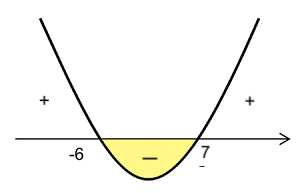
$$ - 6 < x < 7 $$
(b)
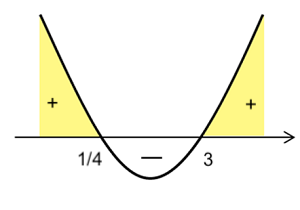
$$ x < {1 \over 4} \text{ or } x > 3 $$
(c)
\begin{align} 9x^2 & \le 16 \\ 9x^2 - 16 & \le 0 \\ (3x)^2 - 4^2 & \le 0 \\ (3x + 4)(3x - 4) & \le 0 \phantom{000000} [a^2 - b^2 = (a + b)(a - b)] \end{align}
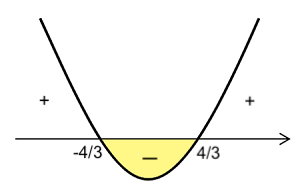
$$ -{4 \over 3} \le x \le {4 \over 3} $$
(d)
\begin{align} 14x^2 + 39x + 10 & \ge 0 \\ (2x + 5)(7x + 2) & \ge 0 \end{align}
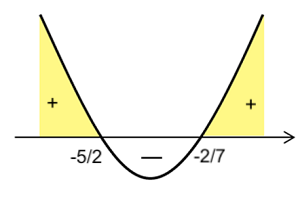
$$ x \le -{5 \over 2} \text{ or } x \ge -{2 \over 7} $$
(e)
\begin{align} 8(x^2 + 3x - 1) & < (3x + 1)(x - 2) \\ 8x^2 + 24x - 8 & < 3x^2 - 6x + x - 2 \\ 8x^2 + 24x - 8 & < 3x^2 - 5x - 2 \\ 5x^2 + 29x - 6 & < 0 \\ (x + 6)(5x - 1) & < 0 \end{align}
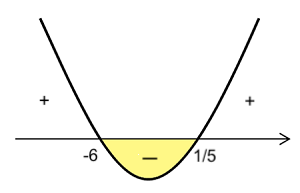
$$ -6 < x < {1 \over 5} $$
(f)
\begin{align} (x + 4)^2 - 11(x + 4) + 18 & > 0 \\ (x + 4)(x + 4) - 11x - 44 + 18 & > 0 \\ x^2 + 4x + 4x + 16 - 11x - 44 + 18 & > 0 \\ x^2 - 3x - 10 & > 0 \\ (x + 2)(x - 5) & > 0 \end{align}
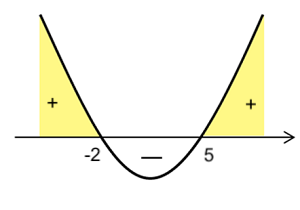
$$ x < -2 \text{ or } x > 5 $$
(g)
\begin{align} {81 - x^2 \over x^2} & \le 0 \\ \\ \text{Since } x^2 > 0 & \text{ for all real values of } x \ne 0, \\ 81 - x^2 & \le 0 \\ x^2 - 81 & \ge 0 \\ x^2 - 9^2 & \ge 0 \\ (x + 9)(x - 9) & \ge 0 \phantom{000000} [a^2 - b^2 = (a + b)(a - b)] \end{align}
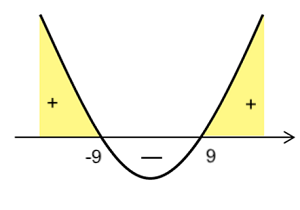
$$ x \le - 9 \text{ or } x \ge 9 $$
(h)
\begin{align} {81 - x^4 \over x^4} & \ge 0 \\ \\ \text{Since } x^4 > 0 & \text{ for all real values of } x \ne 0, \\ 81 - x^4 & \ge 0 \\ x^4 - 81 & \le 0 \\ (x^2)^2 - 9^2 & \le 0 \\ (x^2 + 9)(x^2 - 9) & \le 0 \phantom{000000} [a^2 - b^2 = (a + b)(a - b)] \\ \\ \text{Since } x^2 + 9 \ge 9 & \text{ for all real values of } x, \\ x^2 - 9 & \le 0 \\ x^2 - 3^2 & \le 0 \\ (x + 3)(x - 3) & \le 0 \end{align}
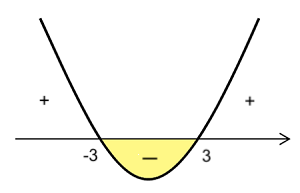
$$ -3 \le x \le 3, x \ne 0 \phantom{0} \phantom{000000} \left[ {81 - x^4 \over x^4} \text{ is undefined if } x = 0 \right] $$
Question 2
\begin{align} 8x^2 - 5x - 2 & < 2x(x - 2) \\ 8x^2 - 5x - 2 & < 2x^2 - 4x \\ 6x^2 - x - 2 & < 0 \\ (2x + 1)(3x - 2) & < 0 \end{align}
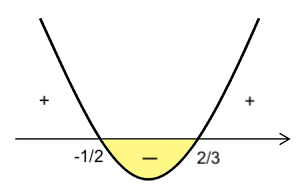
$$ -{1 \over 2} < x < {2 \over 3} $$
Question 3
\begin{align} 2x^2 + 3x - 20 & < 0 \\ (x + 4)(2x - 5) & < 0 \end{align}
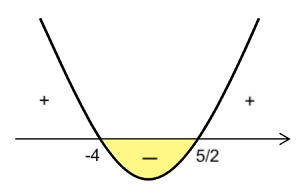
$$ -4 < x < {5 \over 2} $$
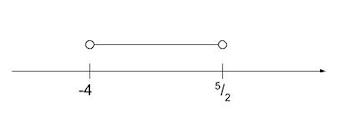
Question 4
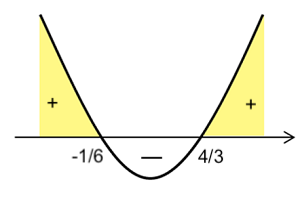
\begin{align} \implies (6x + 1)(3x - 4) & > 0 \\ 18x^2 - 24x + 3x - 4 & > 0 \\ 18x^2 - 21x - 4 & > 0 \\ -1(18x^2 - 21x - 4) & < -1(0) \\ -18x^2 + 21x + 4 & < 0 \\ 4 + 21x - 18x^2 & < 0 \end{align}
Question 5
(a)
\begin{align} {1 \over 5}x + 1 & \ge -2 \\ {1 \over 5}x & \ge -3 \\ x & \ge 5(-3) \\ x & \ge -15 \phantom{0000000} [\text{First condition}] \\ \\ \\ 3 - 11x & < 4x^2 \\ 0 & < 4x^2 + 11x - 3 \\ 0 & < (x + 3)(4x - 1) \end{align}
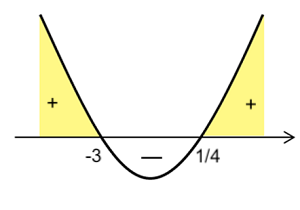
$$ x < -3 \text{ or } x > {1 \over 4} \phantom{0000000} [\text{Second condition}] $$
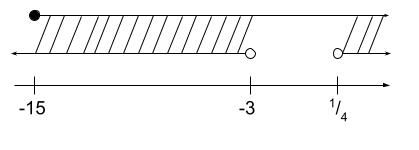
$$ -15 \le x < -3 \text{ or } x > {1 \over 4} $$
(b)
\begin{align} x(x + 6) & < 2x^2 + 11x + 6 \\ x^2 + 6x & < 2x^2 + 11x + 6 \\ 0 & < x^2 + 5x + 6 \\ 0 & < (x + 3)(x + 2) \end{align}
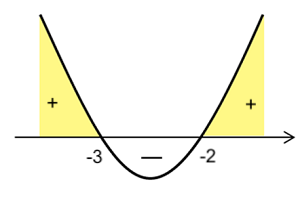
\begin{align} x < -3 & \text{ or } x > -2 \phantom{000000} [\text{First condition}] \\ \\ \\ 2x^2 + 11x + 6 & < -8 \\ 2x^2 + 11x + 14 & < 0 \\ (2x + 7)(x + 2) & < 0 \end{align}
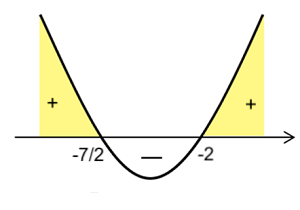
$$ - {7 \over 2} < x < -2 \phantom{000000} [\text{Second condition}] $$
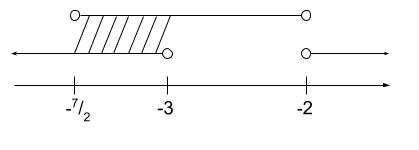
$$ -{7 \over 2} < x < -3 $$
Question 6
\begin{align} & \text{Misconception: the student took the square root of both sides,} \\ & \text{going from } (4x - 1)^2 \ge 0 \text{ to } 4x - 1 \ge 0 \\ & \text{But a square is never negative, so } (4x - 1)^2 \ge 0 \text{ even when } 4x - 1 < 0 \\ \\ \\ 16x^2 + 1 & \ge 8x \\ 16x^2 - 8x + 1 & \ge 0 \\ (4x - 1)^2 & \ge 0 \\ \\ \text{For all real values of } x, \phantom{0} & (4x - 1)^2 \ge 0 \\ \\ \therefore & \text{ All real values of } x \end{align}
Question 7
\begin{align} x^2 - (h + 1)x & + h + 9 = 0 \\ \\ b^2 - 4ac & = [-(h + 1)]^2 - 4(1)(h + 9) \\ & = (h + 1)(h + 1) - 4(h + 9) \\ & = h^2 + h + h + 1 - 4h - 36 \\ & = h^2 - 2h - 35 \\ \\ b^2 - 4ac & < 0 \phantom{000000} [\text{No real roots}] \\ h^2 - 2h - 35 & < 0 \\ (h + 5)(h - 7) & < 0 \end{align}
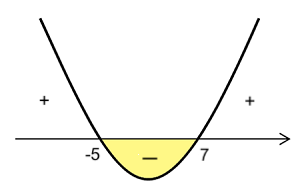
$$ -5 < h < 7 $$
Question 8
\begin{align} {k + 8 \over x^2} + {6 \over x} + k & = 0 \\ {k + 8 \over x^2} + {6x \over x^2} + {kx^2 \over x^2} & = 0 \\ {k + 8 + 6x + kx^2 \over x^2} & = 0 \\ \\ k + 8 + 6x + kx^2 & = 0 \\ kx^2 + 6x + k + 8 & = 0 \\ \\ k & \ne 0 \phantom{000000} [\text{Or else equation only has 1 root}] \\ \\ b^2 - 4ac & = (6)^2 - 4(k)(k + 8) \\ & = 36 - 4k(k + 8) \\ & = 36 - 4k^2 - 32k \\ \\ b^2 - 4ac & > 0 \phantom{000000} [\text{Two distinct real roots}] \\ 36 - 4k^2 - 32k & > 0 \\ -4k^2 - 32k + 36 & > 0 \\ 4k^2 + 32k - 36 & < 0 \\ k^2 + 8k - 9 & < 0 \\ (k + 9)(k - 1) & < 0 \end{align}
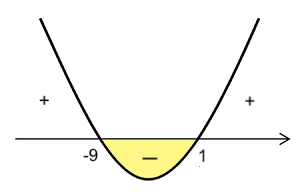
\begin{align} - 9 & < k < 1, \; k \ne 0 \\ \\ \text{If } k = -8, \phantom{0} & -8x^2 + 6x = 0 \implies x = 0 \text{ or } x = {3 \over 4} \\ & x = 0 \text{ is not allowed (} {6 \over x} \text{ is undefined), so there is only one root} \\ \\ \therefore -9 & < k < 1, \; k \ne 0, \; k \ne -8 \\ \\ \text{Largest integer} & \text{ value of } k = -1 \end{align}
Question 9
Note: An irrational number cannot be expressed as a fraction
\begin{align} -kx^2 & + 5kx + (k - 4) \\ \\ -k & < 0 \phantom{000000} [y = -kx^2 + 5kx + (k - 4) \text{ is maximum curve } \cap] \\ k & > 0 \phantom{000000} [\text{Condition 1}] \\ \\ \\ b^2 - 4ac & = (5k)^2 - 4(-k)(k - 4) \\ & = 25k^2 + 4k(k - 4) \\ & = 25k^2 + 4k^2 - 16k \\ & = 29k^2 - 16k \\ \\ b^2 - 4ac & < 0 \phantom{000000} [\text{No real roots for } -kx^2 + 5kx + (k - 4) = 0] \\ 29k^2 - 16k & < 0 \\ k(29k - 16) & < 0 \end{align}
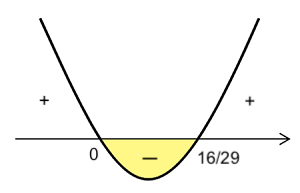
\begin{align} 0 & < k < {16 \over 29} (\approx 0.55172) \\ & [\text{Also } k = 0 \text{, since the expression is then } -4 < 0] \\ \\ \\ \text{Irrational} & \text{ value of } k = {\pi \over 10} \end{align}
Question 10
(i)
\begin{align} y & = x^2 - 8x + 16 \phantom{00} \text{--- (1)} \\ \\ y + 2x - 8 & = 0 \\ y & = -2x + 8 \phantom{00} \text{--- (2)} \\ \\ \text{Substitute } & \text{(2) into (1),} \\ -2x + 8 & = x^2 - 8x + 16 \\ 0 & = x^2 - 6x + 8 \\ 0 & = (x - 2)(x - 4) \end{align} \begin{align} x - 2 & =0 && \text{ or } & x - 4 & = 0 \\ x & = 2 &&& x & = 4 \\ \\ \text{Substitute } & \text{into (2),} &&& \text{Substitute } & \text{into (2),} \\ y & = -2(2) + 8 &&& y & = -2(4) + 8 \\ y & = 4 &&& y & = 0 \\ \\ \therefore & \phantom{.} (2, 4) &&& \therefore & \phantom{.} (4, 0) \end{align}
(ii)
\begin{align} y & = x^2 + ax + 16 \phantom{00} \text{--- (1)} \\ \\ y + 2x + a & = 0 \\ y & = -2x - a \phantom{00} \text{--- (2)} \\ \\ \text{Substitute } & \text{(2) into (1),} \\ -2x - a & = x^2 + ax + 16 \\ 0 & = x^2 + ax + 2x + 16 + a \\ 0 & = x^2 + (a + 2)x + 16 + a \\ \\ \\ b^2 - 4ac & = (a + 2)^2 - 4(1)(16 + a) \\ & = (a + 2)(a + 2) - 4(16 + a) \\ & = a^2 + 2a + 2a + 4 - 64 - 4a \\ & = a^2 - 60 \\ \\ b^2 - 4ac & \le 0 \phantom{000000} [\text{Line meets curve once or not at all}] \\ a^2 - 60 & \le 0 \\ a^2 - (\sqrt{60})^2 & \le 0 \\ (a + \sqrt{60})(a - \sqrt{60}) & \le 0 \end{align}

\begin{align} -\sqrt{60} & \le a \le \sqrt{60} \\ - \sqrt{4}\sqrt{15} & \le a \le \sqrt{4} \sqrt{15} \\ -2 \sqrt{15} & \le a \le 2 \sqrt{15} \\ \\ & \text{For all other values of } a, \; b^2 - 4ac > 0 \\ & \text{so the line intersects the curve at two distinct points (Shown)} \end{align}
Question 11
Note: This is more likely to be tested for A levels, not O levels
\begin{align} y & = {x^2 + 2x + 13 \over x - 1} \\ y(x - 1) & = x^2 + 2x + 13 \\ yx - y & = x^2 + 2x + 13 \\ 0 & = x^2 + 2x - yx + y + 13 \\ 0 & = x^2 + (2 - y)x + (y + 13) \\ \\ b^2 - 4ac & = (2 - y)^2 - 4(1)(y + 13) \\ & = (2 - y)(2 - y) - 4(y + 13) \\ & = 4 - 2y - 2y + y^2 - 4y - 52 \\ & = y^2 - 8y - 48 \\ \\ b^2 - 4ac & \ge 0 \\ y^2 - 8y - 48 & \ge 0 \\ (y + 4)(y - 12) & \ge 0 \end{align}
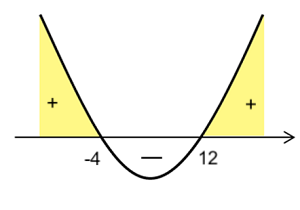
$$ y \le -4 \text{ or } y \ge 12 $$
Review Exercise 2
Question 1
\begin{align} y & = 5x + 9 \phantom{00} \text{--- (1)} \\ \\ y & = -2x^2 + 6x + 3 \phantom{00} \text{--- (2)} \\ \\ \text{Substitute } & \text{(1) into (2),} \\ 5x + 9 & = -2x^2 + 6x + 3 \\ 0 & = -2x^2 + x - 6 \\ \\ b^2 - 4ac & = (1)^2 - 4(-2)(-6) \\ & = -47 < 0 \\ \\ \implies \text{Equation } & \text{has no real roots} \\ \\ \therefore \text{Line and curve } & \text{do not intersect each other} \end{align}
Question 2
(i)
\begin{align} y & = x + 4p \phantom{00} \text{--- (1)} \\ \\ y & = -2x^2 + 5x + 1 \phantom{00} \text{--- (2)} \\ \\ \text{Substitute } & \text{(1) into (2),} \\ x + 4p & = -2x^2 + 5x + 1 \\ 0 & = -2x^2 + 4x + 1 - 4p \\ \\ b^2 - 4ac & = (4)^2 - 4(-2)(1-4p) \\ & = 16 + 8(1- 4p) \\ & = 16 + 8 - 32p \\ & = 24 - 32p \\ \\ b^2 - 4ac & < 0 \phantom{000000} [\text{No real roots since line does not meet curve}] \\ 24 -32p & < 0 \\ -32p & < -24 \\ p & > {-24 \over -32} \\ p & > {3 \over 4} \end{align}
(ii)
\begin{align} \text{From (i), } b^2 - 4ac & = 24 - 32p \\ \\ b^2 - 4ac & = 0 \\ 24 -32p & = 0 \\ -32p & = -24 \\ p & = {-24 \over -32} \\ p & = {3 \over 4} \end{align}
Question 3
\begin{align} -2x^2 & - (4 - p)x + 2p \\ \\ b^2 - 4ac & = [-(4 - p)]^2 - 4(-2)(2p) \\ & = (4 - p)^2 + 8(2p) \\ & = (4 - p)(4 - p) + 16p \\ & = 16 - 4p - 4p + p^2 + 16p \\ & = p^2 + 8p + 16 \\ & = (p + 4)(p + 4) \\ & = (p + 4)^2 \\ \\ \text{For all real } & \text{values of } p, \\ (p + 4)^2 & \ge 0 \\ b^2 - 4ac & \ge 0 \\ \\ \implies \text{Graph of } & y = -2x^2 - (4 - p)x + 2p \text{ will meet the } x \text{-axis at least once} \\ \\ \therefore \text{No real values} &\text{ of } p \text{ for which } -2x^2 - (4 - p)x + 2p \text{ is always negative} \end{align}
Question 4
(i)
\begin{align} 4ax^2 & + 9x + c \\ \\ 4a & < 0 \phantom{000000} [\text{Graph of } y = 4ax^2 + 9x + c \text{ is max. curve } \cap] \\ a & < 0 \phantom{000000} [\text{Condition 1}] \\ \\ \\ b^2 - 4ac & = (9)^2 - 4(4a)(c) \\ & = 81 - 16ac \\ \\ b^2 - 4ac & < 0 \phantom{000000} [\text{No real roots since curve lies below } x \text{-axis}] \\ 81 - 16ac & < 0 \\ -16ac & < -81 \\ ac & > {-81 \over -16} \\ ac & > {81 \over 16} \\ \\ \\ \text{Conditions: } & a < 0, ac > {81 \over 16} \end{align}
(ii)
\begin{align} \text{Let } & a = -2, \phantom{000000} [\text{to satisfy condition 1}] \\ (-2)c & > {81 \over 16} \\ -2c & > {81 \over 16} \\ c & < {81 \over 16} \div -2 \\ c & < -{81 \over 32} \\ c & < -2{17 \over 32} \\ \\ \\ \text{Possible values: } & a = -2, c = -3 \end{align}
Question 5
(i)
\begin{align} {k \over 8}x^2 + kx + 2 & > 0 \phantom{000000} [\text{i.e. expression is positive}] \\ \\ {k \over 8} & > 0 \phantom{000000} [\text{Curve of } y = {k \over 8}x^2 + kx + 2 \text{ is minimum curve } \cup] \\ k & > 0 \phantom{000000} [\text{Condition 1}] \\ \\ \\ b^2 - 4ac & = (k)^2 - 4\left(k \over 8\right)(2) \\ & = k^2 - {4k \over 8} (2) \\ & = k^2 - {8k \over 8} \\ & = k^2 - k \\ \\ b^2 - 4ac & < 0 \phantom{000000} [\text{No real roots since curve lies above } x \text{-axis}] \\ k^2 - k & < 0 \\ k(k - 1) & < 0 \end{align}
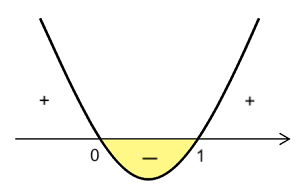
\begin{align} & 0 < k < 1 \\ \\ & \text{Also, when } k = 0, \text{ the expression is } 2 > 0 \text{ for all real values of } x \\ \\ \therefore & \phantom{.} 0 \le k < 1 \end{align}
(ii) Coincident roots means equal real roots
\begin{align}
b^2 - 4ac & = 0 \\
k^2 - k & = 0 \\
k (k - 1) & = 0
\end{align}
\begin{align}
k & = 0 \text{ (Reject: the equation becomes } 2 = 0 \text{, which has no roots)} && \text{ or } & k - 1 & = 0 \\
& &&& k & = 1
\end{align}
Question 6
\begin{align}
2y & = x + 6 \\
y & = {1 \over 2}(x + 6) \\
y & = {1 \over 2}x + 3
\phantom{00} \text{--- (1)} \\
\\
x^2 + xy + y^2 & = 36
\phantom{00} \text{--- (2)} \\
\\
\text{Substitute } & \text{(1) into (2),} \\
x^2 + x \left({1 \over 2}x + 3\right) + \left({1 \over 2}x + 3\right)^2 & = 36 \\
x^2 + {1 \over 2}x^2 + 3x + \left({1 \over 2}x\right)^2 + 2\left({1 \over 2}x\right)(3) + (3)^2 & = 36
\phantom{000000} [(a + b)^2 = a^2 + 2ab + b^2] \\
{3 \over 2}x^2 + 3x + {1 \over 4}x^2 + 3x + 9 & = 36 \\
{7 \over 4}x^2 + 6x + 9 & = 36 \\
{7 \over 4}x^2 + 6x - 27 & = 0 \\
7x^2 + 24x - 108 & = 0 \\
(x + 6)(7x - 18) & = 0
\end{align}
\begin{align}
x + 6 & = 0 && \text{ or } & 7x - 18 & = 0 \\
x & = -6 &&& 7x & = 18 \\
& &&& x & = {18 \over 7} \\
\\
\text{Substitute } & \text{into (1),} &&& \text{Substitute } & \text{into (1),} \\
y & = {1 \over 2}(-6) + 3 &&& y & = {1 \over 2}\left(18 \over 7\right) + 3 \\
y & = 0 &&& y & = {30 \over 7} \\
\\
\text{Substitute } & \text{into } 5y = 2x + 12,
&&& \text{Substitute } & \text{into } 5y = 2x + 12, \\
5(0) & = 2x + 12 &&& 5\left(30 \over 7\right) & = 2x + 12 \\
0 & = 2x + 12 &&& {150 \over 7} & = 2x + 12 \\
-2x & = 12 &&& -2x & = 12 - {150 \over 7} \\
x & = {12 \over -2} &&& -2x & = -{66 \over 7} \\
x & = -6 &&& x & = -{66 \over 7} \div -2 \\
& &&& x & = {33 \over 7} \\
\\
\therefore 5y = 2x + 12 & \text{ passes } (-6, 0)
&&&
\therefore 5y = 2x + 12 & \text{ does not pass } \left({18 \over 7}, {30 \over 7}\right)
\end{align}
Question 7
\begin{align} y & = 2x^2 + 3kx \phantom{00} \text{--- (1)} \\ \\ y & = 2 - 5x \phantom{00} \text{--- (2)} \\ \\ \text{Substitute } & \text{(2) into (1),} \\ 2 - 5x & = 2x^2 + 3kx \\ 0 & = 2x^2 + 3kx +5x - 2 \\ 0 & = 2x^2 + (3k + 5)x - 2 \\ \\ b^2 - 4ac & = (3k + 5)^2 - 4(2)(-2) \\ & = (3k + 5)^2 + 16 \\ \\ \text{For all real} & \text{ values of } k, \\ (3k + 5)^2 & \ge 0 \\ (3k + 5)^2 + 16 & \ge 16 \\ b^2 - 4ac & \ge 16 > 0 \\ \\ \implies 0 = 2x^2 + (3k + 5)x & - 2 \text{ has two distinct real roots for all real values of } k \\ \\ \therefore \text{For all real values of } & k, \text{ graphs will have two points of intersection} \end{align}
Question 8
\begin{align}
\sqrt{x} - 5 & = {36 \over \sqrt{x}} \\
{ \sqrt{x} (\sqrt{x} - 5) \over \sqrt{x}} & = {36 \over \sqrt{x}} \\
\sqrt{x}(\sqrt{x} - 5) & = 36 \\
\\
\text{Let } & u = \sqrt{x}, \\
u(u - 5) & = 36 \\
u^2 - 5u & = 36 \\
u^2 - 5u - 36 & = 0 \\
(u - 9)(u + 4) & = 0
\end{align}
\begin{align}
u - 9 & = 0 && \text{ or } & u + 4 & = 0 \\
u & = 9 &&& u & = -4 \\
\\
\sqrt{x} & = 9 &&& \sqrt{x} & = -4 \text{ (Reject, since } \sqrt{x} \ge 0) \\
x & = 9^2 \\
x & = 81
\end{align}
Question 9
\begin{align}
3x - 5y + 14 & = 0 \\
3x & = 5y - 14 \phantom{00} \text{--- (1)} \\
\\
{3 \over x} \times {3 \over 3} - {5 \over y} & = {1 \over 4} \\
{9 \over 3x} - {5 \over y} & = {1 \over 4}
\phantom{00} \text{--- (2)} \\
\\
\text{Substitute } & \text{(1) into (2),} \\
{9 \over 5y - 14} - {5 \over y} & = {1 \over 4} \\
{9y \over y(5y - 14)} - {5(5y - 14) \over y(5y - 14)} & = {1 \over 4} \\
{9y - 5(5y -14) \over y(5y - 14)} & = {1 \over 4} \\
{9y - 25y + 70 \over y(5y - 14)} & = {1 \over 4} \\
{-16y + 70 \over y(5y - 14)} & = {1 \over 4} \\
4(-16y + 70) & = y(5y - 14) \\
-64y + 280 & = 5y^2 - 14y \\
0 & = 5y^2 + 50y - 280 \\
0 & = y^2 + 10y - 56 \\
0 & = (y + 14)(y - 4)
\end{align}
\begin{align}
y + 14 & = 0 && \text{ or } & y - 4 & = 0 \\
y & = -14 &&& y & = 4 \\
\\
\text{Substitute } & \text{into (1),} &&& \text{Substitute } & \text{into (1),} \\
3x & = 5(-14) - 14 &&& 3x & = 5(4) - 14 \\
3x & = -84 &&& 3x & = 6 \\
x & = {-84 \over 3} &&& x & = {6 \over 3} \\
x & = -28 &&& x & = 2 \\
\\ \\
\therefore x & = -28, y = -14 &&& \therefore x & = 2, y = 4
\end{align}
Question 10
(i)
\begin{align} y & = -0.25x^2 + 0.2x + 0.1 \\ \\ \text{Let } & x = 0, \\ y & = -0.25(0)^2 + 0.2(0)+ 0.1 \\ y & = 0.1 \\ \\ \text{Initially,} & \text{ the frog is 0.1 m above the ground} \end{align}
(ii)
\begin{align} y & = -0.25x^2 + 0.2x + 0.1 \phantom{00} \text{--- (1)} \\ \\ y & = 0.45x - 0.24 \phantom{00} \text{--- (2)} \\ \\ \text{Substitute } & \text{(2) into (1),} \\ 0.45x - 0.24 & = -0.25x^2 + 0.2x + 0.1 \\ 0 & = -0.25x^2 - 0.25x + 0.34 \\ \\ b^2 - 4ac & = (-0.25)^2 - 4(-0.25)(0.34) \\ & = 0.4025 > 0 \\ \\ \implies 0 = -0.25x^2 &- 0.25x + 0.34 \text{ has two distinct roots} \\ \\ x & = {-(-0.25) \pm \sqrt{0.4025} \over 2(-0.25)} \\ & = -1.7689 \text{ (Reject, since } x \ge 0) \text{ or } 0.76886 \\ \\ \text{Substitute } & x = 0.76886 \text{ into (2),} \\ y & = 0.45(0.76886) - 0.24 \\ & = 0.10599 > 0 \phantom{000} [\text{Frog is still above the ground}] \\ \\ \therefore \text{Frog } & \text{catches the dragonfly about 0.769 m horizontally from the start} \end{align}
(iii)
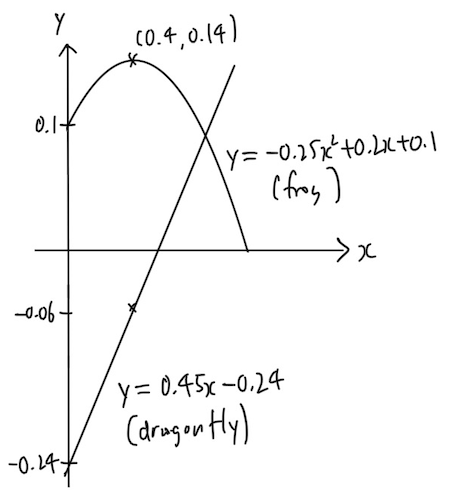
\begin{align} y & = -0.25x^2 + 0.2x + 0.1 \phantom{000000} [\text{Maximum curve } \cap] \\ y & = -0.25(x^2 - 0.8x) + 0.1 \\ y & = -0.25 \left[ x^2 - 0.8x + \left(0.8 \over 2\right)^2 - \left(0.8 \over 2\right)^2 \right] + 0.1 \\ y & = -0.25 ( x^2 - 0.8x + 0.4^2 - 0.4^2 ) + 0.1 \\ y & = -0.25 [ (x - 0.4)^2 - 0.16 ] + 0.1 \\ y & = -0.25(x - 0.4)^2 + 0.04 + 0.1 \\ y & = -0.25(x - 0.4)^2 + 0.14 \\ \\ \text{Turning } & \text{point: } (0.4, 0.14) \\ \\ \text{From (i), } & y \text{-intercept} = 0.1 \\ \\ \\ y & = 0.45x - 0.24 \\ \\ \text{Let } & x = 0, \\ y & = 0.45(0) - 0.24 \\ y & = -0.24 \\ \\ \text{Let } & x = 0.4, \\ y & = 0.45(0.4) - 0.24 \\ y & = -0.06 \end{align}
Question 11
(i)
\begin{align} (6x + 17)(x - 2)(x^2 + 2) & = (6x^2 - 12x + 17x - 34)(x^2 + 2) \\ & = (6x^2 + 5x - 34)(x^2 + 2) \\ & = 6x^4 + 12x^2 + 5x^3 + 10x - 34x^2 - 68 \\ & = 6x^4 + 5x^3 - 22x^2 + 10x - 68 \phantom{00} (\text{Shown}) \end{align}
(ii)
\begin{align} 6x^4 + 5x^3 - 22x^2 + 10x & < 68 \\ 6x^4 + 5x^3 - 22x^2 + 10x - 68 & < 0 \\ (6x + 17)(x - 2)(x^2 + 2) & < 0 \\ \\ \text{Since } x^2 + 2 > 0 \text{ for all } & \text{value of } x, \\ (6x + 17)(x - 2) & < 0 \end{align}
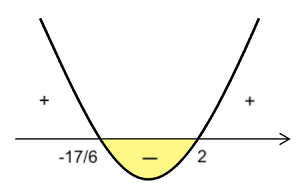
$$ -{17 \over 6} < x < 2 $$
What’s next
- Chapter 3: Surds 🔒 Subscribers
- All chapters of think! Additional Mathematics Workbook (10th Edition)
- O Level A Maths past year solutions — free, 2014 to the latest paper