think! Mathematics 4A Chapter 1: Sets — Solutions
Please email me if you spot a mistake or have a question.
Choose an exercise, then tap a question to show its worked solution.
Practise Now 1–11
Practise Now 1A Question 1
(i)
\begin{align} A & = \{ 2, 4, 6, 8 \} \end{align}
(ii)(a)
\begin{align} \text{True} \end{align}
(ii)(b)
\begin{align} \text{True} \end{align}
(ii)(c)
\begin{align} \text{False} \end{align}
(ii)(d)
\begin{align} \text{True} \end{align}
(iii)(a)
\begin{align} 2 & \in A \end{align}
(iii)(b)
\begin{align} 5 \notin A \end{align}
(iii)(c)
\begin{align} 11 \notin A \end{align}
(iii)(d)
\begin{align} 6 & \in A \end{align}
(iv)
\begin{align} n(A) & = 4 \end{align}
Practise Now 1A Question 2
\begin{align} B & = \{ 3, 6, 9, 12, 15, 18, 21, 24, 27, 30 \} \\ \\ n(B) & = 10 \end{align}
Practise Now 1B
(i)
\begin{align} C & = \{ 11, 12, 13, 14, 15, 16, 17 \} \\ \\ D & = \{ 10, 11, 12, 13, 14, 15, 16, 17 \} \end{align}
(ii)
\begin{align} n(C) & = 7 \\ \\ n(D) & = 8 \\ \\ \therefore n(C) & \ne n(D) \end{align}
(iii)
\begin{align} \text{No, since set } D \text{ has an additional element 10} \end{align}
Practise Now 2
(i)
\begin{align} P & = \emptyset \phantom{000000} [\text{Consonants are non-vowels, i.e. letters that are not A E I O U}] \\ \\ Q & = \emptyset \phantom{000000} [\text{Prime numbers: } 2, 3, 5, 7, 11, 13, ...] \\ \\ [R & \text{ is not empty since it contains the symbol } \emptyset ] \end{align}
(ii)
\begin{align} & \text{Yes, since both sets do not contain any element} \end{align}
(iii)
\begin{align} & \text{No, since } Q \text{ is an empty set while } R \text{ contains 1 element} \end{align}
Practise Now 3
(i)
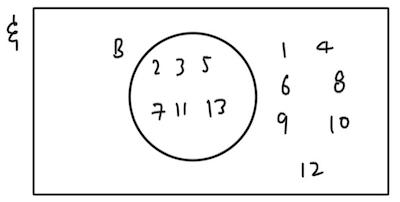
\begin{align} \xi & = \{ 1, 2, 3, 4, 5, 6, 7, 8, 9, 10, 11, 12, 13 \} \\ \\ B & = \{ 2, 3, 5, 7, 11, 13 \} \end{align}
(ii)
(iii)
\begin{align} B' & = \{ 1, 4, 6, 8, 9, 10, 12 \} \end{align}
(iv)
\begin{align} B' \text{ is the set of integers between 1 and 13 inclusive that are not prime numbers} \end{align}
(v)
\begin{align} n (\xi) & = 13 \\ \\ n (B) & = 6 \\ \\ n (B') & = 7 \end{align}
(vi)
\begin{align} & \text{Yes, since } B \text{ and } B' \text{ have no common elements} \\ & \text{and together contain every element of the universal set } \xi. \\ \\ n(B) + n(B') & = 6 + 7 \\ & = 13 = n(\xi) \end{align}
Practise Now 4A Question 1
(i)
(ii)
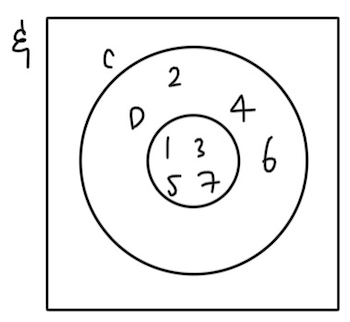
\begin{align} \text{Yes, since all elements in } D \text{ are in } C \text{ and there are more elements in } C \text{ than in } D \end{align}
(iii)
\begin{align} \text{Yes, since } 2, 4, 6 \text{ belong to } C \text{ but not to } D \end{align}
Practise Now 4A Question 2
(a)
\begin{align} \text{True} \end{align}
(b)
\begin{align} \text{True} \phantom{000000} [\text{Since both sets have the same elements}] \end{align}
(c)
\begin{align} \text{True} \phantom{000000} [\text{Since both sets have the same elements}] \end{align}
(d)
\begin{align} \text{False} \end{align}
Practise Now 4A Question 3
(i)
\begin{align} P & = \{ 1, 2, 3, 4, 5, 6, 7, 8, 9, 10, 11, 12, 13 \} \\ \\ Q & = \{ 2, 3, 5, 7, 11 \} \end{align}
(ii)
\begin{align} Q & \subset P \\ \\ \text{Every element in } Q \text{ is in } P & \text{ and there are elements in } P \text{ that are not in } Q \end{align}
(iii)
\begin{align} R & = \{ 1, 2, 3, 4, 5, 6, 7, 8, 9, 10, 11, 12, 13 \} \end{align}
(iv)
\begin{align} P \subseteq R \text{ and } R & \subseteq P \\ \\ \text{Every element in } P \text{ is in } R & \text{ (and vice versa)} \end{align}
Practise Now 4B
(a)
\begin{align} \{ \}, \{7 \} , \{ 8 \}, \{ 7, 8 \} \end{align}
(b)
\begin{align} \{ \}, \{ \text{a} \}, \{ \text{b} \}, \{ \text{c} \}, \{ \text{a, b} \}, \{ \text{b, c} \}, \{ \text{a, c} \}, \{ \text{a, b, c} \} \end{align}
Practise Now 5 Question 1
(i)
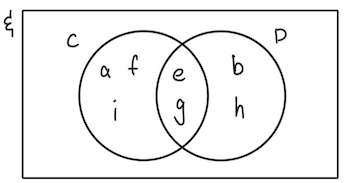
\begin{align} C \cap D & = \{ \text{e, g} \} \end{align}
(ii)
Practise Now 5 Question 2
(i)
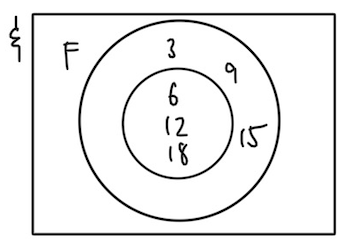
\begin{align} E & = \{ 6, 12, 18 \} \\ \\ F & = \{ 3, 6, 9, 12, 15, 18 \} \end{align}
(ii)
\begin{align} E \cap F & = \{ 6, 12, 18 \} \end{align}
(iii)
(iv)
\begin{align} \text{Yes, since } E \text{ is a proper subset of } F \end{align}
Practise Now 5 Question 3
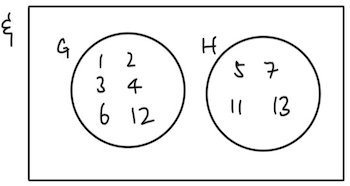
(i)
\begin{align} G & = \{ 1, 2, 3, 4, 6, 12 \} \\ \\ H & = \{ 5, 7, 11, 13 \} \end{align}
(ii)
\begin{align} G \cap H & = \emptyset \\ \\ & \text{Since } G \text{ and } H \text{ have no common elements:} \\ & \text{none of } 5, 7, 11, 13 \text{ is a factor of 12.} \end{align}
(iii)
Practise Now 6 Question 1
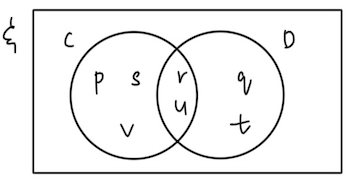
(i)
(ii)
\begin{align} C \cup D & = \{ \text{p, q, r, s, t, u, v} \} \end{align}
Practise Now 6 Question 2
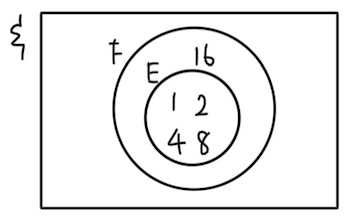
(i)
\begin{align} E & = \{ 1, 2, 4, 8 \} \\ \\ F & = \{ 1, 2, 4, 8, 16 \} \end{align}
(ii)
(iii)
\begin{align} E \cup F & = \{ 1, 2, 4, 8, 16 \} \end{align}
(iv)
\begin{align} \text{Yes, since } E \text{ is a proper subset of } F \end{align}
Practise Now 6 Question 3
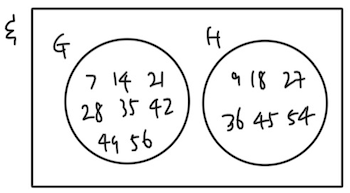
(i)
\begin{align} G & = \{ 7, 14, 21, 28, 35, 42, 49, 56 \} \\ \\ H & = \{ 9, 18, 27, 36, 45, 54 \} \end{align}
(ii)
(iii)
\begin{align} G \cup H & = \{ 7, 9, 14, 18, 21, 27, 28, 35, 36, 42, 45, 49, 54, 56 \} \end{align}
Practise Now 7 Question 1
(i)
\begin{align} \xi & = \{ 1, 2, 3, 4, 5, 6, 7, 8, 9 \} \\ \\ A & = \{ 1, 3, 5, 7, 9 \} \\ \\ B & = \{ 3, 6, 9 \} \end{align}
(ii)
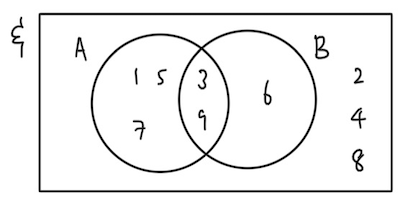
(iii)(a)
\begin{align} (A \cup B)' & = \{ 2, 4, 8 \} \end{align}
(iii)(b)
\begin{align} A \cap B' & = \{ 1, 5, 7 \} \end{align}
Practise Now 7 Question 2
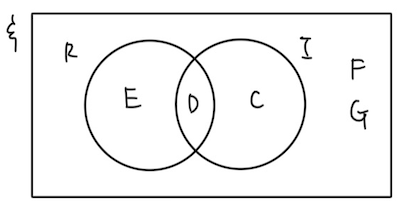
\begin{align} 3^2 + 4^2 & = 25 \\ 5^2 & = 25 \\ \\ \text{By the converse of Pytha} & \text{goras theorem, }E \text{ is a right-angled triangle} \end{align}
Practise Now 8
(i)
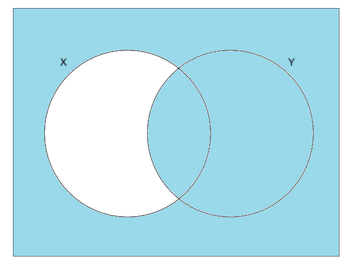
(ii)
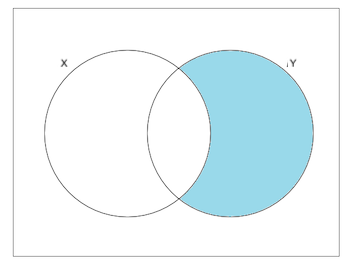
(iii)
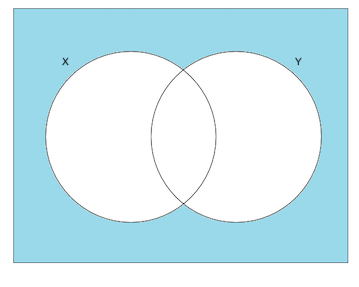
(iv)
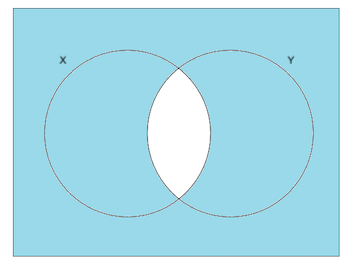
(v)
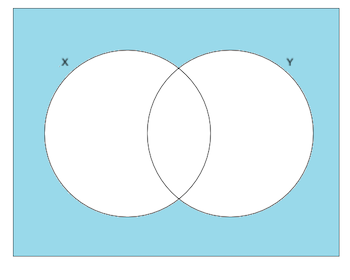
(vi)
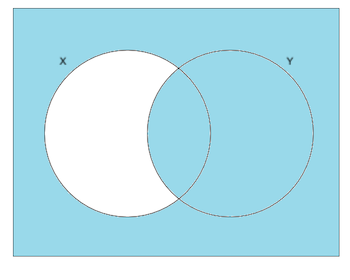
Practise Now 9
(a)
$$ X' \cap Y $$
(b)
$$ (X' \cap Y) \cup (X \cap Y') $$
(c)
$$ Y' $$
(d)
$$ X \cup Y' $$
Practise Now 10 Question 1
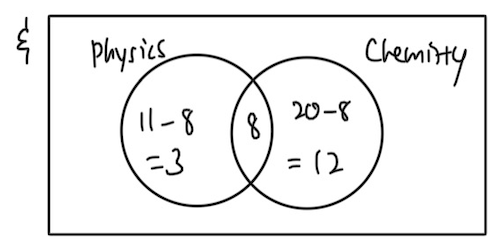
\begin{align} \text{No. of students} & = 38 - 3 - 8 - 12 \\ & = 15 \end{align}
Practise Now 10 Question 2
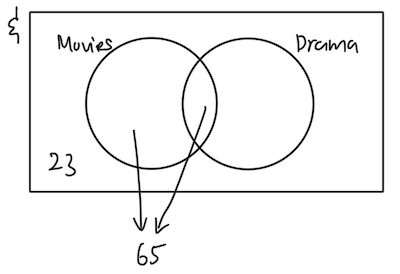
\begin{align} \text{No. of participants} & = 117 - 65 - 23 \\ & = 29 \end{align}
Practise Now 11 Question 1
(i)
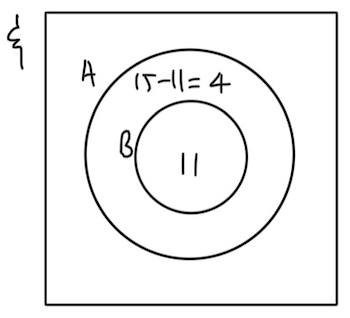
\begin{align} \text{Largest value of } n(A \cup B)' & = 23 - 15 \\ & = 8 \end{align}
(ii)
\begin{align} 15 + 11 & = 26 \\ \\ 26 - 23 & = 3 \end{align}
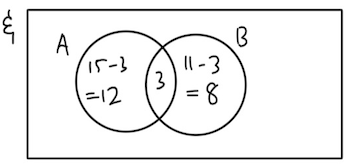
\begin{align} \text{Smallest value of } n(A \cup B)' & = 0 \end{align}
Practise Now 11 Question 2
(i)
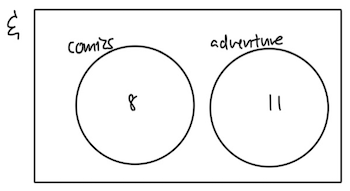
\begin{align} \text{Largest possible no. of students} & = 8 + 11 \\ & = 19 \end{align}
(ii)
\begin{align} \text{Smallest possible no. of students} & = 36 - 19 \phantom{000000} [\text{Refer to Venn diagram in (i)}] \\ & = 17 \end{align}
(iii)
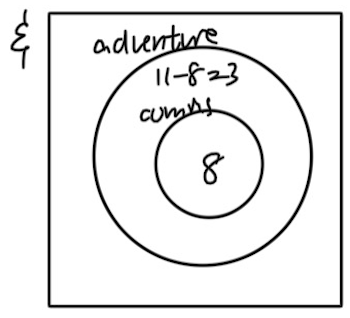
\begin{align} \text{Largest possible no. of students} & = 8 \end{align}
(iv)
\begin{align} \text{Smallest possible no. of students} & = 11 - 8 \phantom{000000} [\text{Refer to Venn diagram in (iii)}] \\ & = 3 \end{align}
Ex 1A: Sets and set notations
Question 1
(i)
\begin{align} A & = \{ 1, 3, 5, 7, 9 \} \end{align}
(ii)(a)
\begin{align} \text{True} \end{align}
(ii)(b)
\begin{align} \text{True} \end{align}
(ii)(c)
\begin{align} \text{False} \end{align}
(ii)(d)
\begin{align} \text{True} \end{align}
(iii)
\begin{align} n(A) & = 5 \phantom{000000} [\text{5 elements in set } A] \end{align}
Question 2
(a)
\begin{align} B & = \{ 2, 3, 4, 5, 6, 7, 8, 9 \} \\ \\ n(B) & = 8 \end{align}
(b)
\begin{align} C & = \{ -10, -9, -8, -7, -6, -5, -4, -3, -2, -1 \} \\ \\ n(C) & = 10 \end{align}
(c)
\begin{align} D & = \{ 2, 4, 6, 8, 10, 12 \} \\ \\ n(D) & = 6 \end{align}
(d)
\begin{align} E & = \{ \text{A} \} \phantom{000000} [\text{Vowels: A, E, I, O, U} ] \\ \\ n(E) & = 1 \end{align}
Question 3
(a)
\begin{align} F & = \{ \text{red, orange, yellow, green, blue, indigo, violet} \}\\ \\ n(F) & = 7 \end{align}
(b)
\begin{align} G & = \{ \text{New Year's Day, CNY (2 days), Good Friday, Labour Day, Hari Raya Puasa,} \\ & \phantom{0000} \text{Vesak Day, Hari Raya Haji, National Day, Deepavali, Christmas Day} \} \\ \\ n(G) & = 10 \end{align}
(c)
\begin{align} H & = \{ \text{S, Y, M, T, R} \} \\ \\ n(H) & = 5 \end{align}
(d)
\begin{align} & \text{Answers vary. List each teacher teaching your current class once.} \\ n(J) & = \text{number of distinct teachers listed} \end{align}
Question 4
(a)
\begin{align} K & = \emptyset \phantom{000000} [\text{Odd numbers are not divisible by 2}] \end{align}
(b)
\begin{align} L & = \{ 2 \} \end{align}
(c)
\begin{align} M & = \emptyset \phantom{000000} [\text{Quadrilaterals have 4 sides, thus have 4 vertices}] \end{align}
(d)
\begin{align} N & = \emptyset \end{align}
Question 5
(i)
\begin{align} P & = \{ \text{Monday, Tuesday, Wednesday, Thursday, Friday, Saturday, Sunday} \} \end{align}
(ii)(a)
\begin{align} \text{Tuesday} & \in P \end{align}
(ii)(b)
\begin{align} \text{Sunday} & \in P \end{align}
(ii)(c)
\begin{align} \text{March} & \notin P \end{align}
(ii)(d)
\begin{align} \text{Holiday} & \notin P \end{align}
(iii)
\begin{align} n(P) & = 7 \end{align}
Question 6
(i)
\begin{align} \sqrt{10} & \approx 3.162 \\ \\ 3^2 & < 10 < 4^2 \\ \\ \therefore 10 & \notin Q \phantom{000000} [\text{10 is not a perfect square}] \end{align}
(ii)
\begin{align} Q & = \{ 2^2, 3^2, 4^2, 5^2, 6^2, 7^2 \} \\ & = \{ 4, 9, 16, 25, 36, 49 \} \end{align}
(iii)
\begin{align} n(Q) & = 6 \end{align}
Question 7
(i)
\begin{align} & R \text{ is the set of non-negative even integers} \\ \\ & S \text{ is the set of non-negative even integers less than 10} \end{align}
(ii)
\begin{align} \text{No, since } & R \text{ is an infinite set while } S \text{ has 5 elements.} \end{align}
(iii)
\begin{align} \text{No, since } R \text{ contains an infinite number of non-negative even integers while } S \text{ contains the first 5 non-negative even integers} \end{align}
Question 8
(i)
\begin{align} T & = \{ \} = \emptyset \phantom{000000} [ 3^2 = 9, 4^2 = 16] \\ \\ U & = \{ 1 \} \phantom{000000000} [1^2 = 1^3 = 1 ] \\ \\ V & = \{ 0 \} \\ \\ \\ \therefore T & \text{ is an empty set} \end{align}
(ii)
\begin{align} \text{No, since } T \text{ is an empty set while } U \text{ contains an element, 1} \end{align}
(iii)
\begin{align} \text{No, since } U \text{ contains the element } 1 \text{ while } V \text{ contains the element } 0 \end{align}
Question 9
(a)
\begin{align} \text{False, since the set } \{ \text{c, a, r} \} \text{ contains the element c} \end{align}
(b)
\begin{align} \text{False, since the set } \{ \text{c, a, r} \} \text{ does not contain the word 'car'} \end{align}
(c)
\begin{align} & \text{False, since the elements of } \{ \text{c, a, r} \} \text{ are the individual letters c, a and r.} \\ & \text{The set } \{ \text{c} \} \text{ is not one of these elements.} \end{align}
(d)
\begin{align} \text{False, since } \{ \text{c, a, r} \} \text{ is a set} \end{align}
Question 10
(a)
\begin{align} X & = \{ x : x \text{ is a prime number} \} \end{align}
(b)
\begin{align} Y & = \{ x: x \text{ is a non-negative multiple of } 4 \} \end{align}
(c)
\begin{align} Z & = \{ x: x \text{ is a factor of 12} \} \end{align}
(d)
\begin{align} W & = \{ x : x \text{ is a student in my current class who wears spectacles} \} \end{align}
Question 11
(a)
\begin{align} \text{False, since the set} \{ 0 \} \text{ contains 1 element, } 0 \end{align}
(b)
\begin{align} \text{True} \end{align}
(c)
\begin{align} \text{False, since the set } \{ \emptyset \} \text{ contains exactly one element, the empty set itself} \end{align}
(d)
\begin{align} \text{True} \end{align}
Ex 1B: Venn diagrams, universal sets, complements of sets and subsets
Question 1
(i)
\begin{align} \xi & = \{ \text{cat, dog, mouse, lion, tiger} \} \\ \\ A & = \{ \text{cat, dog, mouse} \} \end{align}
(ii)
\begin{align} A' & = \{ \text{lion, tiger} \} \end{align}
Question 2
(i)
\begin{align} \xi & = \{ 1, 2, 3, 4, 5, 6, 7, 8, 9, 10 \} \\ \\ B & = \{ 2, 4, 6, 8, 10 \} \end{align}
(ii)
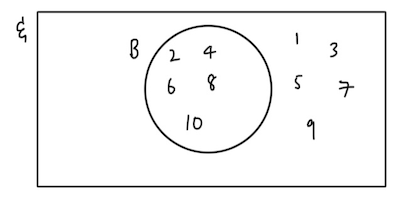
(iii)
\begin{align} B' & = \{ 1, 3, 5, 7, 9 \} \end{align}
(iv)
\begin{align} B' \text{ is the set of positive odd integers between 1 and 10 inclusive} \end{align}
Question 3
(i)
\begin{align} C & = \{ \text{s, t, u} \} \\ \\ D & = \{ \text{s, t, u, v, w, x, y, z} \} \end{align}
(ii)
\begin{align} \text{Yes, since all elements in } C \text{ are in set } D \text{ and there are more elements in } D \text{ than in } C \end{align}
Question 4
(a)
\begin{align} \text{True} \end{align}
(b)
\begin{align} \text{True, since } & \{ \text{a, b, c, d} \} = \{ \text{d, c, b, a} \}. \\ & \text{The sets are equal, so neither is a proper subset of the other.} \end{align}
(c)
\begin{align} \text{True} \end{align}
(d)
\begin{align} \text{False} \end{align}
Question 5
(a)
\begin{align} \{ \}, \{ \text{a} \}, \{ \text{b} \}, \{ \text{a, b} \} \end{align}
(b)
\begin{align} \{ \}, \{ \text{Singapore} \}, \{ \text{Malaysia} \}, \{ \text{Singapore, Malaysia} \} \end{align}
(c)
\begin{align} \{ \}, \{ 14 \}, \{ 16 \}, \{ 14,16 \} \end{align}
(d)
\begin{align} \{ \}, \{ 7 \} \end{align}
Question 6
(i)
\begin{align} \xi & = \{ 1, 2, 3, 4, 5, 6, 7, 8, 9 \} \\ \\ J' & = \{ 2, 3, 5, 7 \} \\ \\ J & = \{ 1, 4, 6, 8, 9 \} \end{align}
(ii)
\begin{align} J' \text{ is the set of the prime numbers between 0 and 10 } \end{align}
(iii)
\begin{align} n(\xi) & = 9 \\ \\ n(J) & = 5 \\ \\ n(J') & = 4 \end{align}
(iv)
\begin{align} & \text{Yes, since } J \text{ and } J' \text{ have no common elements} \\ & \text{and together contain every element of the universal set } \xi. \\ \\ n(J) + n(J') & = 5 + 4 \\ & = 9 = n(\xi) \end{align}
Question 7
(i)
\begin{align} \xi & = \{ \text{a, b, c, d, e, f, g, h, i, j} \} \\ \\ K & = \{ \text{b, c, d, f, g, h, j} \} \phantom{000000} [\text{Consonants: Non-vowels (letter except A E I O U)}] \\ \\ K' & = \{ \text{a, e, i} \} \end{align}
(ii)
\begin{align} K' \text{ is the set of vowels from the first 10 letters of the English alphabet} \end{align}
(iii)
\begin{align} n(\xi) & = 10 \\ \\ n(K) & = 7 \\ \\ n(K') & = 3 \end{align}
(iv)
\begin{align} & \text{Yes, since } K \text{ and } K' \text{ have no common elements} \\ & \text{and together contain every element of the universal set } \xi. \\ \\ n(K) + n(K') & = 7 + 3 \\ & = 10 = n(\xi) \end{align}
Question 8
(i)

(ii)
\begin{align} \text{Yes, since all elements in } M \text{ are in } L \text{ and there are more elements in } L \text{ than in } M \end{align}
(iii)
\begin{align} \text{Yes, since not all elements in } L \text{ are in } M \end{align}
Question 9
(i)
\begin{align} N & = \{ 1, 2, 3, 4, 5, 6, 7, 8, 9, 10, 11, 12, 13, 14, 15, 16, 17, 18, 19, 20 \} \\ \\ P & = \{ 4, 8, 12, 16 \} \end{align}
(ii)
\begin{align} P & \subset N \\ \\ \text{Every element in } P \text{ is in } N & \text{ and there are elements in } N \text{ that are not in } P \end{align}
(iii)
\begin{align} Q & = \{ 1, 2, 3, 4, 5, 6, 7, 8, 9, 10, 11, 12, 13, 14, 15, 16, 17, 18, 19, 20 \} \end{align}
(iv)
\begin{align} N \subseteq Q & \text{ and } Q \subseteq N \\ \\ \text{Every element in } N & \text{ is in } Q \text{ (and vice versa)} \end{align}
Question 10
(a)
\begin{align} \{ \}, \{ 7 \}, \{ 8 \}, \{ 9 \}, \{ 7, 8 \}, \{ 8, 9 \} , \{ 7, 9 \}, \{ 7, 8, 9 \} \end{align}
(b)
\begin{align} S & = \{ 2, 3, 5 \} \\ \\ \text{Possible subsets: } & \{ \}, \{ 2 \}, \{ 3 \}, \{ 5 \}, \{ 2, 3 \}, \{ 3, 5 \}, \{ 2, 5 \}, \{ 2, 3, 5 \} \end{align}
(c)
\begin{align} \{ \}, \{ \text{a} \}, \{ \text{b} \}, \{ \text{c} \}, \{ \text{d} \}, \{ \text{a, b} \}, \{ \text{b, c} \}, \{ \text{c, d} \} , \{ \text{a, c} \}, \{ \text{a, d} \}, \{ \text{b, d} \}, \{ \text{a, b, c} \}, \{ \text{a, b, d} \}, \{ \text{a, c, d} \}, \{ \text{b, c, d} \}, \{ \text{a, b, c, d} \} \end{align}
(d)
\begin{align} U & = \{ \text{U, N, I, O} \} \\ \\ \text{Possible subsets: } & \{ \}, \{ \text{U} \}, \{ \text{N} \}, \{ \text{I} \}, \{ \text{O} \}, \{ \text{U, N} \}, \{ \text{U, I} \}, \{ \text{U, O} \}, \{ \text{N, I} \}, \{ \text{N, O} \}, \{ \text{I, O} \}, \\ & \{ \text{U, N, I} \}, \{ \text{U, N, O} \}, \{ \text{U, I, O} \}, \{ \text{N, I, O} \}, \{ \text{U, N, I, O} \} \end{align}
Question 11
(i)
\begin{align} \xi & = \{ 1, 2, 3, ..., 20 \} \\ \\ V & = \{ 3, 6, 9, 12, 15, 18 \} \\ \\ V' & = \{ 1, 2, 4, 5, 7, 8, 10, 11, 13, 14, 16, 17, 19, 20 \} \end{align}
(ii)
\begin{align} V' & = \{ x : x \text{ is a positive integer less than 21 and is not a multiple of 3} \} \end{align}
Question 12
(i)
\begin{align} & [\text{A rational number can be expressed as } \frac{p}{q}, \text{ where } p, q \text{ are integers and } q \ne 0] \\ \\ & \text{Yes, since all integers can be expressed as fractions and there are some rational numbers that are not integers (i.e. } 1{1 \over 2}) \end{align}
(ii)
\begin{align} & \text{Yes, there are rational numbers that are not integers, i.e. } 1{1 \over 2}, 10.5 \end{align}
Question 13
\begin{align} \text{Consider } A & = \{ 1 \} \\ \\ n(A) & = 1 \\ \\ \text{Possible subsets: } & \{ \}, \{ 1 \} \phantom{000000} [\text{Total 2}] \\ \\ \\ \text{Consider } B & = \{ 1, 2 \} \\ \\ n(B) & = 2 \\ \\ \text{Possible subsets: } & \{ \}, \{ 1 \}, \{ 2 \}, \{ 1, 2 \} \phantom{000000} [\text{Total } 4 = 2^2] \\ \\ \\ \text{Consider } C & = \{ 1, 2, 3 \} \\ \\ n(C) & = 3 \\ \\ \text{Possible subsets: } & \{ \}, \{ 1 \}, \{ 2 \}, \{ 3 \}, \{1, 2\}, \{1, 3\}, \{ 2, 3 \}, \{ 1, 2, 3 \} \phantom{000000} [\text{Total } 8 = 2^3 ] \\ \\ \\ \\ \text{Each of the elements of } & Y \text{ has 2 choices: include it in or exclude it from a subset.} \\ \text{Multiplying the 2 choice} & \text{s for each element gives } 2^a \text{ distinct subsets.} \\ \\ \therefore \text{Number of subsets of } Y & = 2^a \end{align}
Ex 1C: Intersection and union of two sets
Question 1
(i)
\begin{align} A \cap B & = \{ 2, 4 \} \end{align}
(ii)
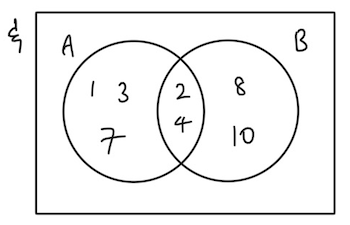
Question 2
(i)
\begin{align} C \cap D & = \{ \text{blue, yellow, pink} \} \end{align}
(ii)
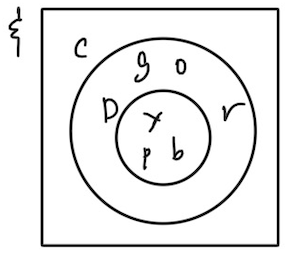
Question 3
(i)
\begin{align} E \cap F & = \emptyset \end{align}
(ii)
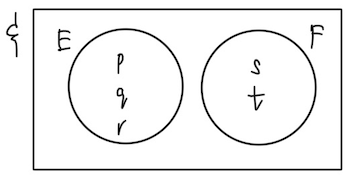
Question 4
(i)
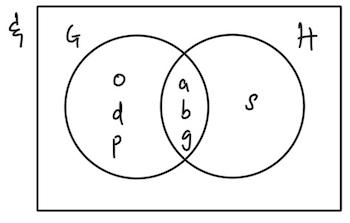
(ii)
\begin{align} G \cup H & = \{ \text{apple, orange, banana, grape, durian, pear, strawberry} \} \end{align}
Question 5
(i)
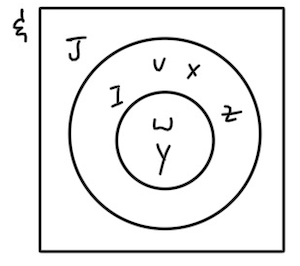
(ii)
\begin{align} I \cup J & = \{ \text{v, w, x, y, z} \} \end{align}
Question 6
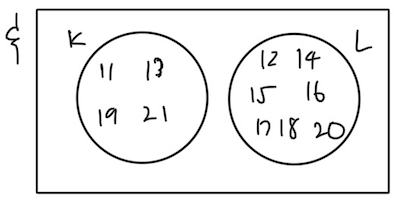
(i)
(ii)
\begin{align} K \cup L & = \{ 11, 12, 13, 14, 15, 16, 17, 18, 19, 20, 21 \} \end{align}
Question 7
(i)
\begin{align} M & = \{ 1^2, 2^2, 3^2, 4^2, 5^2, 6^2, 7^2, 8^2 \} \\ & = \{ 1, 4, 9, 16, 25, 36, 49, 64 \} \\ \\ N & = \{ 1^3, 2^3, 3^3, 4^3 \} \\ & = \{ 1, 8, 27, 64 \} \end{align}
(ii)
\begin{align} M \cap N & = \{ 1, 64 \} \end{align}
(iii)
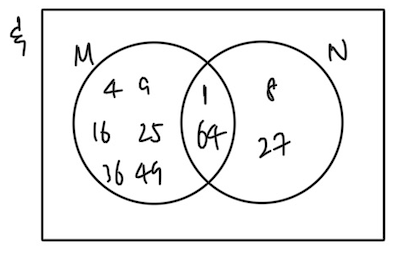
Question 8
(i)
\begin{align} P & = \{ 8, 16, 24, 32 \} \\ \\ Q & = \{ 4, 8, 12, 16, 20, 24, 28, 32 \} \end{align}
(ii)
\begin{align} P \cap Q & = \{ 8, 16, 24, 32 \} \end{align}
(iii)
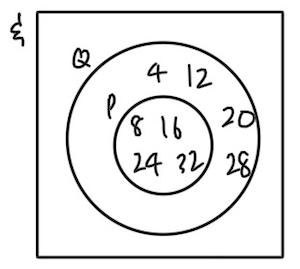
(iv)
\begin{align} \text{Yes, since } P \text{ is a proper subset of } Q \end{align}
Question 9
(i)
\begin{align} R & = \{ 1, 2, 3, 6, 9, 18 \} \\ \\ S & = \{ 10, 12, 14, 15, 16 \} \phantom{000000} [\text{Composite numbers have more than 2 factors}] \end{align}
(ii)
\begin{align} R \cap S & = \emptyset \phantom{000000} [\text{Since } R \text{ and } S \text{ have no common elements}] \end{align}
(iii)
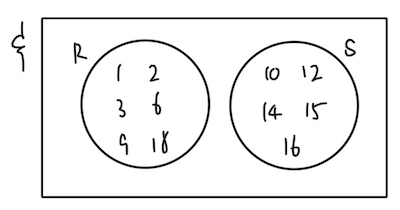
Question 10
(i)
\begin{align} T & = \{ 3, 6, 9, 12, 15, 18 \} \\ \\ V & = \{ 1, 2, 3, 6, 9, 18 \} \end{align}
(ii)
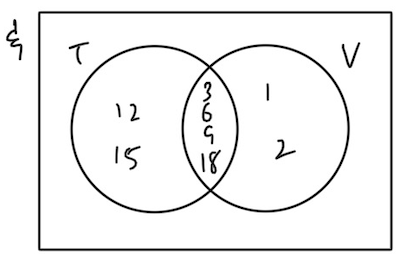
(iii)
\begin{align} T \cup V & = \{ 1, 2, 3, 6, 9, 12, 15, 18 \} \end{align}
Question 11
(i)
\begin{align} W & = \{ 4, 8, 12 \} \\ \\ X & = \{ 1, 2, 3, 4, 6, 8, 12, 24 \} \end{align}
(ii)
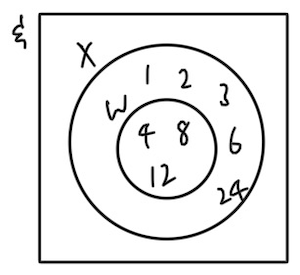
(iii)
\begin{align} W \cup X & = \{ 1, 2, 3, 4, 6, 8, 12, 24 \} \end{align}
(iv)
\begin{align} \text{Yes, since } W \text{ is a proper subset of } X \end{align}
Question 12
(i)
\begin{align} Y & = \{ 1, 5, 25 \} \\ \\ Z & = \{ 6, 12, 18, 24 \} \end{align}
(ii)
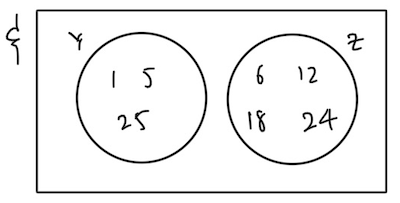
(iii)
\begin{align} Y \cup Z & = \{ 1, 5, 6, 12, 18, 24, 25 \} \end{align}
Question 13
\begin{align}
y & = x^2 - 3x + 2 \\
\\
\text{Let } & y = 0, \\
0 & = x^2 - 3x + 2 \\
0 & = (x - 1)(x - 2)
\end{align}
\begin{align}
x - 1 & = 0 && \text{ or } & x - 2 & =0 \\
x & = 1 &&& x & = 2 \\
\\
\therefore & \phantom{.} (1, 0) &&& \therefore & \phantom{.} (2, 0)
\end{align}
\begin{align}
\therefore A \cap B & = \{ (1, 0), (2, 0) \} \\
\\
A \cap B & = \{ (x, y) : (x, y) \text{ are the points on the curve where } y = 0 \}
\end{align}
Question 14
\begin{align}
y & = x^2 + x + 2 \phantom{00} \text{--- (1)} \\
\\
y & = 3x + 5 \phantom{00} \text{--- (2)} \\
\\
\text{Substitute} & \text{ (2) into (1),} \\
3x + 5 & = x^2 + x + 2 \\
0 & = x^2 - 2x - 3 \\
0 & = (x + 1)(x - 3)
\end{align}
\begin{align}
x + 1 & = 0 && \text{ or } & x - 3 & = 0 \\
x & = -1 &&& x & = 3 \\
\\
\text{Substitute } & \text{into (2),} &&& \text{Substitute } & \text{into (2),} \\
y & = 3(-1) + 5 &&& y & = 3(3) + 5 \\
y & = 2 &&& y & = 14 \\
\\
\therefore & \phantom{.} (-1, 2) &&& \therefore & \phantom{.} (3, 14)
\end{align}
\begin{align}
C \cap D & = \{ (-1, 2), (3, 14) \}
\end{align}
Question 15
\begin{align} y = (x - 5)^2 + 3 & \rightarrow \text{Minimum curve with turning point } (5, 3) \\ \\ y = (x + 2)^2 - 4 & \rightarrow \text{Minimum curve with turning point } (-2, -4) \\ \\ \\ \therefore E \cup F & = \{ y: y \text{ is a real number such that } y \ge - 4 \} \end{align}
Ex 1D
Question 1
(i)
\begin{align} \xi & = \{ 1, 2, 3, 4, 5, 6, 7, 8, 9, 10, 11, 12, 13, 14, 15 \} \\ \\ I & = \{ 4, 8, 12 \} \\ \\ J & = \{ 1, 2, 4, 8 \} \end{align}
(ii)
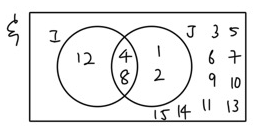
(iii)(a)
\begin{align} ( I \cup J )' & = \{ 3, 5, 6, 7, 9, 10, 11, 13, 14, 15 \} \end{align}
(iii)(b)
\begin{align} I \cap J' & = \{ 12 \} \end{align}
Question 2
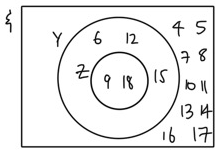
(i)
\begin{align} \xi & = \{ 4, 5, 6, 7, 8, 9, 10, 11, 12, 13, 14, 15, 16, 17, 18 \} \\ \\ Y & = \{ 6, 9, 12, 15, 18 \} \\ \\ Z & = \{ 9, 18 \} \end{align}
(ii)
(iii)(a)
\begin{align} (Y \cup Z)' & = \{ 4, 5, 7, 8, 10, 11, 13, 14, 16, 17 \} \end{align}
(iii)(b)
\begin{align} Y \cap Z' & = \{ 6, 12, 15 \} \end{align}
Question 3
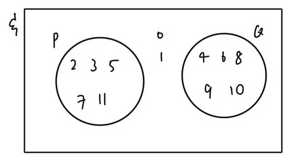
(i)
\begin{align} \xi & = \{ 0, 1, 2, 3, 4, 5, 6, 7, 8, 9, 10, 11 \} \\ \\ P & = \{ 2, 3, 5, 7, 11 \} \\ \\ Q & = \{ 4, 6, 8, 9, 10 \} \phantom{000000} [\text{Composite number has more than 2 factors}] \end{align}
(ii)
(iii)(a)
\begin{align} P \cup Q & = \{ 2, 3, 4, 5, 6, 7, 8, 9, 10, 11 \} \end{align}
(iii)(b)
\begin{align} (P \cup Q)' & = \{ 0, 1 \} \end{align}
(iii)(c)
\begin{align} P' \cap Q & = \{ 4, 6, 8, 9, 10 \} \end{align}
Question 4
(i)
(ii)
(iii)
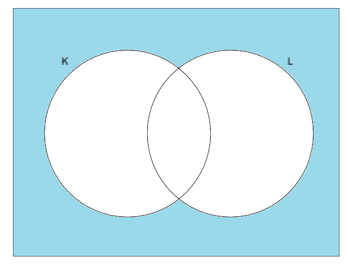
Question 5
(a)
$$ A $$
(b)
$$ B $$
(c)
$$ A \cap B $$
(d)
$$ A \cup B $$
(e)
$$ A' $$
(f)
$$ B' $$
Question 6
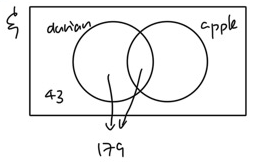
\begin{align} \text{No. of people} & = 253 - 43 - 179 \\ & = 31 \end{align}
Question 7
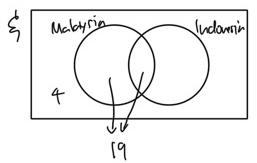
\begin{align} \text{No. of students} & = 38 - 4 - 19 \\ & = 15 \end{align}
Question 8
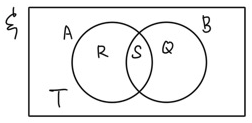
Question 9
(i)
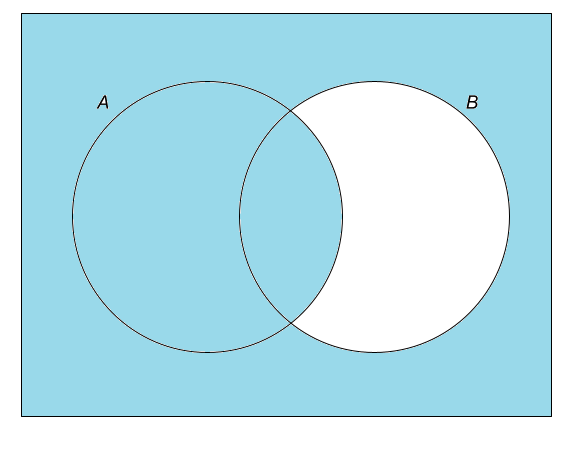
(ii)
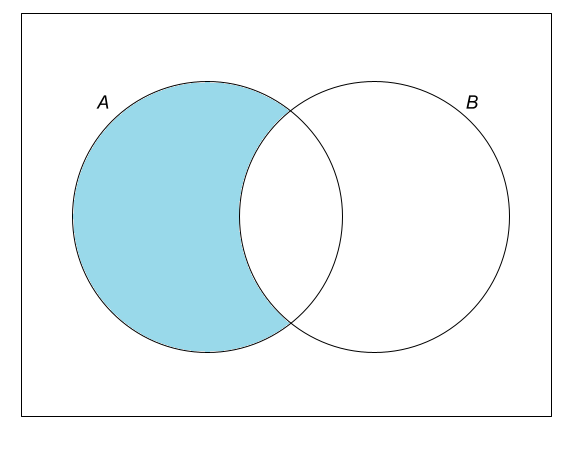
(iii)
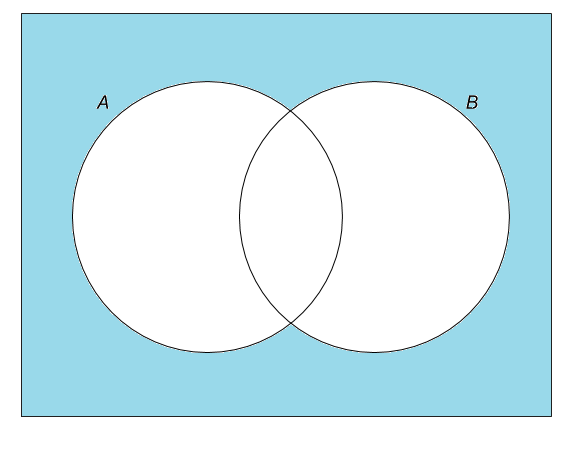
(iv)
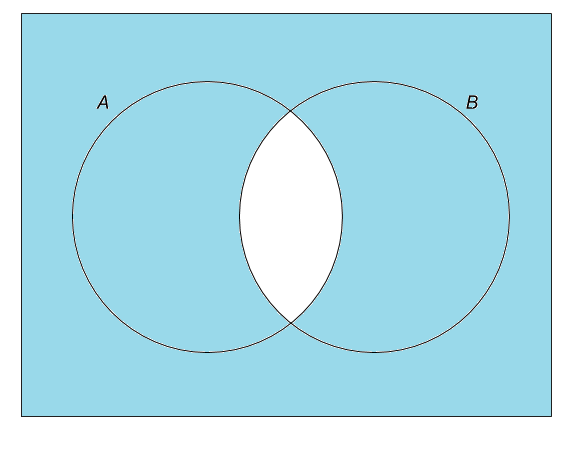
(v)

(vi)

(vii)
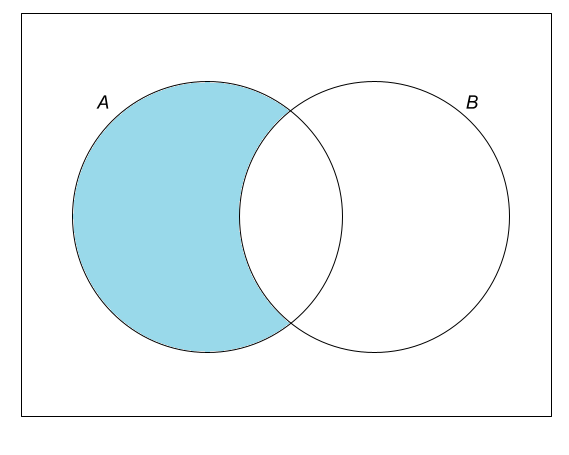
(viii)
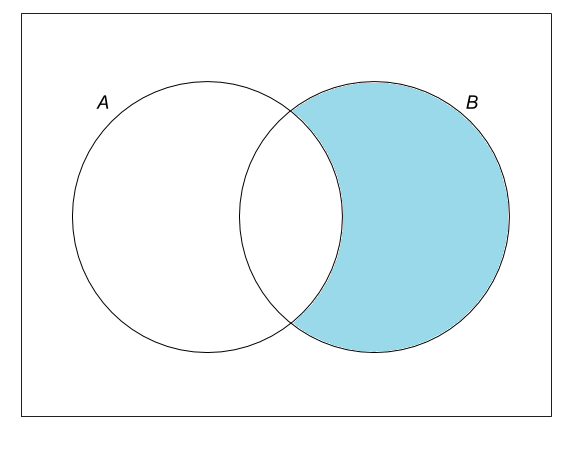
Question 10
(i)
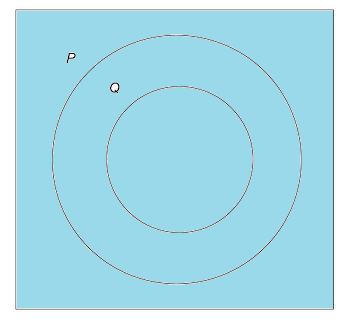
(ii)
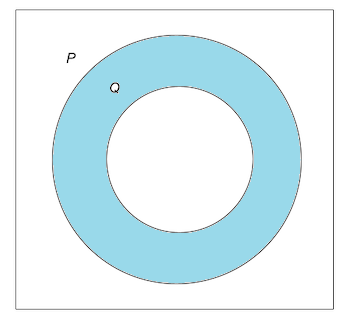
(iii)
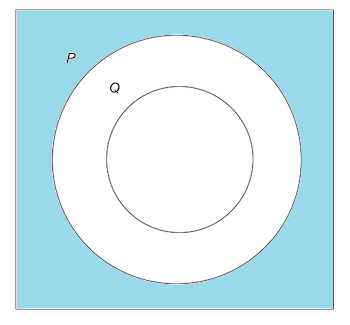
(iv)
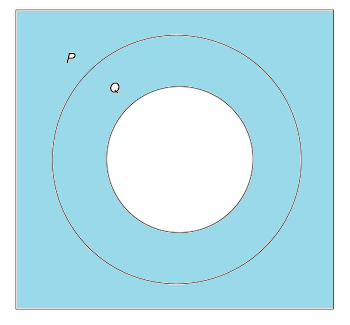
(v)
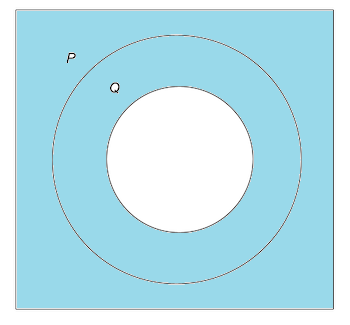
(vi)
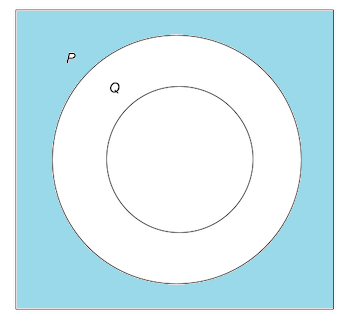
(vii)
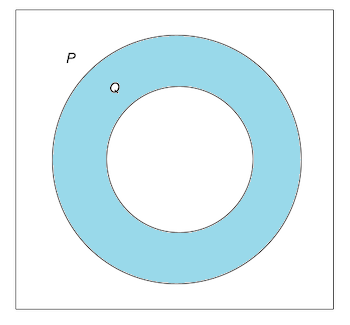
(viii)
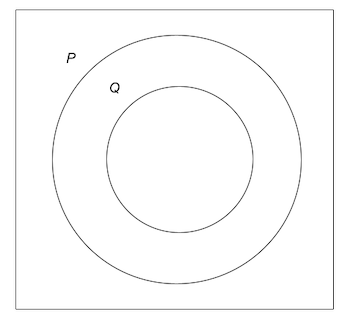
(Yeah it's blank!)
Question 11
(i)
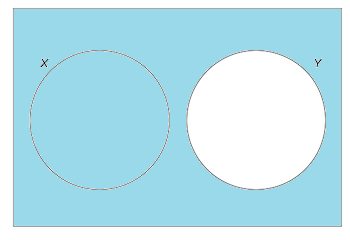
(ii)
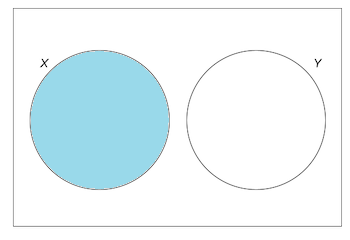
(iii)
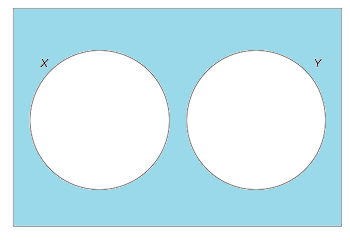
(iv)
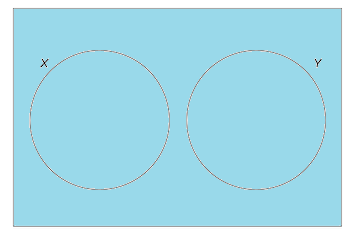
(v)
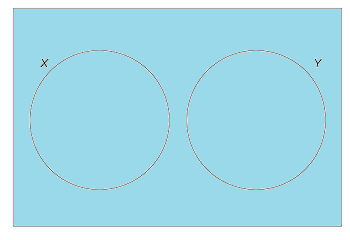
(vi)
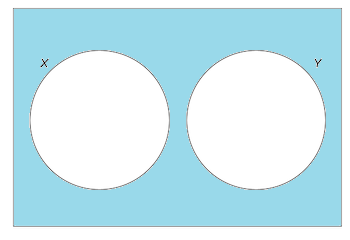
(vii)
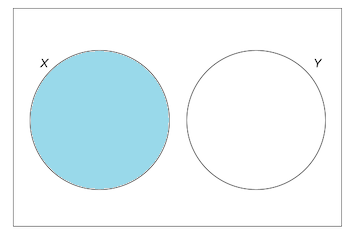
(viii)
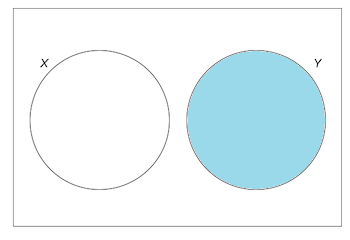
Question 12
(a)
$$ X \cap Y' $$
(b)
$$ X' \cap Y $$
(c)
$$ (X \cup Y)' $$
(d)
$$ (X \cap Y)' $$
(e)
$$ X \cup Y' $$
(f)
$$ X' \cup Y $$
(g)
$$ X \cap Y' $$
(h)
$$ X' \cup Y $$
Question 13
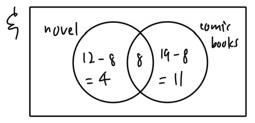
\begin{align} \text{No. of students} & = 37 - 4 - 8 - 11 \\ & = 14 \end{align}
Question 14
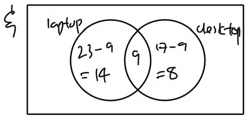
\begin{align} \text{No. of people} & = 14 + 8 \\ & = 22 \end{align}
Question 15
(i)
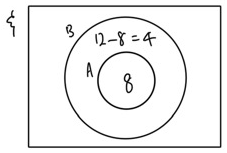
\begin{align} n(A \cup B)' & = 17 - 4 - 8 \\ & = 5 \end{align}
(ii)
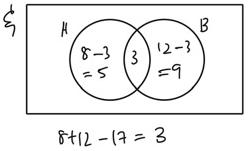
\begin{align} n(A \cup B)' & = 0 \end{align}
Question 16
(i)
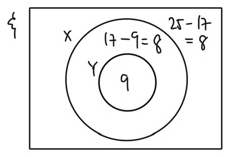
\begin{align} n(X \cap Y)' & = 8 + 8 \\ & = 16 \end{align}
(ii)
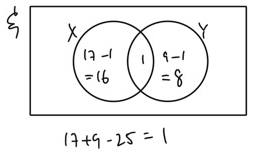
\begin{align} n(X \cap Y)' & = 25 - 1 \\ & = 24 \end{align}
Question 17
(i)
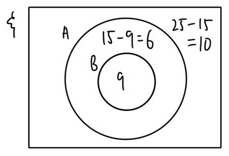
\begin{align} n(A \cup B)' & = 10 \end{align}
(ii)
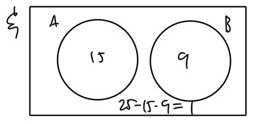
\begin{align} n(A \cup B)' & = 1 \end{align}
Question 18
(i)
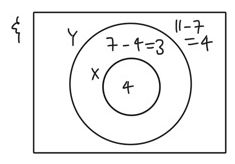
\begin{align} n (X \cap Y)' & = 3 + 4 \\ & = 7 \end{align}
(ii)
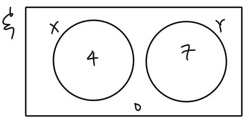
\begin{align} n (X \cap Y)' & = 4 + 7 \\ & = 11 \end{align}
Question 19
(i)
\begin{align} A \cap \xi & = A \end{align}
(ii)
\begin{align} A \cup \xi & = \xi \end{align}
(iii)
\begin{align} A \cap \emptyset & = \emptyset \end{align}
(iv)
\begin{align} A \cup \emptyset & = A \end{align}
Question 20
(i)
\begin{align} A \cap B & = A \phantom{000000} [\text{Since } A \text{ is a proper subset of } B] \end{align}
(ii)
\begin{align} A \cup B & = B \phantom{000000} [\text{Since } A \text{ is a proper subset of } B] \end{align}
(iii)
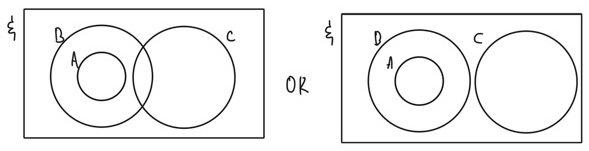
\begin{align} \text{Not possible to simplify} \end{align}
(iv)
\begin{align} \text{Not possible to simplify} \end{align}
(v)
\begin{align} (B \cup C) \cap A & = A \end{align}
(vi)
\begin{align} (B \cap C) \cap A & = \emptyset \end{align}
(vii)
\begin{align} \text{Not possible to simplify} \end{align}
(viii)
\begin{align} (A \cap C) \cup B & = B \end{align}
Question 21
(i)
\begin{align} (P \cap Q') \cup (P' \cap Q) \end{align}
(ii)
\begin{align} [(P \cap Q') \cup (P' \cap Q)] \cup (P' \cap Q') \end{align}
Question 22
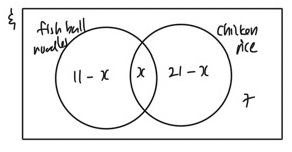
\begin{align} \text{Let no. of students who like both} & = x \\ \\ 11 - x + x + 21 - x + 7 & = 35 \\ -x + x - x & = 35 - 11 - 21 - 7 \\ -x & = -4 \\ x & = 4 \end{align}
Question 23
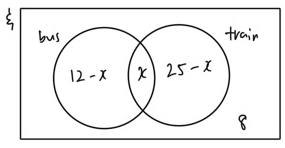
\begin{align} \text{Let no. of adults that commute by both ways} & = x \\ \\ 12 - x + x + 25 - x + 8 & = 40 \\ - x + x - x & = 40 - 12 - 25 - 8 \\ - x & = - 5 \\ x & = 5 \\ \\ \text{No. of adults who commute by bus or by train but not both} & = 12 - x + 25 - x \\ & = 37 - 2 x\\ & = 37 - 2(5) \\ & = 27 \end{align}
Question 24
(i)

\begin{align} \text{No. of students} & = 15 + 9 \\ & = 24 \end{align}
(ii)
\begin{align} \text{No. of students} & = 38 - 15 - 9 \phantom{000000} [\text{Refer to Venn diagram in (i)}] \\ & = 14 \end{align}
(iii)

\begin{align} \text{No. of students} & = 9 \end{align}
(iv)
\begin{align} \text{No. of students} & = 0 \phantom{000000} [\text{Refer to Venn diagram in iii - all students} \\ & \phantom{0000000000} \text{who enjoy swimming enjoy cycling as well!}] \end{align}
Question 25
(i)
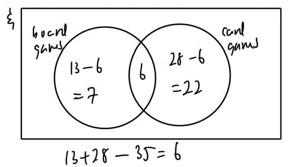
\begin{align} \text{No. of children} & = 6 \end{align}
(ii)
\begin{align} \text{No. of children} & = 35 - 7 - 6 - 22 \phantom{000000} [\text{Refer to Venn diagram in i}] \\ & = 0 \end{align}
(iii)
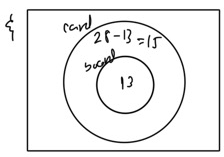
\begin{align} \text{No. of children} & = 15 + 13 \\ & = 28 \end{align}
(iv)
\begin{align} \text{No. of children} & = 15 \phantom{000000} [\text{Refer to Venn diagram in iii}] \end{align}
Review Exercise 1
Question 1
(i)
\begin{align} 5 \in B \end{align}
(ii)
\begin{align} \{ 6 , 9 \} \not\subset A \end{align}
(iii)
\begin{align} \{ 4, 11, 16 \} \subset C' \end{align}
(iv)
\begin{align} B' \cup C' & = \xi \end{align}
Question 2
(i)
\begin{align} A & = \{ 2, 4, 6, 8, 10, 12 \} \end{align}
(ii)(a)
$$ \text{False} $$
(ii)(b)
$$ \text{False} $$
(ii)(c)
$$ \text{True} $$
(ii)(d)
$$ \text{True} $$
(iii)(a)
\begin{align} -4 \notin A \end{align}
(iii)(b)
\begin{align} 6 \in A \end{align}
(iii)(c)
\begin{align} 0 \notin A \end{align}
(iii)(d)
\begin{align} 9 \notin A \end{align}
Question 3
(a)
\begin{align} A & = \{ 2 \} \end{align}
(b)
\begin{align} B & = \{ \text{Saturday, Sunday} \} \end{align}
(c)
\begin{align} C & = \emptyset \phantom{000000} [\text{Factors of 24: 1, 2, 3, 4, 6, 8, 12, 24 (None multiples of 9)}] \end{align}
(d)
\begin{align} D & = \emptyset \phantom{000000} [360^\circ \div 4 = 90^\circ \implies \text{Not possible for four obtuse angles}] \end{align}
Question 4
(i)
\begin{align} A' & = \{ -4, -2, 0, 1, 3 \} \end{align}
(ii)
\begin{align} B' & = \emptyset \end{align}
(iii)
\begin{align} C & = \{ 2, 3 \} \\ \\ C' & = \{ -5, -4, -3, -2, -1, 0, 1 \} \end{align}
(iv)
\begin{align} D & = \{ 3 \} \\ \\ D' & = \{ -5, -4, -3, -2, -1, 0, 1, 2 \} \end{align}
Question 5
(a)
\begin{align} \text{True (since every element in } X \text{ is in } Y) \end{align}
(b)
\begin{align} \text{False} \end{align}
(c)
\begin{align} \text{True} \end{align}
(d)
\begin{align} \text{True} \end{align}
Question 6
(i)
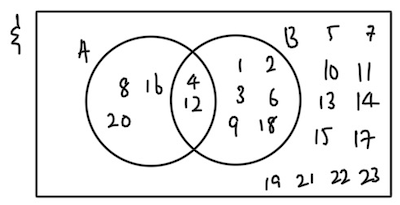
(ii)
\begin{align} A \cup B' & = \{ 4, 5, 7, 8, 10, 11, 12, 13, 14, 15, 16, 17, 19, 20, 21, 22, 23 \} \end{align}
Question 7
(i)
\begin{align} \xi & = \{ -7, -6, -5, -4, -3, -2, -1, 0, 1, 2, 3, 4, 5, 6, 7 \} \\ \\ A & = \{ -6, -5, -4, -3, -2, -1, 0, 1, 2, 3, 4, 5, 6 \} \\ \\ A' & = \{ -7, 7 \} \end{align}
(ii)
\begin{align} B & = \{ 1, 2, 3, 4, 5, 6, 7 \} \\ \\ A \cap B & = \{ 1, 2, 3, 4, 5, 6 \} \end{align}
(iii)
\begin{align} B' & = \{ -7, -6, -5, -4, -3, -2, -1, 0 \} \\ \\ A \cup B' & = \{ -7, -6, -5, -4, -3, -2, -1, 0, 1, 2, 3, 4, 5, 6 \} \end{align}
Question 8
(i)

(ii)
\begin{align} A' \cap B' & = \{ 3, 5, 6, 7, 8, 10, 11, 12, 14, 15 \} \end{align}
Question 9
(i)
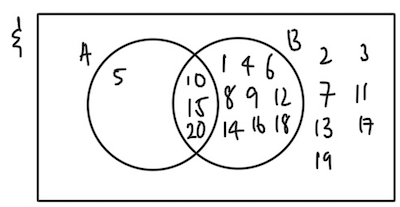
(ii)
\begin{align} A \cap B' & = \{ 5 \} \end{align}
Question 10
\begin{align} \text{Proper subsets of } S: & \{ \}, \{ \text{s} \}, \{ \text{i} \}, \{ \text{t} \}, \{ \text{s, i} \}, \{ \text{s, t} \}, \{ \text{i, t} \} \phantom{000000} [\{ \text{s, i, t} \} \text{ is not a proper subset}] \end{align}
Question 11

Note: A rational number can be written as \( \frac{p}{q} \), where \( p \) and \( q \) are integers and \( q \ne 0 \). Thus, all integers are rational numbers, i.e. \( 5 = \frac{5}{1} = \frac{10}{2} \)
Question 12
(i)
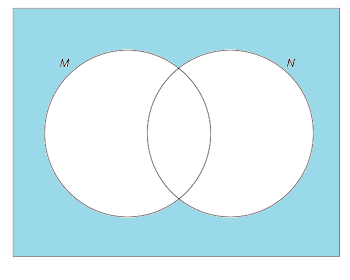
(ii)

(iii)
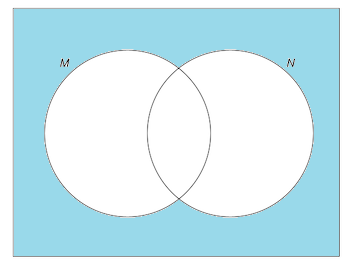
Question 13
(a)
\begin{align} (P \cup Q)' \end{align}
(b)
\begin{align} P' \cup Q \end{align}
(c)
\begin{align} P \cup Q' \end{align}
(d)
\begin{align} P \cap Q \end{align}
Question 14
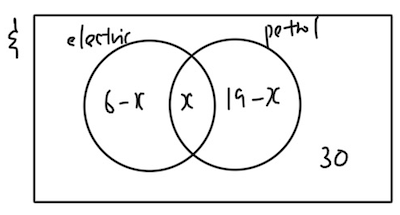
\begin{align} \text{Let no. of people with both types of cars} & = x \\ \\ 6 - x + x + 19 - x + 30 & = 53 \\ -x + x - x & = 53 - 6 - 19 - 30 \\ -x & = - 2 \\ x & = 2 \\ \\ \text{No. of people with either electric or petrol cars, but not both} & = 6 - x + 19 - x \\ & = 25 - 2x \\ & = 25 - 2(2) \\ & = 21 \end{align}
Question 15
(i)
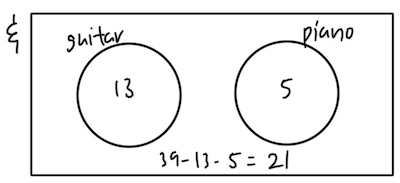
\begin{align} \text{No. of students} & = 13 + 5 \\ & = 18 \end{align}
(ii)
\begin{align} \text{No. of students} & = 21 \phantom{000000} [\text{Refer to Venn diagram in (i)}] \end{align}
(iii)
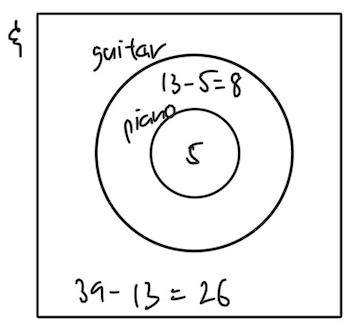
\begin{align} \text{No. of students} & = 5 \end{align}
(iv)
\begin{align} \text{No. of students} & = 0 \phantom{000000} [\text{Refer to Venn diagram in (iii) - Every student who plays piano} \\ & \phantom{0000000000} \text{also plays guitar}] \end{align}
What’s next
- Chapter 2: Probability of Combined Events 🔒 Subscribers
- All chapters of think! Mathematics 4A & 4B
- O Level E Maths past year solutions — free, 2016 to the latest paper