Revision notes
Double angle and half angle formulas in trigonometry
Double angle formulas (provided)
\begin{align*}
\sin 2A & = 2 \sin A \cos A \\
\\
\cos 2A = \cos^2 A - \sin^2 A & = 2 \cos^2 A - 1 = 1 - 2 \sin^2 A \\
\\
\tan 2A & = {2 \tan A \over 1 - \tan^2 A}
\end{align*}
Deriving $\sin 4A$, $\cos 4A$ and $\tan 4A$
\begin{align*}
\text{From double angle} & \text{ formulas, replace } A \text{ by } 2A \\
\\
\sin [2(2A)] & = 2 \sin 2A \cos 2A \\
\sin 4A & = 2 \sin 2A \cos 2A \\
\\
\cos [2(2A)] = \cos^2 2A - \sin^2 2A & = 2 \cos^2 2A - 1 = 1 - 2 \sin^2 2A \\
\cos 4A = \cos^2 2A - \sin^2 2A & = 2 \cos^2 2A - 1 = 1 - 2 \sin^2 2A \\
\\
\tan [2(2A)] & = {2 \tan 2A \over 1 - \tan^2 2A} \\
\tan 4A & = {2 \tan 2A \over 1 - \tan^2 2A}
\end{align*}
Deriving half angle formulas
\begin{align*}
\text{From double angle} & \text{ formulas, replace } A \text{ by } {1 \over 2}A \\
\\
\sin \left[2 \left({1 \over 2}A\right) \right] & = 2 {1 \over 2}A\cos {1 \over 2}A \\
\sin A & = 2 \sin {1 \over 2}A \cos {1 \over 2}A \\
\\
\cos \left[2 \left({1 \over 2}A\right) \right] = \cos^2 {1 \over 2}A - \sin^2 {1 \over 2}A & = 2 \cos^2 {1 \over 2}A - 1 = 1 - 2 \sin^2 {1 \over 2}A \\
\cos A = \cos^2 {1 \over 2}A - \sin^2 {1 \over 2}A & = 2 \cos^2 {1 \over 2}A - 1 = 1 - 2 \sin^2 {1 \over 2}A \\
\\
\tan \left[2 \left({1 \over 2}A\right) \right] & = {2 \tan {1 \over 2}A \over 1 - \tan^2 {1 \over 2}A} \\
\tan A & = {2 \tan {1 \over 2}A \over 1 - \tan^2 {1 \over 2}A}
\end{align*}
How to express sin2 x and cos2 x in terms of cos 2x
From the formula $ \cos 2A = 2 \cos^2 A - 1 $:
$ 2 \cos^2 A = $ $ \cos 2A + 1 $
From the formula $ \cos 2A = 1 - 2 \sin^2 A $:
$ 2 \sin^2 A = $ $ 1 - \cos 2A $
Example
Show that $ 2 \sin^2 x + 4 \cos^2 x $ can be expressed in the form $ a \cos 2x + b $, where $a$ and $b$ are integers to be found.
Answer: $ \cos 2x + 3 $
Solutions
\begin{align*}
2 \sin^2 x + 4 \cos^2 x & = 1 - \cos 2x + 4 \cos^2 x
\phantom{00000000} [\cos 2A = 1 - 2 \sin^2 A \implies 2 \sin^2 A = 1 - \cos 2A] \\
& = 1 - \cos 2x + 2(2 \cos^2 x) \\
& = 1 - \cos 2x + 2(\cos 2x + 1)
\phantom{000} [\cos 2A = 2 \cos^2 A - 1 \implies 2 \cos^2 A = \cos 2A + 1] \\
& = 1 - \cos 2x + 2 \cos 2x + 2 \\
& = \cos 2x + 3
\end{align*}
Practice questions
Find trigonometric ratios using double angle formulas
1. Given that $A$ is acute such that $\sin A = {12 \over 13}$, find the exact value of each of the following.
(from think A Maths Workbook Worksheet 10D)
(i) $ \sin 2A$
Answer: $ {120 \over 169} $
Solutions
\begin{align}
\sin A & = {12 \over 13} \\
{Opp \over Hyp} & = {12 \over 13}
\end{align}

\begin{align}
\sqrt{13^2 - 12^2} & = 5 \\
\\
\sin 2A & = 2 \sin A \cos A \\
& = 2 \left(12 \over 13\right) \left(5 \over 13\right) \\
& = {120 \over 169}
\end{align}
(ii) $\cos 2A$
Answer: $ -{119 \over 169} $
Solutions
\begin{align}
\cos 2A & = 1 - 2 \sin^2 A \\
& = 1 - 2 \left(12 \over 13\right)^2 \\
& = -{119 \over 169}
\end{align}
(iii) $ \cos 4A $
Answer: $ -{239 \over 28 \phantom{.} 561} $
Solutions
\begin{align}
\cos 2A & = 1 - 2 \sin^2 A \\
\\
\text{Replace } A & \text{ by } 2A, \\
\cos 4A & = 1 - 2 \sin^2 2A \\
& = 1 - 2 \left(120 \over 169\right)^2 \\
& = -{239 \over 28 \phantom{.} 561}
\end{align}
(iv) $ \sin {1 \over 2}A$
Answer: $ {2 \sqrt{13} \over 13} $
Solutions
\begin{align*}
\cos 2A & = 1 - 2 \sin^2 A \\
\\
\text{Replace } A & \text{ by } {1 \over 2}A, \\
\cos A & = 1 - 2 \sin^2 {1 \over 2}A \\
2 \sin^2 {1 \over 2}A & = 1 - \cos A \\
\sin^2 {1 \over 2} A & = {1 \over 2} (1 - \cos A) \\
\sin {1 \over 2}A & = \pm \sqrt{ {1 \over 2} (1 - \cos A) } \\
& = \pm \sqrt{ {1 \over 2} \left(1 - {5 \over 13}\right)} \\
& = \pm \sqrt{ 4 \over 13} \\
& = \pm {2 \over \sqrt{13}} \times {\sqrt{13} \over \sqrt{13}} \\
& = \pm {2 \sqrt{13} \over 13} \\
\\
\text{Since } 0^\circ & < A < 90^\circ, \phantom{.} 0^\circ < {1 \over 2} A < 45^\circ \\
\\
\implies & \sin {1 \over 2} A > 0 \\
\\
\therefore & \phantom{.} \sin {1 \over 2}A = {2 \sqrt{13} \over 13}
\end{align*}
Use double angle formula to find exact values of special angles
2. Without using a calculator, use the identity for $ \cos 2A $ to show that $ \sin {\pi \over 12} = \sqrt{ 2 - \sqrt{3} \over 4 } $.
Solutions
\begin{align*}
{\pi \over 12} \text{ radians} & = 15^\circ \\
\\
\cos 2A & = 1 - 2 \sin^2 A \\
\\
\text{Let } & A = 15^\circ, \\
\cos 30^\circ & = 1 - 2 \sin^2 15^\circ \\
2 \sin^2 15^\circ & = 1 - \cos 30^\circ \\
2 \sin^2 15^\circ & = 1 - {\sqrt{3} \over 2} \\
2 \sin^2 15^\circ & = {2 \over 2} - {\sqrt{3} \over 2} \\
2 \sin^2 15^\circ & = {2 - \sqrt{3} \over 2} \\
\sin^2 15^\circ & = {1 \over 2} \left(2 - \sqrt{3} \over 2\right) \\
\sin^2 15^\circ & = {2 - \sqrt{3} \over 4} \\
\sin 15^\circ & = \pm \sqrt{ 2 - \sqrt{3} \over 4 } \\
\\
\text{Since } & \sin 15^\circ > 0, \\
\sin 15^\circ & = \sqrt{ 2 - \sqrt{3} \over 4 } \phantom{0} \text{ (Shown)}
\end{align*}
Prove identities using double angle formulas
3. Prove the following identities:
(i) $ { (\sin 2 \theta + \cos 2 \theta)^2 \over \cos 4 \theta } = \sec 4 \theta + \tan 4 \theta $
Solutions
\begin{align*}
\text{L.H.S} & = { (\sin 2 \theta + \cos 2 \theta)^2 \over \cos 4 \theta } \\
& = { \sin^2 2 \theta + 2 (\sin 2 \theta) (\cos 2 \theta) + \cos^2 2 \theta \over \cos 4 \theta }
\phantom{000000} [ (a + b)^2 = a^2 + 2ab + b^2 ] \\
& = { \sin^2 2 \theta + 2 \sin 2 \theta \cos 2 \theta + \cos^2 2 \theta \over \cos 4 \theta } \\
& = { 1 + 2 \sin 2 \theta \cos 2 \theta \over \cos 4 \theta }
\phantom{000000000000000000000} [\sin^2 A + \cos^2 A = 1] \\
& = { 1 + \sin 4 \theta \over \cos 4 \theta }
\phantom{0000000000000000000000000000} [ \sin 4A = 2 \sin 2A \cos 2A ] \\
& = {1 \over \cos 4 \theta} + {\sin 4 \theta \over \cos 4 \theta } \\
& = \sec 4 \theta + \tan 4 \theta \\
& = \text{R.H.S}
\end{align*}
(ii) $ \text{cosec } \theta + \cot \theta = \tan {1 \over 2} \theta $
Solutions
\begin{align*}
\require{cancel}
\text{L.H.S} & = \text{cosec } \theta + \cot \theta \\
& = {1 \over \sin \theta} + {\cos \theta \over \sin \theta} \\
& = {1 + \cos \theta \over \sin \theta} \\
& = {1 + 2 \cos^2 {1 \over 2} \theta - 1 \over \sin \theta}
\phantom{000000} [\text{Use } \cos A = 2 \cos^2 {1 \over 2} \theta - 1 \text{ to eliminate '1'}] \\
& = { 2 \cos^2 {1 \over 2} \theta \over \sin \theta } \\
& = { \cancel{2} \cos^\cancel{2} {1 \over 2} \theta \over \cancel{2} \sin {1 \over 2} \theta \cancel{\cos {1 \over 2} \theta } }
\phantom{000000000} [ \sin A = 2 \sin {1 \over 2} \theta \cos {1 \over 2} \theta ] \\
& = { \cos {1 \over 2} \theta \over \sin {1 \over 2} \theta }\\
& = \cot {1 \over 2} \theta \\
& = \text{R.H.S}
\end{align*}
Prove sin 3A and cos 3A
Besides double angle formula, need to use addition formula and identities to prove (all provided):
\begin{align*}
\sin (A + B) & = \sin A \cos B + \cos A \sin B \\
\\
\cos (A + B) & = \cos A \cos B - \sin A \sin B \\
\\
\sin^2 A & + \cos^2 A = 1
\end{align*}
4. Prove the following identities:
(i) $ \sin 3A = 3 \sin A - 4 \sin^3 A $
Solutions
\begin{align*}
\text{L.H.S} & = \sin 3A \\
& = \sin (A + 2A) \\
& = \sin A \cos 2A + \cos A \sin 2A
\phantom{000000000000000000} [\sin (A + B)] \\
& = \sin A (1 - 2 \sin^2 A) + \cos A (2 \sin A \cos A)
\phantom{000000} [\text{Double angle formulas}] \\
& = \sin A - 2 \sin^3 A + 2 \sin A \cos^2 A \\
& = \sin A - 2 \sin^3 A + 2 \sin A (1 - \sin^2 A)
\phantom{000000000} [\sin^2 A + \cos^2 A = 1 \implies \cos^2 A = 1 - \sin^2 A] \\
& = \sin A - 2 \sin^3 A + 2 \sin A - 2 \sin^3 A \\
& = 3 \sin A - 4 \sin^3 A \\
& = \text{R.H.S}
\end{align*}
(ii) $ \cos 3A = 4 \cos^3 A - 3 \cos A $
Solutions
\begin{align*}
\text{L.H.S} & = \cos 3A \\
& = \cos (A + 2A) \\
& = \cos A \cos 2A - \sin A \sin 2A
\phantom{000000000000000000} [\cos (A + B)] \\
& = \cos A (2 \cos^2 A - 1) - \sin A (2 \sin A \cos A)
\phantom{000000} [\text{Double angle formulas}] \\
& = 2 \cos^3 A - \cos A - 2 \sin^2 A \cos A \\
& = 2 \cos^3 A - \cos A - 2 (1 - \cos^2 A) \cos A
\phantom{000000000} [ \sin^2 A + \cos^2 A = 1 \implies \sin^2 A = 1 - \cos^2 A] \\
& = 2 \cos^3 A - \cos A - 2 \cos A + 2 \cos^3 A \\
& = 4 \cos^3 A - 3 \cos A \\
& = \text{R.H.S}
\end{align*}
Solve trigonometric equations using double angle formulas
5. Solve the equation $3 \sin x = 2 \cos 2x $ for $ 0^\circ \le x \le 360^\circ $.
Answer: $ 25.2^\circ, 154.8^\circ $
Solutions
\begin{align*}
3 \sin x & = 2 \cos 2x \\
3 \sin x & = 2 (1 -2 \sin^2 x) \phantom{000000} [\text{Formula for } \cos 2A \text{ to form quadratic eqn in } \sin x] \\
3 \sin x & = 2 - 4 \sin^2 x \\
4 \sin^2 x + 3 \sin x - 2 & = 0 \\
\\
\sin x & = { -b \pm \sqrt{b^2 - 4ac} \over 2a} \\
& = {-3 \pm \sqrt{(3)^2 - 4(4)(-2)} \over 2(4)} \\
& = 0.42539 \text{ or } -1.1753 \text{ (No solutions since } -1 \le \sin x \le 1) \\
\\
\sin x & = 0.42539 \phantom{000000} [\text{1st or 2nd quadrant}] \\
\\
\text{Basic angle, } \alpha & = 25.175^\circ
\end{align*}
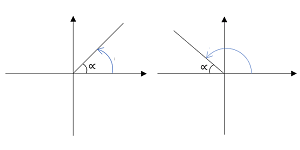
\begin{align*}
x & = 25.175^\circ, 180^\circ - 25.175^\circ \\
& = 25.175^\circ, 154.825^\circ \\
& \approx 25.2^\circ, 154.8^\circ
\end{align*}
Prove identity then use it to solve an equation
6(i) Prove the identity $ {\cos 2A - 1 \over \cos 2A + 1 } = - \tan^2 A $.
Solutions
\begin{align*}
\text{L.H.S} & = { \cos 2A - 1 \over \cos 2A + 1} \\
& = { 1 - 2 \sin^2 A - 1 \over 2 \cos^2 A - 1 + 1 }
\phantom{000000} [\text{Use appropriate version of } \cos 2A \text{ to eliminate the term '1'}] \\
& = { -2 \sin^2 A \over 2 \cos^2 A } \\
& = - { \sin^2 A \over \cos^2 A } \\
& = - \tan^2 A \\
& = \text{R.H.S}
\end{align*}
6(ii) Hence, solve the equation $ \cos 2x - 1 = \tan x \cos 2x + \tan x $ for $ 0^\circ \le x \le 360^\circ $.
Answer: $ 0^\circ, 135^\circ, 180^\circ, 315^\circ, 360^\circ $
Solutions
\begin{align*}
\cos 2x - 1 & = \tan x \cos 2x + \tan x \\
\cos 2x - 1 & = \tan x (\cos 2x + 1) \\
\underbrace{{\cos 2x - 1 \over \cos 2x + 1}}_\text{L.H.S of (i)} & = \tan x \\
-\tan^2 x & = \tan x \\
0 & = \tan^2 x + \tan x \\
0 & = \tan x(\tan x + 1) \\
\\
\tan x & = 0 \phantom{0} \text{ or } \phantom{0} \tan x + 1 = 0 \\
& \phantom{000000000000} \tan x = -1 \\
\\ \\
\tan x & = 0 \phantom{000000} [\text{1st or 3rd quadrant}] \\
\\
\text{Basic angle, } \alpha & = \tan^{-1} (0) \\
& = 0^\circ
\end{align*}

\begin{align*}
x & = 0^\circ, 180^\circ + 0^\circ \\
& = 0^\circ, 180^\circ, 0^\circ + 360^\circ \\
& = 0^\circ, 180^\circ, 360^\circ \\
\\ \\
\tan x & = -1 \phantom{000000} [\text{2nd or 4th quadrant}] \\
\\
\text{Basic angle, } \alpha & = \tan^{-1} (1) \\
& = 45^\circ
\end{align*}

\begin{align*}
x & = 180^\circ - 45^\circ, 360^\circ - 45^\circ \\
& = 135^\circ, 315^\circ \\
\\ \\
\therefore x & = 0^\circ, 135^\circ, 180^\circ, 315^\circ, 360^\circ
\end{align*}
O Level past year questions on double angle formulas
Fully worked, step-by-step solutions to these past-year questions (2016 to 2025) are in the O Level A Maths Solutions page.
| Year & paper |
Comments |
| 2025 P1 Question 9 |
Prove identity in first part, then use identity to solve equation in second part |
| 2024 P2 Question 9 |
Part a: Prove identity
Part b: Solve equation using identity from part a
Part c: Find set of values of k for which equation has no solutions (difficult) |
| 2023 P2 Question 4a |
Special angles |
| 2022 P2 Question 3 |
Prove identity in first part, then use identity to solve equation in second part |
| 2018 P1 Question 8i |
Change from sin2 x and cos2 x to cos 2x |
| 2016 P2 Question 3 |
Prove cos 3x in first part, then use identity to solve equation in second part |
| 2015 P1 Question 6i |
Change from sin2 x and cos2 x to cos 2x |
| 2014 P2 Question 9i |
Solve equation |
| 2012 P1 Question 6 |
Prove identity in first part, then use identity to solve equation in second part |
| 2008 P2 Question 3 |
Prove identity in first part, then use identity to solve equation in second part |
← Trigonometry: Addition formulas
Trigonometry: R-formulas →