Revision notes
ASTC rule and key angles in radians
ASTC rule
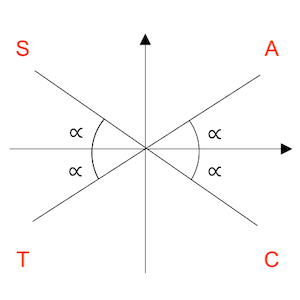
sin θ is positive in the first and second quadrants and negative in the third and fourth quadrants.
cos θ is positive in the first and fourth quadrants and negative in the second and third quadrants.
tan θ is positive in the first and third quadrants and negative in the second and fourth quadrants.
Key angles in radians
$ 180^\circ = $ $ \phantom{.} \pi $ $ \text{ radians}$,
$ 360^\circ = $ $ \phantom{.} 2 \pi $ $ \text{ radians}$
How to find solutions using the basic angle in each quadrant
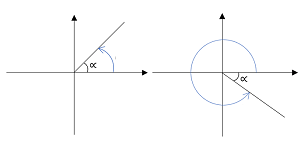
Find solutions in first quadrant

\begin{align*}
\theta & = \alpha \\
\\
\text{Other possible values of } \theta
& = ..., \underbrace{\alpha - 720^\circ}_\text{2 rounds clockwise},
\underbrace{\alpha - 360^\circ}_\text{1 round clockwise},
\underbrace{\alpha + 360^\circ}_\text{1 round anti-clockwise},
\underbrace{\alpha + 720^\circ}_\text{2 rounds anti-clockwise}, ...
\end{align*}
Find solutions in second quadrant

\begin{align*}
\theta & = 180^\circ - \alpha \\
\\
\text{Other possible values of } \theta
& = ..., \underbrace{\theta - 720^\circ}_\text{2 rounds clockwise},
\underbrace{\theta - 360^\circ}_\text{1 round clockwise},
\underbrace{\theta + 360^\circ}_\text{1 round anti-clockwise},
\underbrace{\theta + 720^\circ}_\text{2 rounds anti-clockwise}, ...
\end{align*}
Find solutions in third quadrant

\begin{align*}
\theta & = 180^\circ + \alpha \\
\\
\text{Other possible values of } \theta
& = ..., \underbrace{\theta - 720^\circ}_\text{2 rounds clockwise},
\underbrace{\theta - 360^\circ}_\text{1 round clockwise},
\underbrace{\theta + 360^\circ}_\text{1 round anti-clockwise},
\underbrace{\theta + 720^\circ}_\text{2 rounds anti-clockwise}, ...
\end{align*}
Find solutions in fourth quadrant

\begin{align*}
\theta & = 360^\circ - \alpha \\
\\
\text{Other possible values of } \theta
& = ..., \underbrace{\theta - 720^\circ}_\text{2 rounds clockwise},
\underbrace{\theta - 360^\circ}_\text{1 round clockwise},
\underbrace{\theta + 360^\circ}_\text{1 round anti-clockwise},
\underbrace{\theta + 720^\circ}_\text{2 rounds anti-clockwise}, ...
\end{align*}
Practice questions
Solve basic trigonometric equations
1. Solve the equation $ \sqrt{3} \tan x + 1$ for $ 0 < x < 2 \pi $, leaving your answer in terms of $\pi$.
Answer: $ {5 \pi \over 6}, {11 \pi \over 6} $
Solutions
\begin{align*}
\sqrt{3} \tan x + 1 & = 0 \\
\sqrt{3} \tan x & = -1 \\
\tan x & = -{1 \over \sqrt{3}} \phantom{000000} [\text{2nd or 4th quadrant since } \tan x < 0 ] \\
\\
\text{Basic angle, } \alpha & = \tan^{-1} \left(1 \over \sqrt{3}\right) \\
& = 30^\circ \\
& = {\pi \over 6} \text{ radians}
\end{align*}

\begin{align*}
x & = \pi - {\pi \over 6}, 2\pi - {\pi \over 6} \\
& = {5\pi \over 6}, {11\pi \over 6}
\end{align*}
2. Solve the equation $ 3 \sin 2 \theta - 1 = 0 $ for $ -180^\circ < \theta <180^\circ $.
Answer: $ -170.3^\circ, -99.7^\circ, 9.7^\circ, 80.3^\circ $
Solutions
\begin{align*}
3\sin 2\theta - 1 & = 0 \\
3\sin 2\theta & = 1 \\
\sin 2\theta & = {1 \over 3} \phantom{000000} [\text{1st or 2nd quadrant since } \sin 2\theta > 0] \\
\\
\text{Basic angle, } \alpha & = \sin^{-1} \left(1 \over 3\right) \\
& = 19.47^\circ \\
\end{align*}

\begin{align*}
[ \text{Since } & -180^\circ < \theta < 180^\circ, -360^\circ < 2 \theta < 360^\circ ] \\
\\
2 \theta & = 19.47^\circ, 180^\circ - 19.47^\circ \\
& = 19.47^\circ, 160.53^\circ, 19.47^\circ - 360^\circ, 160.53^\circ - 360^\circ \\
& = -340.53^\circ, -199.47^\circ, 19.47^\circ, 160.53^\circ \\
\\
\theta & = -170.265^\circ, -99.735^\circ, 9.735^\circ, 80.275^\circ \\
& \approx -170.3^\circ, -99.7^\circ, 9.7^\circ, 80.3^\circ
\end{align*}
Solve trigonometric equations by taking square roots
3. Solve the equation $ \tan^2 x - 3 = 0$ for $0^\circ < x < 360^\circ$.
Answer: $ 60^\circ, 120^\circ, 240^\circ, 300^\circ $
Solutions
\begin{align*}
\tan^2 x - 3 & = 0 \\
\tan^2 x & = 3 \\
\tan x & = \pm \sqrt{3} \phantom{000000} [\text{All four quadrants}] \\
\\
\text{Basic angle, } \alpha & = \tan^{-1} (\sqrt{3}) \\
& = 60^\circ
\end{align*}

\begin{align*}
x & = 60^\circ, 180^\circ - 60^\circ, 180^\circ + 60^\circ, 360^\circ - 60^\circ \\
& = 60^\circ, 120^\circ, 240^\circ, 300^\circ
\end{align*}
Solve trigonometric equations by forming tan
4. Solve the equation $ 4 (\sin 2x - \cos 2x) = \cos 2x $ for $ 0^\circ < x < 360^\circ $.
Answer: $ 25.7^\circ, 115.7^\circ, 205.7^\circ, 295.7^\circ $
Solutions
\begin{align*}
4 (\sin 2x - \cos 2x) & = \cos 2x \\
4 \sin 2x - 4 \cos 2x & = \cos 2x \\
4 \sin 2x & = 5 \cos 2x \\
{4 \sin 2x \over \cos 2x} & = 5 \\
4 \tan 2x & = 5 \\
\tan 2x & = {5 \over 4} \phantom{000000} [\text{1st or 3rd quadrant}] \\
\\
\text{Basic angle, } \alpha & = \tan^{-1} \left(5 \over 4\right) \\
& = 51.34^\circ
\end{align*}

\begin{align*}
[ \text{Since } & 0^\circ < x < 360^\circ, 0^\circ < 2x < 720^\circ ] \\
\\
2x & = 51.34^\circ, 180^\circ + 51.34^\circ \\
& = 51.34^\circ, 231.34^\circ, 51.34^\circ + 360^\circ, 231.34^\circ + 360^\circ \\
& = 51.34^\circ, 231.34^\circ, 411.34^\circ, 591.34^\circ \\
\\
x & = 25.67^\circ, 115.67^\circ, 205.67^\circ, 295.67^\circ \\
& \approx 25.7^\circ, 115.7^\circ, 205.7^\circ, 295.7^\circ
\end{align*}
Solve trigonometric equations by factorising
5. Solve the equation $ 3\sin x = 2 \sin x \cos x $ for $0 < x < 2 \pi $.
Answer: $ x = \pi $
Solutions
\begin{align*}
3 \sin x & = 2 \sin x \cos x \\
3 \sin x - 2 \sin x \cos x & = 0 \\
\sin x (3 - 2 \cos x) & = 0 \\
\\
\sin x = 0 \phantom{0} \text{ or } & \phantom{0} 3 - 2 \cos x = 0 \\
& \phantom{00} -2 \cos x = -3 \\
& \phantom{00000.} \cos x = {-3 \over -2} \\
& \phantom{00000.} \cos x = 1.5 \phantom{0} \text{ (No solutions since } -1 \le \cos x \le 1) \\
\\ \\
\sin x & = 0
\end{align*}

\begin{align*}
x & = 0 \text{ (N.A.)}, \pi, 2\pi \text{ (N.A.)} \\
\\
\therefore x & = \pi
\end{align*}
6. Solve the equation $ 2 \cos^2 x = 5 - 4\cos x $ for $ 0 < x < 2 \pi $.
Answer: $ 0.514, 5.77 $
Solutions
\begin{align*}
2 \cos^2 x & = 5 - 4\cos x \\
2 \cos^2 x + 4 \cos x - 5 & = 0 \phantom{0000000000000000000} [\text{Quadratic equation in } \cos x] \\
\\
\cos x & = {-b \pm \sqrt{b^2 - 4ac} \over 2a}
\phantom{000000} [\text{Use this since equation cannot be factorised}] \\
& = {-4 \pm \sqrt{(4)^2 - 4(2)(-5)} \over 2(2)} \\
& = {-4 \pm \sqrt{56} \over 4} \\
& = 0.8708 \text{ or } -2.8708 \text{ (No solutions since } -1 \le \cos x \le 1) \\
\\
\cos x & = 0.8708 \phantom{000000} [\text{1st or 4th quadrant}] \\
\\
\text{Basic angle, } \alpha & = \cos^{-1} (0.8708) \\
& = 0.5139
\end{align*}
\begin{align*}
x & = 0.5139, 2\pi - 0.5139 \\
& = 0.5139, 5.7692 \\
& \approx 0.514, 5.77
\end{align*}
O Level past year questions on solving trigonometric equations
| Year & paper |
Comments |
| 2004 P2 Question 6i |
Form tangent |
| 2002 P1 Question 1 |
Form tangent |
← Trigonometry: Find trigonometric ratio without the use of calculator
Trigonometry: Real-life problem →