Real-life problem
Sections:
1) Revision notes
2) Practice questions
Revision notes
Shape and features of sine and cosine graphs
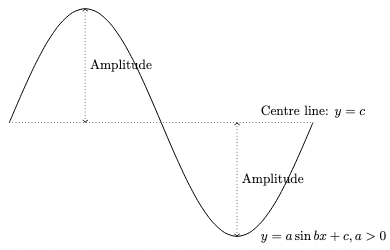
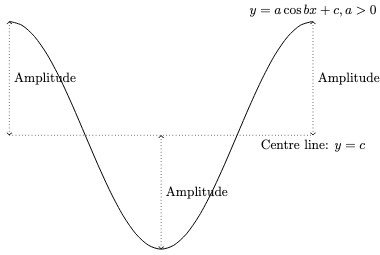
Key angles in radians
$ 180^\circ = $ $ \phantom{.} \pi $ $ \text{ radians}$, $ 360^\circ = $ $ \phantom{.} 2 \pi $ $ \text{ radians}$
Practice questions
Trigonometry in tide and water depth problems
1. The depth, $h$ m, of the water at a pier $t$ ours after midnight is given by $ h = a \cos \left(t \over k\right) + c $, where $a$, $c$ and $k$ are positive constants. The depth of the water is $21$ m at high tide and $13$ m at low tide. The time between successive high tides is $4 \pi $ hours.
(from A Maths 360 2nd edition Ex 11.6)
(i) Find the values of $a$, $c$ and $k$.
Answer: $ a = 4, c = 17, k = 2 $
(ii) Sketch the graph of $h$ for $ 0 \le t \le 8 \pi $.

(iii) Explain how your graph will change, if the start of the depth measurement is delayed by $2 \pi$ hours. Sketch the new graph for $0 \le t \le 8 \pi$.

Trigonometry in Ferris wheel problems
2. The height above ground level, $h$ m, of a capsule on the Singapore Flyer is modelled by the equation $h = 80(1 - \cos kt)$, where $k$ is a constant and $t$ is the time in minutes after starting the ride at ground level.

The total time to complete one revolution is 30 minutes.
(from 4048 Specimen P1)
(i) Explain why this model suggests that the height of the Singapore Flyer is 160 m.
[1]
(ii) Show that the value of $k$ is ${\pi \over 15}$ radians per minute.
[2]
It is possible for a person riding in a capsule to see a certain landmark, provided the capsule is at least $100$ m above ground level.
(iii) Find the length of time for which the landmark will be in view during one revolution.
[5]
Answer: $ 12.6 \text{ minutes} $


← Trigonometry: Solve trigonometric equation Trigonometry: Geometry problem →